
Accendo Reliability

Your Reliability Engineering Professional Development Site

  • Home
  • About
    • Contributors
    • About Us
    • Colophon
    • Survey
  • Reliability.fm
    • Speaking Of Reliability
    • Rooted in Reliability: The Plant Performance Podcast
    • Quality during Design
    • CMMSradio
    • Way of the Quality Warrior
    • Critical Talks
    • Asset Performance
    • Dare to Know
    • Maintenance Disrupted
    • Metal Conversations
    • The Leadership Connection
    • Practical Reliability Podcast
    • Reliability Gang
    • Reliability Hero
    • Reliability Matters
    • Reliability it Matters
    • Maintenance Mavericks Podcast
    • Women in Maintenance
    • Accendo Reliability Webinar Series
  • Articles
    • CRE Preparation Notes
    • NoMTBF
    • on Leadership & Career
      • Advanced Engineering Culture
      • ASQR&R
      • Engineering Leadership
      • Managing in the 2000s
      • Product Development and Process Improvement
    • on Maintenance Reliability
      • Aasan Asset Management
      • AI & Predictive Maintenance
      • Asset Management in the Mining Industry
      • CMMS and Maintenance Management
      • CMMS and Reliability
      • Conscious Asset
      • EAM & CMMS
      • Everyday RCM
      • History of Maintenance Management
      • Life Cycle Asset Management
      • Maintenance and Reliability
      • Maintenance Management
      • Plant Maintenance
      • Process Plant Reliability Engineering
      • RCM Blitz®
      • ReliabilityXperience
      • Rob’s Reliability Project
      • The Intelligent Transformer Blog
      • The People Side of Maintenance
      • The Reliability Crime Lab
      • The Reliability Mindset
    • on Product Reliability
      • Accelerated Reliability
      • Achieving the Benefits of Reliability
      • Apex Ridge
      • Breaking Bad for Reliability
      • Field Reliability Data Analysis
      • Metals Engineering and Product Reliability
      • Musings on Reliability and Maintenance Topics
      • Product Validation
      • Reliability by Design
      • Reliability Competence
      • Reliability Engineering Insights
      • Reliability in Emerging Technology
      • Reliability Knowledge
    • on Risk & Safety
      • CERM® Risk Insights
      • Equipment Risk and Reliability in Downhole Applications
      • Operational Risk Process Safety
    • on Systems Thinking
      • The RCA
      • Communicating with FINESSE
    • on Tools & Techniques
      • Big Data & Analytics
      • Experimental Design for NPD
      • Innovative Thinking in Reliability and Durability
      • Inside and Beyond HALT
      • Inside FMEA
      • Institute of Quality & Reliability
      • Integral Concepts
      • Learning from Failures
      • Progress in Field Reliability?
      • R for Engineering
      • Reliability Engineering Using Python
      • Reliability Reflections
      • Statistical Methods for Failure-Time Data
      • Testing 1 2 3
      • The Hardware Product Develoment Lifecycle
      • The Manufacturing Academy
  • eBooks
  • Resources
    • Special Offers
    • Accendo Authors
    • FMEA Resources
    • Glossary
    • Feed Forward Publications
    • Openings
    • Books
    • Webinar Sources
    • Journals
    • Higher Education
    • Podcasts
  • Courses
    • Your Courses
    • 14 Ways to Acquire Reliability Engineering Knowledge
    • Live Courses
      • Introduction to Reliability Engineering & Accelerated Testings Course Landing Page
      • Advanced Accelerated Testing Course Landing Page
    • Integral Concepts Courses
      • Reliability Analysis Methods Course Landing Page
      • Applied Reliability Analysis Course Landing Page
      • Statistics, Hypothesis Testing, & Regression Modeling Course Landing Page
      • Measurement System Assessment Course Landing Page
      • SPC & Process Capability Course Landing Page
      • Design of Experiments Course Landing Page
    • The Manufacturing Academy Courses
      • An Introduction to Reliability Engineering
      • Reliability Engineering Statistics
      • An Introduction to Quality Engineering
      • Quality Engineering Statistics
      • FMEA in Practice
      • Process Capability Analysis course
      • Root Cause Analysis and the 8D Corrective Action Process course
      • Return on Investment online course
    • Industrial Metallurgist Courses
    • FMEA courses Powered by The Luminous Group
      • FMEA Introduction
      • AIAG & VDA FMEA Methodology
    • Barringer Process Reliability Introduction
      • Barringer Process Reliability Introduction Course Landing Page
    • Fault Tree Analysis (FTA)
    • Foundations of RCM online course
    • Reliability Engineering for Heavy Industry
    • How to be an Online Student
    • Quondam Courses
  • Webinars
    • Upcoming Live Events
    • Accendo Reliability Webinar Series
  • Calendar
    • Call for Papers Listing
    • Upcoming Webinars
    • Webinar Calendar
  • Login
    • Member Home
Home » AI » Hardware Product Realization in the Age of AI

by Michael Keer Leave a Comment

Hardware Product Realization in the Age of AI

Hardware Product Realization in the Age of AI

Chapter 6: Applying Agile Hardware Techniques, Changing the Normalized “Old Ways” Part 2

In the previous chapter the first part of a practical look at how to apply agile methodologies to your hardware development process was explored.

This chapter completes a look at how to apply agile methodologies to your hardware development process.

As illustrated in the diagram at the beginning of this blog, companies that follow an agile hardware product realization process plan to invest more resources early in the process and, as a result, are able to realize extra profits over the product’s lifecycle. Compare the two lines showing the investment and profit profile of a standard (old ways) development process (from the diagram shown in the previous blog post) with that of those organizations who invest strategically early in the process.
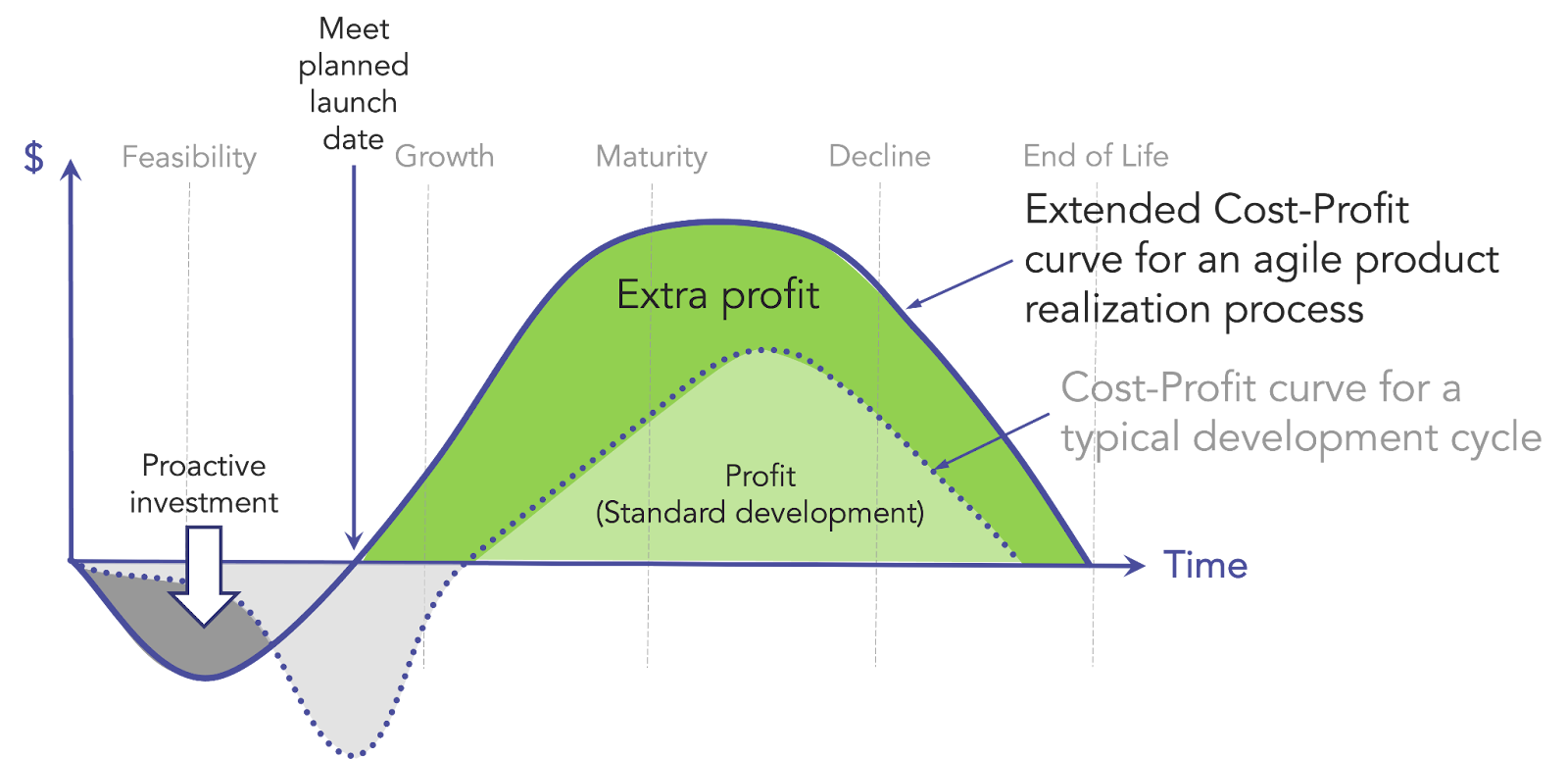
By aligning resources early and fostering cross-functional collaboration, these organizations gain clearer visibility into requirements, risks and tradeoffs. with the result is a more agile and effective process that delivers measurable business advantages including:

  • On time market delivery
  • Lower total costs and higher profits
  • Products that meet intended requirements.

Some thoughts on current AI-based hardware (electronic) design capabilities

While AI is increasingly useful in many areas of the NPDI process, caution is advised when applying AI tools to electronic circuit design. Unlike software development, where reusable code libraries enable AI to generate effective results, hardware design involves greater complexity and dependency on physical constraints.

Key challenges include:

1. Limited training data – Circuit designs vary widely, and the data available to train AI tools is limited compared to the vast libraries of software code available online.

2. Component complexity – Each part requires detailed evaluation before inclusion in a design.

In software design environments, modular “building blocks” (e.g., reusable functions for Bluetooth connectivity) lend themselves to AI-driven assembly and reuse. With hardware, however, each design must integrate unique, highly specific physical, electrical, and environmental constraints. As a result, full electronic circuit design still requires deep engineering expertise and careful human oversight.

Join us next time to learn how to prepare your organization to have the strong foundational principals needed to fully utilize agile hardware product development. 

Sources:

Extracts from the completely revised book Agile Hardware Product Realization (version 4.0)  by Michael Keer and David Eden.


Filed Under: AI, Articles, on Product Reliability, on Tools & Techniques, The Hardware Product Develoment Lifecycle

About Michael Keer

Founder & Managing Partner, Product Realization Group
Michael Keer has over 30 years of high technology New Product Introduction experience in development and manufacturing. As founder of the Product Realization Group (PRG), Michael created a solutions based team of consultants that help companies make the leap from concept to full market scale.

« Are You Writing Failure Modes All Wrong? Learn the Truth
Developing a Planned Maintenance Strategy based on Criticality »

Leave a Reply Cancel reply

Your email address will not be published. Required fields are marked *

The Hardware Product Development Lifecyle series logo Photo of Michael KeerArticles Edited by Michael Keer
in the The Hardware Product Development Lifecycle article series

Recent Posts

  • How to Create a Positive Risk Culture
  • Developing a Planned Maintenance Strategy based on Criticality
  • Hardware Product Realization in the Age of AI
  • Are You Writing Failure Modes All Wrong? Learn the Truth
  • Decoding Early Thermal Stress in Rotating Equipment

Join Accendo

Receive information and updates about articles and many other resources offered by Accendo Reliability by becoming a member.

It’s free and only takes a minute.

Join Today

© 2026 FMS Reliability · Privacy Policy · Terms of Service · Cookies Policy

Book the Course with John
  Ask a question or send along a comment. Please login to view and use the contact form.
This site uses cookies to give you a better experience, analyze site traffic, and gain insight to products or offers that may interest you. By continuing, you consent to the use of cookies. Learn how we use cookies, how they work, and how to set your browser preferences by reading our Cookies Policy.
