
Communicating “asset life” is far harder than it looks. The term sounds universal, yet accountants, engineers, and operations leaders often mean entirely different things when they use it. When organizations fail to reconcile them, capital plans become unrealistic, maintenance strategies drift, and leadership loses confidence in the numbers. When we communicate asset life clearly and contextually correctly, we create shared understanding and decisions that hold up in the real world.
Summary of Asset Life in Plain Terms
The goal is to see why each life exists and integrate them into decisions.
- Mean life is statistical and shows inherent reliability.
- Useful life is accounting-related and guides financial recovery.
- Service life reflects operational reality.
An Example from a Wastewater Utility
A 20-year horizon is a strategic document used for capital planning. Basing it solely on mean life (the technical reliability limit) or useful life (an accounting term) often results in a “front-loaded” or unrealistic budget, as it assumes every asset is replaced the moment its theoretical life ends. Using service life may raise questions about whether the asset will experience unplanned breakdowns and related poor-quality or non-compliance issues.
Operational Reality: Assets often stay in service beyond their design life through strategic maintenance.
Budget Smoothing: Using service life allows you to “level out” variations in renewal needs, creating a more sustainable 20-year expenditure profile.
Cyclical Renewals: For long-term forecasts, you must account for assets with short lives (e.g., HVAC controls or carpets) that will be replaced multiple times within the 20-year window. A modified useful life based on mean life and context-specific O&M experience best captures these operational cycles. This term is best framed as “remaining useful life.”
The Parking Lot Example
Here is how those three timelines play out for a standard asphalt parking lot.
1. Useful Life (Accounting) ~ 15 Years
Standard accounting practices generally classify parking lots as “Land Improvements” with a 15-year recovery period. At Year 15, the parking lot is “dead” on your balance sheet (fully depreciated), but it is almost certainly still in use.
The goal is financial cost recovery, not physical reality.
2. Mean Life (Reliability) ~ 15–20 Years
From an engineering standpoint, the Mean Time Between Failures (MTBF) for asphalt without significant intervention is often around 15 to 20 years. This is the point where, statistically, the base layer and surface have degraded enough that half of the parking lots like this have experienced “failure” (potholes, structural cracking).
The goal is to identify a “design life” at which the parking lot naturally reaches the end of its first functional cycle, with satisfactory performance in terms of quality, safety, and regulatory compliance.
3. Service Life (Operations) ~ 25–35 Years
This is the longest period because it accounts for strategic maintenance. By performing regular maintenance like sealcoating (every 3-5 years) and a mid-life resurfacing or overlay (around Year 15-20), the actual replacement date can be pushed much further out.
The reality is that most organizations do not rip out a parking lot just because it’s 20 years old. They keep it in service until it is no longer safe or until the maintenance costs exceed a specified percentage of the cost of replacement.
The goal is to maximize the return on the initial investment, even if the cumulative cost exceeds the value of that investment.
What We Really Want is Remaining Useful Life (RUL)
In practice, we want to estimate “remaining useful life” to forecast future renewal and replacement (R&R) needs.
This is where the terminology gets messy. In practice, “useful life” (accounting) and “remaining useful life” (engineering/asset management) do not share the same conceptual foundation, even though the words look similar. And that’s why many people get tripped up.
RUL is a condition‑based estimate of how long the asset can continue to perform its intended function. It’s based on degradation, inspections, performance, and failure modes. RUL is used for maintenance, risk management, and operational planning, but has nothing to do with accounting or depreciation schedules.
Remaining Service Life Adds to the Confusion
Service Life and Remaining Service Life (RSL) are directly related—RSL is simply the unexpired portion of an asset’s total service life. They use the same operational perspective, just from different points in time. In contrast, Remaining Useful Life (RUL) is an engineering estimate based on asset condition and is conceptually distinct from RSL, as it is not tied to the originally expected service duration but to the current capability left.
- Service Life is the total period that an asset is expected to remain in service.
- Remaining Service Life (RSL) is the portion of that service life that has not yet elapsed.
The two terms differ only in where you are on the timeline, not in the conceptual basis.
However, useful life and remaining useful life (as previously discussed) are different conceptually.
A Formal Approach Is Needed for Communicating Asset Life
Useful life is a financial estimate; remaining useful life is a physical estimate; service life is an operational estimate. They answer different questions and should never be treated as interchangeable.
Situations with high complexity and uncertainty require formal communication approaches, and this one certainly does. It’s also uncertain because most organizations don’t have “asset life” clearly defined and estimated.
Ultimately, estimating remaining useful life or a modified asset life within ranges and developing forecasts using Monte Carlo simulations is the most efficient and effective analytical approach.
The elements of the FINESSE Fishbone Diagram® are Frame, Illustrate, Noise reduction, Empathy, Structure, Synergy, and Ethics.
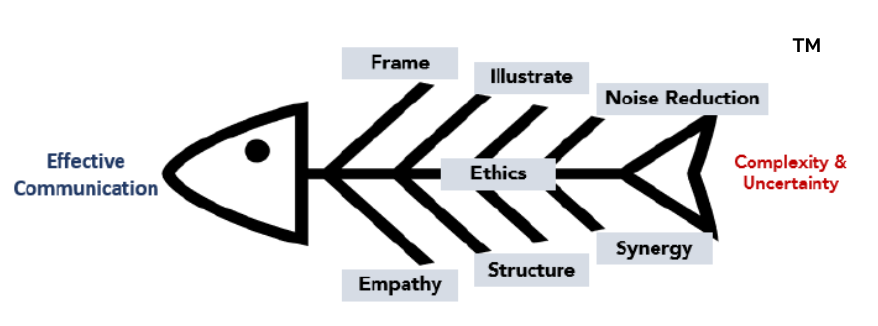
Communicating with the FINESSE Approach
The FINESSE Fishbone Diagram® is a structured approach designed to enhance effective communication, particularly in complex and uncertain situations, by focusing on seven cause-and-effect elements: Frame, Illustrate, Noise Reduction, Empathy, Structure, Synergy, and Ethics.
Frame
Define the problem in decision-maker language, not reliability jargon.
Frame the issue as: “We need a simple, repeatable way to connect statistical reliability (mean life) to how long assets remain useful, so our capital and maintenance plans are credible.” Providing the definitions is a fundamental aspect of framing.
Illustrate
Use visuals, examples, and simple ratios to make the abstract concrete.
A table is one of six essential visuals in the FINESSE approach. Tables are ideal for showing industry standards for ranges of useful life, remaining useful life and service life.
Noise Reduction
Strip away details that do not change the decision.
Avoid dragging executives into debates about distribution fitting, confidence bounds, or β used in Weibull calculations to the third decimal place. Keep the message focused on, “For planning purposes, mean life is roughly two-thirds of service life for most of our mechanical assets.”
Empathy
Acknowledge the pressures and constraints decision makers face.
Recognize that managers don’t have time for statistical arguments on one hand or operational short-cuts on the other. They want: “Can I trust this number?” and “What will happen if we’re wrong?” In most cases, they will “safe” asset life estimates (at least until they see the rolled-up budget requirements).
Structure
Organize the message so a busy leader can follow it in one pass.
Use a simple three-step process:
- Show a range of potential asset lives.
- Pick a number in between (either the average or the median)
- Be prepared to explain your judgment, if asked.
Most decision makers want a reasonable estimate, usually a synthesis of industry norms and organizational experience.
Synergy
Align technical positions (engineering, accounting, and O&M) with organizational priorities.
Most senior managers and board members will have strong alignment with one discipline. Others will not care about the useful life. Communicate how your conclusions tie to the organization’s mission, vision, and values. This provides decision makers the room to compromise.
Ethics
Be transparent about limits and assumptions.
Acknowledge uncertainty, reiterate boundary conditions, and politically share data limitations. That honesty builds trust far more than a false sense of precision.
Need Help Refining Asset Life Communication?
Need help getting started? JD Solomon Inc. provides practical solutions to align asset useful life and strengthen your asset management program.
JD Solomon writes and consults on decision-making, reliability, risk, and communication for leaders and technical professionals. His work connects technical disciplines with human understanding to help people make better decisions and build stronger systems. Learn more at www.jdsolomonsolutions.com and www.communicatingwithfinesse.com.


Leave a Reply