Rare-event risks make or break any capital project because we manage them poorly. By contrast, traditional project risks are handled well in the engineering and construction industry. Reliability engineers employ systems thinking to address tasks ranging from root cause analysis to forecasting future trends. A few key issues are important for understanding when and how to handle rare events.
Five Years as a Breakpoint for Minor and Major Projects
Project risks are inherent to every major facility and infrastructure project. Five years from engineering through construction is a good breakpoint for the difference between minor and major projects. Project risk modeling is typically performed using probability distributions derived from historical data on cost and schedule.
Seven Types of Rare Events
Rare event categories include Economic, Informational, Physical (key equipment), Human Resource, Reputational, Psychopathic Acts, and Natural Disasters. Another description can be extreme events. The thought process for including them is “externally driven.” Modeling of rare events is performed with a Bernoulli distribution (occurring over the project life cycle or not, on a one-time basis) or a Poisson distribution (occurring over the project life cycle or not, potentially more than once).
Example: Flooding
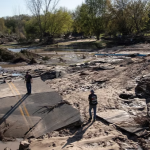
One example to consider when deciding whether an event is a rare event risk, or a traditional project risk is flooding. If your project is near or partially in a 100-year floodplain, the chance of being flooded in any one year is 0.01.
However, the chance of being flooded over the life of a 30-year mortgage is 26% [Probability = 1-(1-p)^N]. For most projects of less than 10 years, they can be classified as a rare event (and probably not the most impactful in the Natural Disaster category).
If you are an owner or investor with a 30- to 50-year perspective, the risk is something you should consider as a project risk.
Example: Hurricanes
If the project duration matters, so does the project location. Mobile, Alabama, or New Orleans, Louisiana, experiences a minor hurricane (category 1 or 2) almost every year. Consider it a project risk on major projects. Major hurricanes (category 3, 4, or 5) make landfall much less frequently.
Consider a major hurricane as a rare event (and probably the most significant one in the Natural Disaster category) if you are in Mobile or New Orleans and doing a 5- to 7-year duration project.
Example: Human Resources
Under the human resources category, a turnover of elected officials usually provides the greatest impact on major public projects. Turnover results in delays while new members question previous decisions, re-scoping of the project, or killing the project. It is common to lose one or two elected officials, so in practice, this occurrence should be considered as a project risk.
Having the turnover of a majority of elected commissioners is usually a rare event on most projects less than 10 years in duration.
Example: Long-Lead Equipment
Delays of long-lead equipment, as we have seen during the global pandemic, may come to mind as a rare event in the Physical (key equipment) category. But be careful – supply chain issues and resulting delays should be expected on any major project. The magnitude of the delay is probably the best indicator to distinguish between project risk and a rare event in this case.
Analyze Rare Events Separately
Good practice is usually to list and analyze rare events separately from project risks. One reason for doing this is that mitigation planning can be done differently, and not solely as a financial contingency.
For example, the potential rare event of Board Turnover was identified early on a Clean Energy project I did a decade ago for a pro-green City Council. By recognizing the rare event early, we were able to mitigate the potential risk by incorporating pro-business approaches into the project. The rare event did occur, but we were able to navigate seamlessly through the transition without additional cost or delay.
Rare Events Make or Break Major Projects
Remember that context matters most. And what was rare yesterday may not be rare tomorrow. In the end, you will have to decide on a case-specific basis things like the quality of the flood-mapping prediction and mapping, whether a direct hit by the major hurricane is most important or one just hitting the region, and whether losing one decision-maker is just as impactful as losing a majority.
The important thing is to formally incorporate rare events into your project planning because we handle the normal stuff well. Rare events make or break major projects.
See also: Solomon, J. D. (2024, August 2). Tips for including rare event risks into new project development. J.D. Solomon Solutions. https://www.jdsolomonsolutions.com/post/tips-for-including-rare-event-risks-into-new-project-development
JD Solomon Inc. provides solutions for program development, asset management, and facilitation at the nexus of facilities, infrastructure, and the environment. Visit our Asset Management page for more information related to reliability, risk management, resilience, and other asset management services.


Leave a Reply