Accendo Reliability

Your Reliability Engineering Professional Development Site

  • Home
  • About
    • Contributors
    • About Us
    • Colophon
    • Survey
  • Reliability.fm
    • Speaking Of Reliability
    • Rooted in Reliability: The Plant Performance Podcast
    • Quality during Design
    • CMMSradio
    • Way of the Quality Warrior
    • Critical Talks
    • Asset Performance
    • Dare to Know
    • Maintenance Disrupted
    • Metal Conversations
    • The Leadership Connection
    • Practical Reliability Podcast
    • Reliability Gang
    • Reliability Hero
    • Reliability Matters
    • Reliability it Matters
    • Maintenance Mavericks Podcast
    • Women in Maintenance
    • Accendo Reliability Webinar Series
  • Articles
    • CRE Preparation Notes
    • NoMTBF
    • on Leadership & Career
      • Advanced Engineering Culture
      • ASQR&R
      • Engineering Leadership
      • Managing in the 2000s
      • Product Development and Process Improvement
    • on Maintenance Reliability
      • Aasan Asset Management
      • AI & Predictive Maintenance
      • Asset Management in the Mining Industry
      • CMMS and Maintenance Management
      • CMMS and Reliability
      • Conscious Asset
      • EAM & CMMS
      • Everyday RCM
      • History of Maintenance Management
      • Life Cycle Asset Management
      • Maintenance and Reliability
      • Maintenance Management
      • Plant Maintenance
      • Process Plant Reliability Engineering
      • RCM Blitz®
      • ReliabilityXperience
      • Rob’s Reliability Project
      • The Intelligent Transformer Blog
      • The People Side of Maintenance
      • The Reliability Crime Lab
      • The Reliability Mindset
    • on Product Reliability
      • Accelerated Reliability
      • Achieving the Benefits of Reliability
      • Apex Ridge
      • Breaking Bad for Reliability
      • Field Reliability Data Analysis
      • Metals Engineering and Product Reliability
      • Musings on Reliability and Maintenance Topics
      • Product Validation
      • Reliability by Design
      • Reliability Competence
      • Reliability Engineering Insights
      • Reliability in Emerging Technology
      • Reliability Knowledge
    • on Risk & Safety
      • CERM® Risk Insights
      • Equipment Risk and Reliability in Downhole Applications
      • Operational Risk Process Safety
    • on Systems Thinking
      • The RCA
      • Communicating with FINESSE
    • on Tools & Techniques
      • Big Data & Analytics
      • Experimental Design for NPD
      • Innovative Thinking in Reliability and Durability
      • Inside and Beyond HALT
      • Inside FMEA
      • Institute of Quality & Reliability
      • Integral Concepts
      • Learning from Failures
      • Progress in Field Reliability?
      • R for Engineering
      • Reliability Engineering Using Python
      • Reliability Reflections
      • Statistical Methods for Failure-Time Data
      • Testing 1 2 3
      • The Hardware Product Develoment Lifecycle
      • The Manufacturing Academy
  • eBooks
  • Resources
    • Special Offers
    • Accendo Authors
    • FMEA Resources
    • Glossary
    • Feed Forward Publications
    • Openings
    • Books
    • Webinar Sources
    • Journals
    • Higher Education
    • Podcasts
  • Courses
    • Your Courses
    • 14 Ways to Acquire Reliability Engineering Knowledge
    • Live Courses
      • Introduction to Reliability Engineering & Accelerated Testings Course Landing Page
      • Advanced Accelerated Testing Course Landing Page
    • Integral Concepts Courses
      • Reliability Analysis Methods Course Landing Page
      • Applied Reliability Analysis Course Landing Page
      • Statistics, Hypothesis Testing, & Regression Modeling Course Landing Page
      • Measurement System Assessment Course Landing Page
      • SPC & Process Capability Course Landing Page
      • Design of Experiments Course Landing Page
    • The Manufacturing Academy Courses
      • An Introduction to Reliability Engineering
      • Reliability Engineering Statistics
      • An Introduction to Quality Engineering
      • Quality Engineering Statistics
      • FMEA in Practice
      • Process Capability Analysis course
      • Root Cause Analysis and the 8D Corrective Action Process course
      • Return on Investment online course
    • Industrial Metallurgist Courses
    • FMEA courses Powered by The Luminous Group
      • FMEA Introduction
      • AIAG & VDA FMEA Methodology
    • Barringer Process Reliability Introduction
      • Barringer Process Reliability Introduction Course Landing Page
    • Fault Tree Analysis (FTA)
    • Foundations of RCM online course
    • Reliability Engineering for Heavy Industry
    • How to be an Online Student
    • Quondam Courses
  • Webinars
    • Upcoming Live Events
    • Accendo Reliability Webinar Series
  • Calendar
    • Call for Papers Listing
    • Upcoming Webinars
    • Webinar Calendar
  • Login
    • Member Home
Home » Articles » on Maintenance Reliability » Maintenance Management » An Accuracy Controlled SOP Protects Against Human Error

by Mike Sondalini Leave a Comment

An Accuracy Controlled SOP Protects Against Human Error

An Accuracy Controlled SOP Protects Against Human Error

An Accuracy Controlled Enterprise Ace 3T Standard Operating Procedure Protects Against Human Error and Mistakes

With thousands of opportunities to make human errors and mistakes in a job an ACE 3T standard operating procedure is a powerful way to get work done right-first-time. When the situational risk from errors is too high a Plant Wellness Way EAM System-of-Reliability uses ACE 3T SOPs to ensure work tasks and activities are correct and error-free.

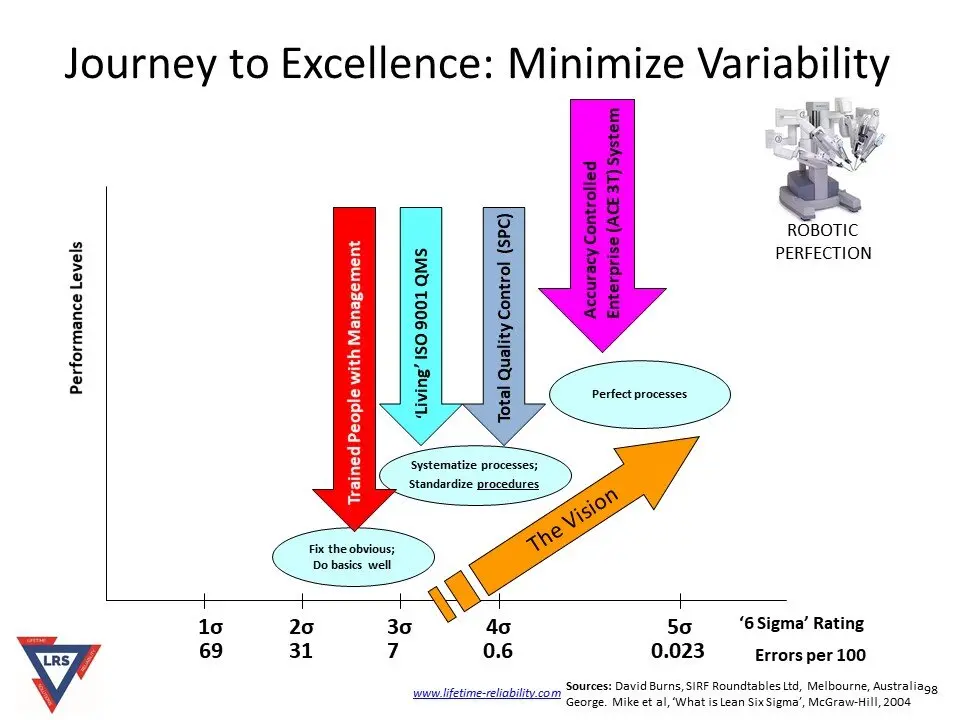
We’re all human, and humans make mistakes—lots of them every day. The image below warns that 10 to 30 errors per 100 opportunities is typical for trained people not using a standard operating procedure. Mistakes happen to all of us. The more complicated the job and the more stressful the situation the higher is the human error rate. A PWW EAM System-of-Reliability protects against human error by giving people an ACE 3T standard operating procedure to follow and be 100% successful.

If you think you do top class work, you’re being very generous to yourself. It’s impossible to be human and to always be that good, unless you follow a prescribed process for sure success. Only robots can reach and sustain perfection in their work because they always follow a program guaranteed to do work perfectly (which explains why robots will be used to replace humans every where possible). You too will make few mistakes if you follow a scripted program intentionally constructed to get 100% successful results.

<img decoding=”async” class=”wp-image-5191 aligncenter” src=”https://plant-wellness-way.com/wp-content/uploads/2021/07/system-of-success-gets-excellence.jpg” alt=”” width=”685″ height=”514″ srcset=”https://plant-wellness-way.com/wp-content/uploads/2021/07/system-of-success-gets-excellence.jpg 685w, https://plant-wellness-way.com/wp-content/uploads/2021/07/system-of-success-gets-excellence-480×360.jpg 480w” sizes=”(min-width: 0px) and (max-width: 480px) 480px, (min-width: 481px) 685px, 100vw”/>
Everything that you do, every decision you make, and every action you take can go badly wrong in ways you can imagine, and in ways you would never imagine. When the consequences of failure are unacceptable, then maximize the chance of success by removing randomness and unintended variability in a task that might lead to disaster. Write and explain in an ACE 3T standard operating procedure exactly what to do to proactively eliminate those unwanted and the unknown risks.

You protect yourself against failure and guarantee the utmost chance of job success by exactly following a clearly defined and highly detailed ACE 3T standard operating procedure. With an ACE 3T SOP you build a ‘system-of-work-success.’ It defines how to do a task successfully in a prescribed way, and done only that way, because following the procedure guarantees the utmost successful outcomes. Experimentation and trialing of new ideas are welcome in an ACE 3T standard operating procedure, but they are done in controlled experiments and tests. Only when a new approach is proven to bring greater success does it supersede the existing practice.

Build A System-Of-Work-Success Within An Accuracy Controlled Enterprise Ace 3T Standard Operating Procedure

A system-of-work-success is a sure way to guarantee maximum success in jobs with bad consequential risk. A system-of-work-success is built to system reliability engineering principles because the methodology maximizes the chance of job task success.  An ACE 3T standard operating procedure gives you a system-of-work-success with the right way to do each task and get the best possible results. Writing ACE 3T SOPs start by developing a detailed flow chart of all the tasks and their activities to complete a job. Next, you explain each task and activity in a clearly described and detailed SOP. You set measurable, defined work quality performance standards needed to do each task right. In  and to tell you when a task is done badly.

In sites using a Plant Wellness Way EAM System-of-Reliability the ACE 3T standard operating procedure methodology is used to design and build job procedure for 100% success. Follow this link to read about Human Error Prevention with Accuracy Controlled Enterprise 3T SOPs.

Because you’re heavily biased in favor of yourself you can’t write sound ACE 3T procedures for yourself. You’ll miss recording all the details since you already know them and think some are so obvious that they don’t need to be explained. It’s the reason that aircraft procedures are written by the designer and not the pilot or the maintenance technician. The first question an aircraft mechanic asks on any job is, “Where’s the approved procedure?” They have been inculcated to only trust and follow the one specified way to do successful work.

It’s easy to understand why following an ACE 3T standard operating procedure system-of-work-success is best. It contains the best way known to always be 100% successful. ACE 3T SOPs are written by subject matter experts. They’re developed in controlled conditions by people with clear heads and the time to think without the worry and stress of other work. They contain all the right information about each task’s required outcomes and how to do them perfectly. The contents of draft 3T SOPs are reviewed by other experts and improved. They are trialed in laboratory tests and refined. They become quality controlled documents always kept up to date with the most current knowledge and methods to be used. It’s hard to fail if you follow the approved system-of-work-success in an ACE 3T standard operating procedure.

Technology now lets you be 100% successful forevermore. Heads-up display glasses and mobile computer devices can proactively guide you through a procedure. They let you know what’s coming up. They let you check yourself against the prescribed method. They connect you with subject matter experts who you can ask for information. They track the history of a job task-by-task so you can spot causes of problems. They let you do experiments and trials and then compare the new outcomes against the old practices to see which one gets the best results.

We all make mistakes. In fact we need to make mistakes to learn—that’s how the design of the human brain works. But you can’t have mistakes when it brings on disaster. So protect yourself with an ACE 3T standard operating procedure.


Filed Under: Articles, Maintenance Management, on Maintenance Reliability

About Mike Sondalini

In engineering and maintenance since 1974, Mike’s career extends across original equipment manufacturing, beverage processing and packaging, steel fabrication, chemical processing and manufacturing, quality management, project management, enterprise asset management, plant and equipment maintenance, and maintenance training. His specialty is helping companies build highly effective operational risk management processes, develop enterprise asset management systems for ultra-high reliable assets, and instil the precision maintenance skills needed for world class equipment reliability.

« Agile 2 and Agility (Part 1)

Leave a Reply Cancel reply

Your email address will not be published. Required fields are marked *

Headshot of Mike SondaliniArticles by Mike Sondalini
in the Maintenance Management article series

Join Accendo

Receive information and updates about articles and many other resources offered by Accendo Reliability by becoming a member.

It’s free and only takes a minute.

Join Today

Recent Posts

  • An Accuracy Controlled SOP Protects Against Human Error
  • Agile 2 and Agility (Part 1)
  • Hardware Product Realization in the Age of AI
  • What is the REAL reason we do Reliability Centered Maintenance (RCM)?
  • Evaluating Risk: When to Apply a Risk Matrix or Monte Carlo Analysis

© 2026 FMS Reliability · Privacy Policy · Terms of Service · Cookies Policy

Book the Course with John
  Ask a question or send along a comment. Please login to view and use the contact form.
This site uses cookies to give you a better experience, analyze site traffic, and gain insight to products or offers that may interest you. By continuing, you consent to the use of cookies. Learn how we use cookies, how they work, and how to set your browser preferences by reading our Cookies Policy.