
Chapter 2: Defining Product Realization and New Product Introduction
In the previous episode, the concepts of agile hardware product realization were introduced along with the idea of the ten best practices. Before diving into the details of these, there are a few basics to understand. In this episode Product Realization will be defined at a high level as well as the ideas behind a New Product Development Introduction (sometimes written as NPDI) framework.
Product realization is a term used by the International Organization for Standardization (ISO) 9001:2015 and refers to the basic design and realization of a product provided to customers that are measurable by quality control. This standard provides a certifiable framework for consistently bringing products to market.
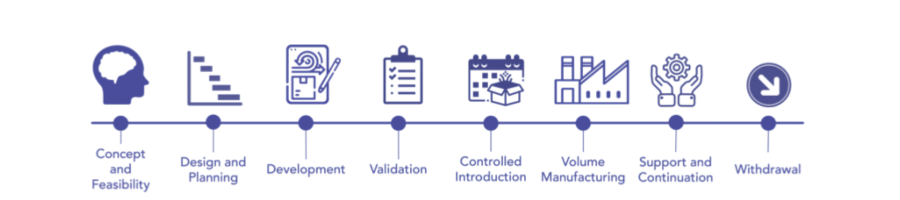
Transforming a product from concept to volume manufacturing requires a journey through a series of stages or phases of activity increasing the details of knowledge about it and reducing any associated uncertainties and risks.
The diagram at the start of this chapter shows the typical set of stages from the initial Concept and Feasibility of the product through to its eventual withdrawal from the market. All of these stages begin and end with a review of the current state of knowledge or uncertainty and risk for the product – these reviews are called stage gates and are held not to prevent a product development proceeding, but to allow everyone involved to become aware of the progress and challenges involved so that there are few surprises and the product will reach the market on time.
The title of this blog series includes the word agile which to many people would be the exact opposite of a stage-gate (or waterfall process) leading to a longer time to market however, in the hardware product world, the risks for failure are much higher due to the cost of changes growing significantly greater the further through the development the product progresses. Thus, a combination of agile techniques and NPDI stages can be used to speed up development where possible – this combination is discussed in later chapters of this blog.
Many hardware product development efforts fail because teams underestimate the cross-functional team coordination and rigor required to get a complete product to market. The NPDI framework allows for regular and managed collaboration ensuring all those involved in the product development stay aligned and that budgetary and time to market risks are known.
Join us next time for an overview of how your markets can impact your product development both positively and negatively.
Sources: Extracts from the completely revised book Agile Hardware Product Realization (version 4.0) by Michael Keer and David Eden, available from November 2025.


Leave a Reply