
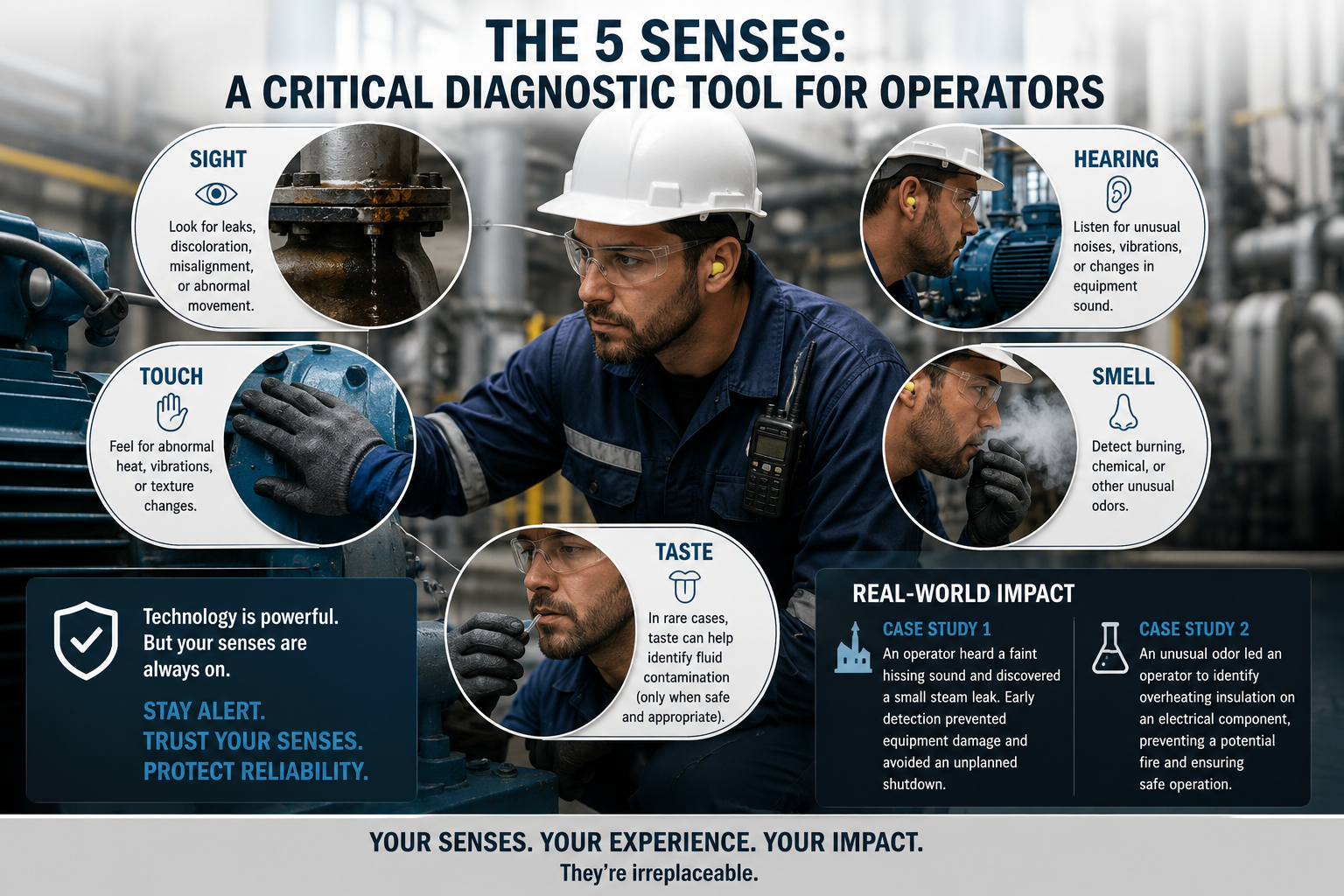
Harnessing the power of the 5 senses aids equipment health through early detection of issues before they lead to long-term consequences. Operators play a crucial role in maintaining the reliability of complex machinery and systems. While technology offers many diagnostic tools, the 5 human senses remain an invaluable asset in identifying early signs of equipment issues. Using sight, hearing, touch, smell, and even taste (in rare cases) can provide immediate, actionable insights that machines might miss or take longer to detect. This article explores how the five senses enhance operator diagnostic reliability and presents two real-world case studies that demonstrate their impact.
The Role of the Five Senses in Operator Diagnostic Reliability
Operators often rely on their senses to detect subtle changes in equipment performance. Each sense contributes uniquely:
- Sight helps identify visual signs such as leaks, corrosion, wear, or unusual vibrations.
- Hearing detects abnormal sounds like grinding, knocking, or hissing that indicate mechanical problems.
- Touch allows operators to feel temperature changes, vibrations, or looseness in components.
- Smell can reveal burning, chemical leaks, or other unusual odors.
- Taste is rarely used but can be relevant in specific industries, such as food processing, to detect off-flavors indicating contamination or spoilage.
Case Study 1: Operator Diagnostic Reliability leads to Early Detection of Bearing Failure in a Manufacturing Plant
In a large manufacturing plant, operators noticed a faint but unusual high-pitched sound coming from a critical conveyor motor. The sound was subtle and did not trigger any alarms from the monitoring system. Using their hearing, operators pinpointed the source and then used touch to feel the motor casing, which was warmer than usual.
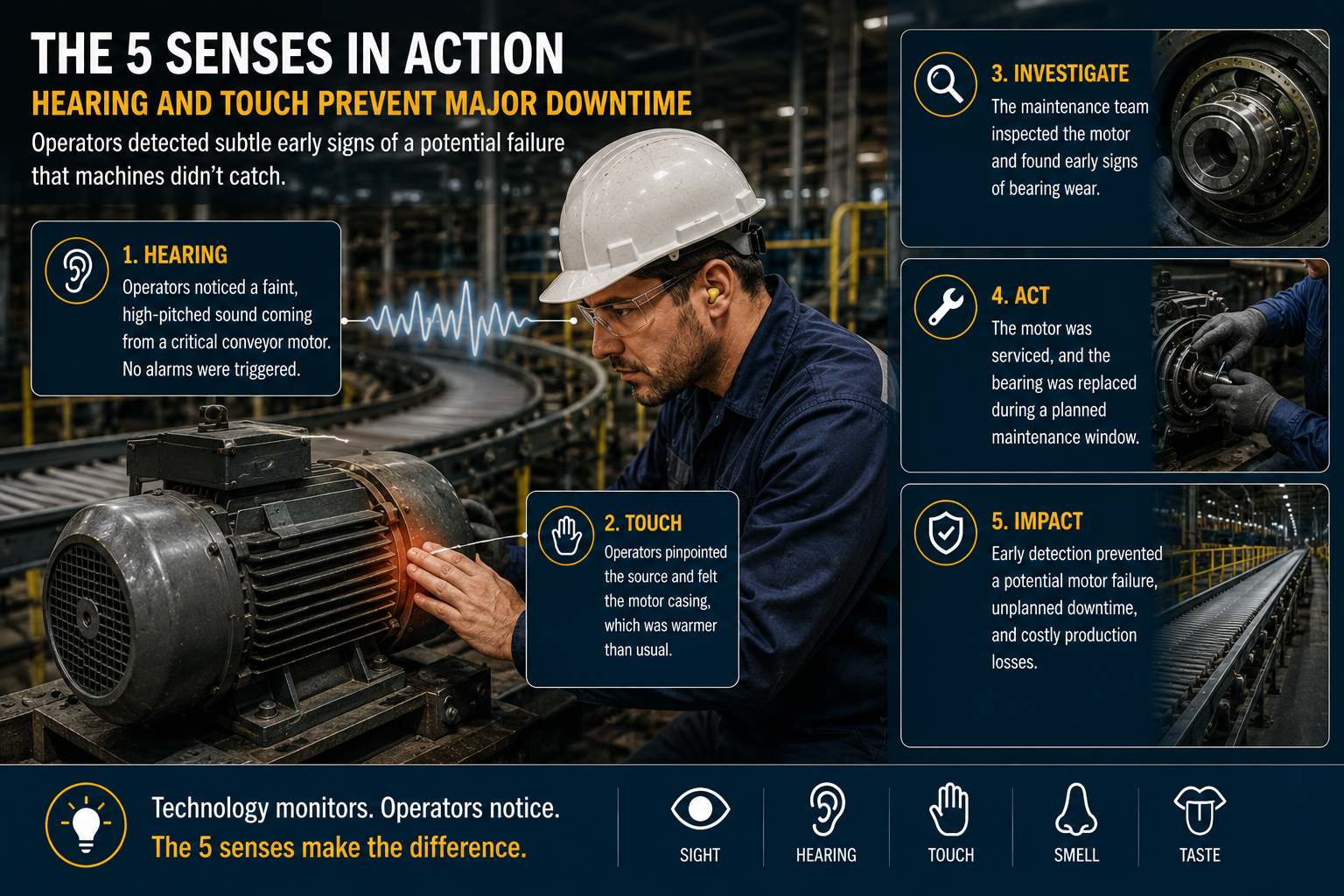
Visual inspection revealed slight discoloration around the bearing housing. The operator’s combined sensory observations led to an early diagnosis of bearing wear. Maintenance was scheduled immediately, preventing a catastrophic failure that could have halted production for days.
This case highlights how hearing and touch can detect issues before sensors or automated systems do, saving time and costs.
The Importance of Harnessing the Power of the 5 Senses in Operator Diagnostic Reliability
To maximize the benefits of sensory diagnostics, operators need training to:
- Recognize normal versus abnormal sensory cues, also known as fingerprints.
- Use their senses systematically during routine inspections.
- Document and communicate sensory findings effectively.
- Combine sensory data with technical diagnostics for better decision-making.
Regular sensory training sessions and sharing case studies help build operator confidence and sharpen their diagnostic skills.
Case Study 2: Smell and Sight Prevent Chemical Leak in a Refinery
At a refinery, an operator detected a faint chemical odor near a pipeline during a routine walk-around inspection. The smell was unusual but not strong enough to trigger alarms. The operator followed the scent and visually inspected the pipeline, spotting a small, almost invisible crack with a slight oily residue.
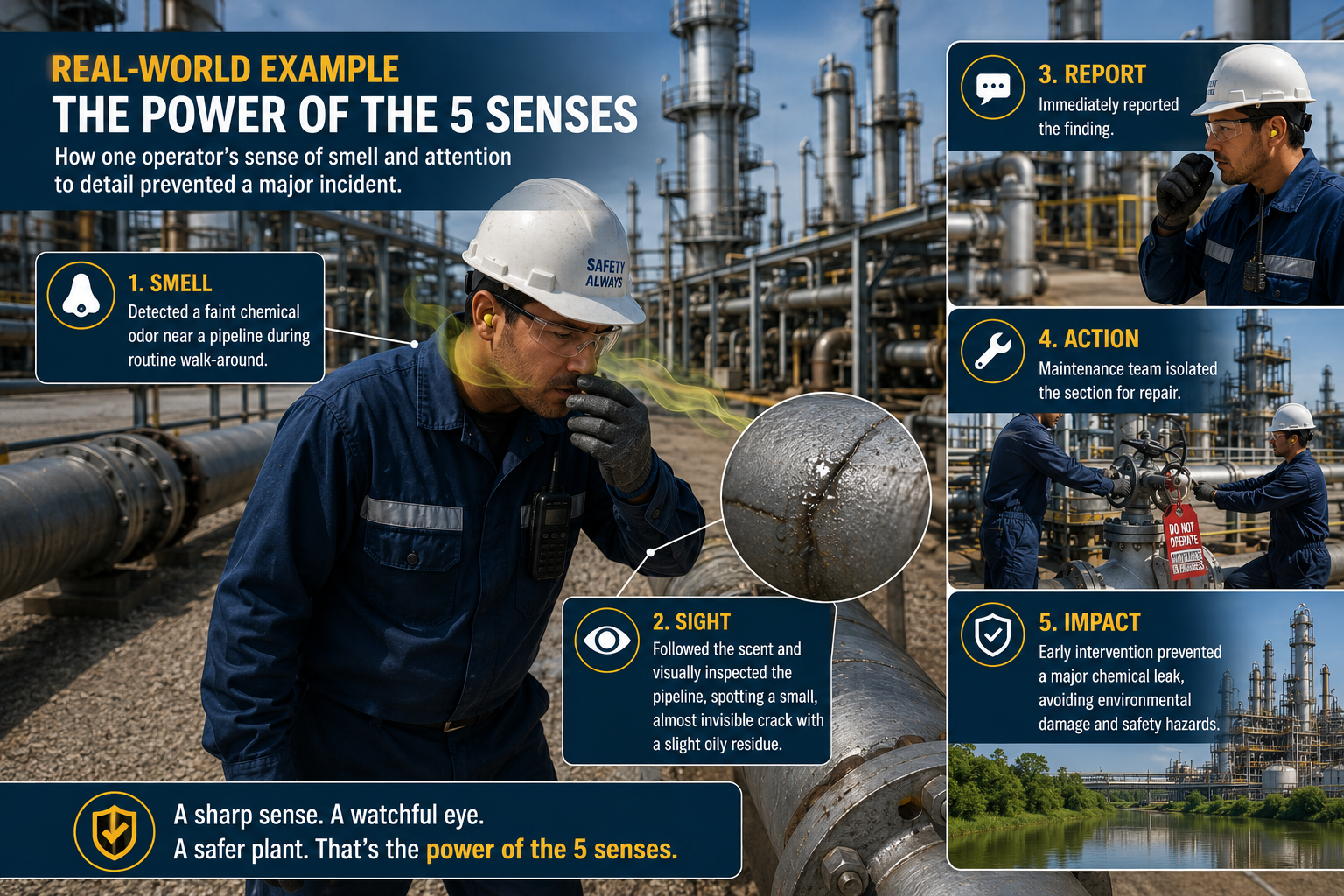
The operator immediately reported the finding, and the maintenance team isolated the section for repair. This early intervention prevented a major chemical leak that could have caused environmental damage and safety hazards.
This example shows how smell and sight can work together to catch problems that automated systems might overlook.
Practical Tips for Operators Using Their 5 Senses
Operators can enhance their diagnostic reliability by following these tips:
- Stay alert and focused during inspections to notice subtle changes.
- Use all senses in combination rather than relying on one alone.
- Keep a sensory log to track recurring issues or patterns.
- Communicate clearly with maintenance and engineering teams about sensory observations.
- Use sensory checks alongside instruments for a complete assessment.
- Practice regularly to maintain sensory acuity.
- Escalate defects promptly according to established defect handling protocols.
The Future of Sensory Diagnostics in Operations
Integrating five-sense detection into an Autonomous Maintenance training program should be an essential part of operator development. While many organizations focus on cleaning, inspection, and lubrication, operators’ most powerful diagnostic tool is the one they already possess: their five senses.
An effective Autonomous Maintenance program transforms operators from equipment users into equipment owners. As they learn to observe with purpose using sight, hearing, touch, smell, and, in rare situations, taste they begin detecting subtle changes in machine condition long before alarms activate or failures occur. The benefits are often immediate. Operators identify abnormalities earlier, communicate defects more effectively, improve the quality of work orders, and help prevent unplanned downtime through timely intervention.
Empowering Operators: Crafting an Autonomous Maintenance Program to Transform Them into Equipment Owners places five-sense detection at the heart of operator development. Rather than relying solely on technology, the program teaches operators how to recognize the earliest signs of deterioration, document meaningful observations, and take ownership of equipment reliability. This shift in mindset strengthens communication between operations and maintenance, accelerates problem detection, and builds a culture where reliability begins with the people closest to the equipment.
Do You Know Where Your 24-Hours Go?
Need help understanding why your shift reports fail to reveal where your greatest production losses really occur?
Most shift reports tell you what happened. Very few help you discover why it happened or where your missing minutes actually went.
If your team struggles with recurring downtime, hidden losses, inconsistent communication, or reports that don’t match what operators experienced on the floor, it’s time to investigate the evidence.
Discover Reliability Crime Lab Field Guide: Do You Know Where Your 24 Hours Go? by Kerina Epperly.
Learn how to:
- Investigate production losses like a detective.
- Uncover the hidden factory and the missing minutes.
- Improve operator observations and shift communication.
- Connect field evidence with data to find the real causes of lost production.
Available now on Amazon:
https://www.amazon.com/dp/B0FH97GN1M
#Manufacturing #OperationalExcellence #LeanManufacturing #TPM #OEE #ContinuousImprovement #Reliability #Maintenance #RootCauseAnalysis #ManufacturingLeadership
FREE Manufacturing Leadership Workshop
Do You Know Where Your 24 Hours Go?
Every production facility has hidden losses, but do you know where yours are occurring?
Join us for an interactive workshop where we’ll challenge the way you think about OEE, downtime, the hidden factory, and the “missing minutes” that quietly reduce productivity every day. Through practical examples and discussion, you’ll learn how to investigate production losses like a detective and uncover opportunities that traditional reports often miss.
📅 Date: July 21, 2026
📍 Location: Bloomington, Illinois
Whether you’re a plant manager, operations leader, reliability engineer, maintenance professional, continuous improvement leader, or supervisor, you’ll leave with practical tools you can begin using immediately.
Registration is still open!
I look forward to seeing you there!
#Manufacturing #OperationalExcellence #LeanManufacturing #TPM #Reliability #ContinuousImprovement #OEE #ManufacturingLeadership #RootCauseAnalysis #Maintenance
Other articles you may find interesting:
The Curious Case of “Normal” Bearing Failure – Accendo Reliability
Unlocking Plastic Deformation – Accendo Reliability
Decoding Early Thermal Stress in Rotating Equipment – Accendo Reliability



Leave a Reply