Accendo Reliability

Your Reliability Engineering Professional Development Site

  • Home
  • About
    • Contributors
    • About Us
    • Colophon
    • Survey
  • Reliability.fm
    • Speaking Of Reliability
    • Rooted in Reliability: The Plant Performance Podcast
    • Quality during Design
    • CMMSradio
    • Way of the Quality Warrior
    • Critical Talks
    • Asset Performance
    • Dare to Know
    • Maintenance Disrupted
    • Metal Conversations
    • The Leadership Connection
    • Practical Reliability Podcast
    • Reliability Gang
    • Reliability Hero
    • Reliability Matters
    • Reliability it Matters
    • Maintenance Mavericks Podcast
    • Women in Maintenance
    • Accendo Reliability Webinar Series
  • Articles
    • CRE Preparation Notes
      • Reliability Bites
    • NoMTBF
    • on Leadership & Career
      • Advanced Engineering Culture
      • ASQR&R
      • Engineering Leadership
      • Managing in the 2000s
      • Product Development and Process Improvement
    • on Maintenance Reliability
      • Aasan Asset Management
      • AI & Predictive Maintenance
      • Asset Management in the Mining Industry
      • CMMS and Maintenance Management
      • CMMS and Reliability
      • Conscious Asset
      • EAM & CMMS
      • Everyday RCM
      • History of Maintenance Management
      • Life Cycle Asset Management
      • Maintenance and Reliability
      • Maintenance Management
      • Plant Maintenance
      • Process Plant Reliability Engineering
      • RCM Blitz®
      • ReliabilityXperience
      • Rob’s Reliability Project
      • The Intelligent Transformer Blog
      • The People Side of Maintenance
      • The Reliability Crime Lab
      • The Reliability Mindset
    • on Product Reliability
      • Accelerated Reliability
      • Achieving the Benefits of Reliability
      • Apex Ridge
      • Beyond the Numbers
      • Breaking Bad for Reliability
      • Field Reliability Data Analysis
      • Metals Engineering and Product Reliability
      • Musings on Reliability and Maintenance Topics
      • Product Validation
      • Reliability by Design
      • Reliability Competence
      • Reliability Engineering Insights
      • Reliability in Emerging Technology
      • Reliability Knowledge
    • on Risk & Safety
      • CERM® Risk Insights
      • Equipment Risk and Reliability in Downhole Applications
      • Operational Risk Process Safety
    • on Systems Thinking
      • The RCA
      • Communicating with FINESSE
    • on Tools & Techniques
      • Big Data & Analytics
      • Experimental Design for NPD
      • Innovative Thinking in Reliability and Durability
      • Inside and Beyond HALT
      • Inside FMEA
      • Institute of Quality & Reliability
      • Integral Concepts
      • Learning from Failures
      • Progress in Field Reliability?
      • R for Engineering
      • Reliability Engineering Using Python
      • Reliability Reflections
      • Statistical Methods for Failure-Time Data
      • Testing 1 2 3
      • The Hardware Product Develoment Lifecycle
      • The Manufacturing Academy
  • eBooks
  • Resources
    • Special Offers
    • Accendo Authors
    • FMEA Resources
    • Glossary
    • Feed Forward Publications
    • Openings
    • Books
    • Webinar Sources
    • Journals
    • Higher Education
    • Podcasts
  • Courses
    • Your Courses
    • 14 Ways to Acquire Reliability Engineering Knowledge
    • Live Courses
      • Introduction to Reliability Engineering & Accelerated Testings Course Landing Page
      • Advanced Accelerated Testing Course Landing Page
    • Integral Concepts Courses
      • Reliability Analysis Methods Course Landing Page
      • Applied Reliability Analysis Course Landing Page
      • Statistics, Hypothesis Testing, & Regression Modeling Course Landing Page
      • Measurement System Assessment Course Landing Page
      • SPC & Process Capability Course Landing Page
      • Design of Experiments Course Landing Page
    • The Manufacturing Academy Courses
      • An Introduction to Reliability Engineering
      • Reliability Engineering Statistics
      • An Introduction to Quality Engineering
      • Quality Engineering Statistics
      • FMEA in Practice
      • Process Capability Analysis course
      • Root Cause Analysis and the 8D Corrective Action Process course
      • Return on Investment online course
    • Industrial Metallurgist Courses
    • FMEA courses Powered by The Luminous Group
      • FMEA Introduction
      • AIAG & VDA FMEA Methodology
    • Barringer Process Reliability Introduction
      • Barringer Process Reliability Introduction Course Landing Page
    • Fault Tree Analysis (FTA)
    • Foundations of RCM online course
    • Reliability Engineering for Heavy Industry
    • How to be an Online Student
    • Quondam Courses
  • Webinars
    • Upcoming Live Events
    • Accendo Reliability Webinar Series
  • Calendar
    • Call for Papers Listing
    • Upcoming Webinars
    • Webinar Calendar
  • Login
    • Member Home
Home » Articles » on Tools & Techniques » The Manufacturing Academy » Orientation to the OEE Components

by Ray Harkins Leave a Comment

Orientation to the OEE Components

Orientation to the OEE Components

This article is adapted from Chapter 4 of my book, Measuring Manufacturing Effectiveness.

The book is organized as a structured, multi-chapter examination of how manufacturing organizations define, measure, and interpret “effectiveness.” Rather than focusing on isolated metrics or individual tools, it treats measurement as a system, one that directly influences operational decisions, improvement priorities, and management behavior across manufacturing organizations.

Each chapter is written to stand on its own, while also contributing to a larger, integrated framework for understanding manufacturing performance.

Chapter 4 introduces the core components that make up Overall Equipment Effectiveness (OEE). While OEE is often presented as a single number, it is actually the product of three distinct elements, each representing a different category of loss and a different dimension of system performance.

This chapter provides an orientation to those components, explains what each is intended to capture, and establishes the conceptual foundation needed before OEE can be used meaningfully as a measurement or improvement tool.

Orientation to the OEE Components

OEE decomposes manufacturing effectiveness into three components: availability, performance, and quality. Each component represents a distinct class of loss acting on production time.

This chapter provides an orientation to these components. Detailed analysis follows in subsequent chapters.

Relationship to TEEP and OOE

OEE represents effectiveness within scheduled production time.

OOE and TEEP extend the same logic upstream by expanding the time base. The component structure remains unchanged.

Understanding OEE components is therefore prerequisite to interpreting all three metrics.

Availability: Can the Equipment Run?

Availability measures whether production is possible during scheduled production time.

Within the OEE framework, availability is reduced only by unplanned downtime; planned downtime is excluded beforeavailability is calculated.

Availability answers the question:

When production is scheduled, is the equipment capable of running?

Availability loss reflects system reliability and maintainability, not operator effort or scheduling policy.

Performance: How Effectively Is Time Used?

Performance measures how effectively available production time is converted into effective production time.

Performance loss occurs while equipment is running and available. It includes:

  • Speed loss
  • Capability limits
  • Intentional derating

Performance answers the question:

When the equipment is running, how close is output to the reference condition?

Performance loss does not necessarily indicate inefficiency. It often reflects deliberate operating choices.

Quality: How Much Output Is Usable?

Quality measures how much effective production results in usable output.

Quality loss includes both predictable yield loss and instability-related loss.

Quality answers the question:

Of what is produced, how much meets requirements?

Quality loss frequently originates upstream in availability, performance, and recovery behavior.

Sequential Nature of the Components

The components act sequentially, not independently.

  • Availability determines how much time exists for production
  • Performance determines how effectively production time is used
  • Quality determines how much of the output is usable

Losses compound. Improvements applied downstream cannot recover time lost upstream.

Why Decomposition Matters

Decomposition isolates loss mechanisms that would otherwise be aggregated.

A single OEE value describes outcome. Its components describe behavior.

Interpreting the components together reveals whether constraints are driven by instability, capability, or recovery dynamics.

Interpreting Metrics in Sequence

Manufacturing metrics should be interpreted in the order that time is reduced:

  • Utilization before availability
  • Availability before performance
  • Performance before quality

Interpreting downstream metrics without understanding upstream losses leads to misattribution. This sequential interpretation is central to the framework presented.

Purpose of the Detailed Chapters

The chapters that follow examine each component in detail:

  • Availability (Chapters 5–7)
  • Performance (Chapter 8)
  • Quality (Chapter 9)
  • Recovery behavior (Chapter 11)

These chapters focus on interpretation rather than calculation.

Key Takeaways

  • OEE decomposes effectiveness into availability, performance, and quality.
  • Each component represents a distinct loss mechanism.
  • The components act sequentially and cumulatively.
  • Decomposition enables diagnosis, not scoring.
  • Understanding components precedes interpretation of TEEP and OOE.

The detailed analysis begins in the next chapter.

This chapter is one part of a 12-chapter framework presented in Measuring Manufacturing Effectiveness, which examines how manufacturing measurement systems influence operational outcomes, decision-making, and organizational behavior. If you purchase Measuring Manufacturing Effectiveness through this link, it helps support the ongoing work of Accendo Reliability, which has generously hosted this serialized release.

Ray Harkins is the General Manager of Lexington Technologies in Lexington, North Carolina. He earned his Master of Science from Rochester Institute of Technology and his Master of Business Administration from Youngstown State University. He also teaches 60+ quality, engineering, manufacturing, and business-related courses such as Quality Engineering Statistics, Reliability Engineering Statistics, Failure Modes and Effects Analysis (FMEA), and Root Cause Analysis and the 8D Corrective Action Process through the online learning platform, Udemy.
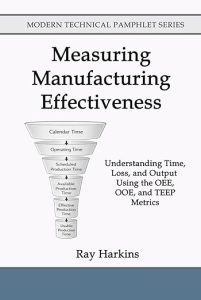
Book cover for Measuring Manufacturing Effectivenss by Ray Harkins

Measuring Manufacturing Effectiveness

Understanding Time, Loss, and Output Using the OEE, OOE, and TEEP Metrics

by Ray Harkins

The book consolidates the complete framework into a single coherent model rather than isolated articles. If you’d like access to the full structured framework, including all chapters, diagrams, models, equations, and supporting examples, the complete book is available in hardcover and Kindle ebook.

Measuring Manufacturing Effectiveness is a concise technical handbook for manufacturing professionals who want to use data and metrics to understand what is really happening on the shop floor.

Most discussions of OEE reduce performance to “running too slow” and treat downtime as a single bucket. Those approaches produce scorekeeping, not insight. This book takes a different route: it shows how manufacturing time is progressively converted into usable output, and how common effectiveness metrics make losses visible when they are interpreted correctly.


Filed Under: Articles, on Tools & Techniques, The Manufacturing Academy

About Ray Harkins

Ray Harkins is a senior manufacturing professional with over 25 years of experience in manufacturing engineering, quality management, and business analysis.

During his career, he has toured hundreds of manufacturing facilities and worked with leading industry professionals throughout North America and Japan.

« Is Your Reliability Testing Adding Value?
Systems Thinking and Twelve Ways to Express Asset Life »

Leave a Reply Cancel reply

Your email address will not be published. Required fields are marked *

Logo for The Manufacturing Acadamey headshot of RayArticle by Ray Harkins
in the The Manufacturing Academy article series

Join Accendo

Receive information and updates about articles and many other resources offered by Accendo Reliability by becoming a member.

It’s free and only takes a minute.

Join Today

Recent Posts

  • Systems Thinking and Twelve Ways to Express Asset Life
  • Orientation to the OEE Components
  • Is Your Reliability Testing Adding Value?
  • The Hindenburg Disaster
  • The Happiness and Pleasure of Doing World-Class Work Quality

© 2026 FMS Reliability · Privacy Policy · Terms of Service · Cookies Policy

Book the Course with John
  Ask a question or send along a comment. Please login to view and use the contact form.
This site uses cookies to give you a better experience, analyze site traffic, and gain insight to products or offers that may interest you. By continuing, you consent to the use of cookies. Learn how we use cookies, how they work, and how to set your browser preferences by reading our Cookies Policy.