
Guest Post by Malcolm Peart (first posted on CERM ® RISK INSIGHTS – reposted here with permission)
Communication…dictionarily is the imparting or exchanging of information by speaking, writing, or using some other medium. It’s essential to humankind and allows us to live, work, trade and co-exist. It’s the basis of society, culture and civilizations and through communication there’s understanding and establishment of common beliefs.
Communication allows us to impart information, clarify such information and rectify misunderstandings. Of course, if miscommunication occurs and is acted upon then mistakes may well happen, and these mistakes can then cause problems. In Project Management such mistakes often result in delays, cost overruns, quality shortfalls, disputes and, possibly, project failure.
Project management includes for the management of communication as a knowledge area. As a risk mitigation measure project management attempts to ensure that communication is both effective and efficient. But what is ‘communication management’ and are we really ‘managing’ communication or just it’s transmission and receipt?
Project Communication Management
PMI define Project Communication Management as:
“including the processes required to ensure timely and appropriate planning, collection, creation, distribution, storage, retrieval, management, control, monitoring and ultimate disposition of project information,
Most projects, when going through its initial paces, will have a requirement for a formal ‘Project Communication Management Plan’ which will address, as a matter of course, the following:
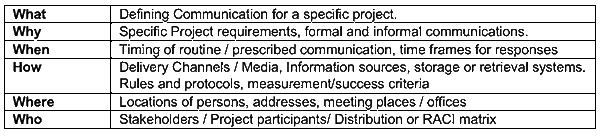
And, in keeping with the management mantra of “You can’t manage what you can’t measure”, success criteria are measured through some form of performance indicators to demonstrate that there is ‘management’.
However, we also need to understand what is being managed. Is it the efficiency of communication process and conveying of information or is the effectiveness of the communication itself and its understanding. Or is just about who gets what and when and how.
Measurement & Metrics
We measure things from a management perspective so we can ‘see’ if those things are getting better or worse. Positive progress is not made unless what you measure is seen to be improving and, of course, what is not. Inevitably this is done through a collection of Key Performance Indicators (KPI) and these can take many forms depending on the medium of communication but can include:
- Emails – number of first-time responses and number of reminders issued,
- Formal Correspondence – time taken to provide a requested response
- Quality Reports – time taken to close or respond to NCRs
- Meetings – time taken to issue minutes / records
- Townhall Meetings – number of people who log on / attend
- Status Reports – timely production of routine reports and issuing to stakeholders
- Stakeholders – checking distribution has happened as planned
For example: emails may be required to be answered or acknowledged withing a fixed timeframe (no matter what the subject); formal letters will need to be answered within, say, 5 working days (no matter what the content or complexity); reports must meet deadlines (even if they await important information); or NCRs must be closed with a predetermined time frame (no matter what their nature).
The use of KPIs is a tried and tested means of measuring performance but how often is the rationale for their establishment questioned? Are they based upon sound and justifiable reasoning or are they arbitrary and open to manipulation to give positive results. For example ,how often are NCRs raised when a reinspection would suffice, or minor matters are escalated rather than being addressed summarily so as to meet KPIs?
In any event, and in an unthinking environment, KPIs become quotas and in doing so, according to Goodhart’s Law, they cease to become good measures as the original intent of the measure is lost, or forgotten or, possibly, didn’t exist in the first place.
Efficiency, Exceptions & Effectiveness
Communication can be made to be efficient if all prescribed processes are followed. However, its effectiveness may well be compromised through the constraints of arbitrary deadlines or time frames. That is not to say timely communication is not important but there are exceptions. These exceptions may challenge the rule and, even though the existence of the general rule is proven, they need to be dealt with on a case-by-case basis. In such circumstances the meeting of a KPIs as proof of effectiveness over efficiency will be more than questionable.
A well-known humorous example comes from WW1. A senior officer sends a substantiated message requesting reinforcements. In the subsequent, and obviously urgent relaying, the simple radio message became garbled to point that the message became a confusing nonsense:
- “Send reinforcements. We are going to advance”, with its clear intent, became
- “Send reinforcements. We are going to our aunts” and then
- “Send these endorsements. We’re going to France” and finally
- “Send three and fourpence. We’re going to a dance” which is clearly nonsense.
The message was passed and, assumedly, a KPI regarding transmission times may have been achieved. However as with many targets based on KPIs if they are achieved without thinking then there is no consideration as to the how other areas of performance will be affected.
For managers who are unsure as to what people are doing then, by setting of arbitrary KPIs and ensuring adherence to them, they can demonstrate that communication happened, and efficiency was achieved. The ‘rules’ are followed and in the event of any ‘communication management problems’ there is evidence to show ‘communication compliance’ and efficiency despite the communication being ineffective and, as Shaw once observed, merely illusionary.
Managing Communication
The purpose of communication is to convey information from one party to another so the other party perform some action or will behave in a particular manner. It’s not only humans that communicate; dogs bark and draw attention to something of importance, at least to them, dry crops communicate the need for water, and the wind whistling in trees can portend of an oncoming storm while dark clouds reinforce the message of rain.
Communication is everywhere. On a grander scale the rising and setting sun herald the start and end of a day but an eclipse can easily introduce ambiguity to our diurnal cycle. However, the messages are conveyed but the information that is meant to be transferred is sometimes as never as clear as we wish and yet we apparently “manage communication”.
At a project level we can initiate a need for communication and manage the process of converting the requisite information into a suitable medium, transmitting it, keeping a record of its transmission, ensuring it’s been received and even obtaining, acknowledgement of the same. However, once in the hands of the recipient the transmitted information will be distributed, interpreted and a decision will then be made as to how to act by the recipient and the recipient alone.
Actions by the recipient can be in line with expectations of the initiator or, due any misunderstanding may well be to the contrary. If there is ambiguity or error, or confusion then subsequent communication will suffer and disagreement and dispute will occur. In the cycle of communication, the original initiator becomes the recipient and will act according to their understanding and the start of a communication breakdown may well have started.
Conclusions
Communication is not a tangible product confined to the transmission and receipt of cold hard facts, it’s also about the reaction and response to it. Even a clear and unequivocal message can become garbled as the number of communication channels increases. The risk of misunderstanding increases as does the risk of just doing the wrong thing.
We measure certain tangibles; the time taken to initiate communication, or react to it, to whom information has been passed, when, and in what medium as well as having the records to prove it. This allows for the management of the efficiency of the process but its effectiveness in terms of intent and understanding is a more difficult.
“There’s many a slip ‘twixt cup and lip” goes the 16th Century English proverb concerning presumptions regarding certainty. There may be certainty regarding the sending of the information and its receipt. However, if the intent of the information is unclear or its interpretation is wrong, then all we have is a slip that’s been ‘well executed’.
We can manage the communication process and its efficiency. However, if communication is mistaken or misunderstood all we can do is react to any issues that arise. Effectiveness is difficult to measure so remember, engage brain before speaking, check what you’ve written, and think before you press send; well begun is half done.
Bio:
Malcolm Peart is an UK Chartered Engineer & Chartered Geologist with over thirty-five years’ international experience in multicultural environments on large multidisciplinary infrastructure projects including rail, metro, hydro, airports, tunnels, roads and bridges. Skills include project management, contract administration & procurement, and design & construction management skills as Client, Consultant, and Contractor.


Leave a Reply