Accendo Reliability

Your Reliability Engineering Professional Development Site

  • Home
  • About
    • Contributors
    • About Us
    • Colophon
    • Survey
  • Reliability.fm
    • Speaking Of Reliability
    • Rooted in Reliability: The Plant Performance Podcast
    • Quality during Design
    • CMMSradio
    • Way of the Quality Warrior
    • Critical Talks
    • Asset Performance
    • Dare to Know
    • Maintenance Disrupted
    • Metal Conversations
    • The Leadership Connection
    • Practical Reliability Podcast
    • Reliability Gang
    • Reliability Hero
    • Reliability Matters
    • Reliability it Matters
    • Maintenance Mavericks Podcast
    • Women in Maintenance
    • Accendo Reliability Webinar Series
  • Articles
    • CRE Preparation Notes
      • Reliability Bites
    • NoMTBF
    • on Leadership & Career
      • Advanced Engineering Culture
      • ASQR&R
      • Engineering Leadership
      • Managing in the 2000s
      • Product Development and Process Improvement
    • on Maintenance Reliability
      • Aasan Asset Management
      • AI & Predictive Maintenance
      • Asset Management in the Mining Industry
      • CMMS and Maintenance Management
      • CMMS and Reliability
      • Conscious Asset
      • EAM & CMMS
      • Everyday RCM
      • History of Maintenance Management
      • Life Cycle Asset Management
      • Maintenance and Reliability
      • Maintenance Management
      • Plant Maintenance
      • Process Plant Reliability Engineering
      • RCM Blitz®
      • ReliabilityXperience
      • Rob’s Reliability Project
      • The Intelligent Transformer Blog
      • The People Side of Maintenance
      • The Reliability Crime Lab
      • The Reliability Mindset
    • on Product Reliability
      • Accelerated Reliability
      • Achieving the Benefits of Reliability
      • Apex Ridge
      • Beyond the Numbers
      • Breaking Bad for Reliability
      • Field Reliability Data Analysis
      • Metals Engineering and Product Reliability
      • Musings on Reliability and Maintenance Topics
      • Product Validation
      • Reliability by Design
      • Reliability Competence
      • Reliability Engineering Insights
      • Reliability in Emerging Technology
      • Reliability Knowledge
    • on Risk & Safety
      • CERM® Risk Insights
      • Equipment Risk and Reliability in Downhole Applications
      • Operational Risk Process Safety
    • on Systems Thinking
      • The RCA
      • Communicating with FINESSE
    • on Tools & Techniques
      • Big Data & Analytics
      • Experimental Design for NPD
      • Innovative Thinking in Reliability and Durability
      • Inside and Beyond HALT
      • Inside FMEA
      • Institute of Quality & Reliability
      • Integral Concepts
      • Learning from Failures
      • Progress in Field Reliability?
      • R for Engineering
      • Reliability Engineering Using Python
      • Reliability Reflections
      • Statistical Methods for Failure-Time Data
      • Testing 1 2 3
      • The Hardware Product Develoment Lifecycle
      • The Manufacturing Academy
  • eBooks
  • Resources
    • Special Offers
    • Accendo Authors
    • FMEA Resources
    • Glossary
    • Feed Forward Publications
    • Openings
    • Books
    • Webinar Sources
    • Journals
    • Higher Education
    • Podcasts
  • Courses
    • Your Courses
    • 14 Ways to Acquire Reliability Engineering Knowledge
    • Live Courses
      • Introduction to Reliability Engineering & Accelerated Testings Course Landing Page
      • Advanced Accelerated Testing Course Landing Page
    • Integral Concepts Courses
      • Reliability Analysis Methods Course Landing Page
      • Applied Reliability Analysis Course Landing Page
      • Statistics, Hypothesis Testing, & Regression Modeling Course Landing Page
      • Measurement System Assessment Course Landing Page
      • SPC & Process Capability Course Landing Page
      • Design of Experiments Course Landing Page
    • The Manufacturing Academy Courses
      • An Introduction to Reliability Engineering
      • Reliability Engineering Statistics
      • An Introduction to Quality Engineering
      • Quality Engineering Statistics
      • FMEA in Practice
      • Process Capability Analysis course
      • Root Cause Analysis and the 8D Corrective Action Process course
      • Return on Investment online course
    • Industrial Metallurgist Courses
    • FMEA courses Powered by The Luminous Group
      • FMEA Introduction
      • AIAG & VDA FMEA Methodology
    • Barringer Process Reliability Introduction
      • Barringer Process Reliability Introduction Course Landing Page
    • Fault Tree Analysis (FTA)
    • Foundations of RCM online course
    • Reliability Engineering for Heavy Industry
    • How to be an Online Student
    • Quondam Courses
  • Webinars
    • Upcoming Live Events
    • Accendo Reliability Webinar Series
  • Calendar
    • Call for Papers Listing
    • Upcoming Webinars
    • Webinar Calendar
  • Login
    • Member Home
Home » Articles » on Maintenance Reliability » Life Cycle Asset Management » Reliability Block Diagrams Introduction

by Mike Sondalini Leave a Comment

Reliability Block Diagrams Introduction

Reliability Block Diagrams Introduction

Reliability Block Diagrams are a powerful reliability analysis tool. They are visual representation of reliability and risk that exists within machinery or work processes.

They allow the user to notate the reliability of each part or task and calculate the reliability for the whole scenario. The use of Reliability Block Diagrams extends to all aspects of operational processes and procedures, both as series and parallel arrangements.

Once a Reliability Block Diagram is created, you can do “what-if” scenarios to identify the defects that can happen to each part. This information allows you to then make informed decisions about to how to proactively eliminate the causes of each risk or defect, and by extension, eliminate that cause of failure.

Below is a series of examples where Reliability Block Diagrams are applied to a range of situations, and aid in identifying risks, defects, and causes of failure.

RELIABILITY BLOCK DIAGRAMS FOR MACHINERY

The engineering logic of how machine parts work together is show in their Reliability Block Diagram.

When you look at a machine you see a complete piece of equipment. How this machine is built, and where each part is interconnected is detailed in its engineering drawings. It is an assembly of many parts working together in a series arrangement.

We can draw this series arrangements of parts on paper as a row of boxes connected by arrows. An example of this, known as a Reliability Block Diagram, is shown below. The engineering logic of how the parts of this electric motor drive end bearing work together is show in their Reliability Block Diagram. Each component detailed in the engineering drawing is placed into the Reliability Block Diagram in the order it works when the machine operates.
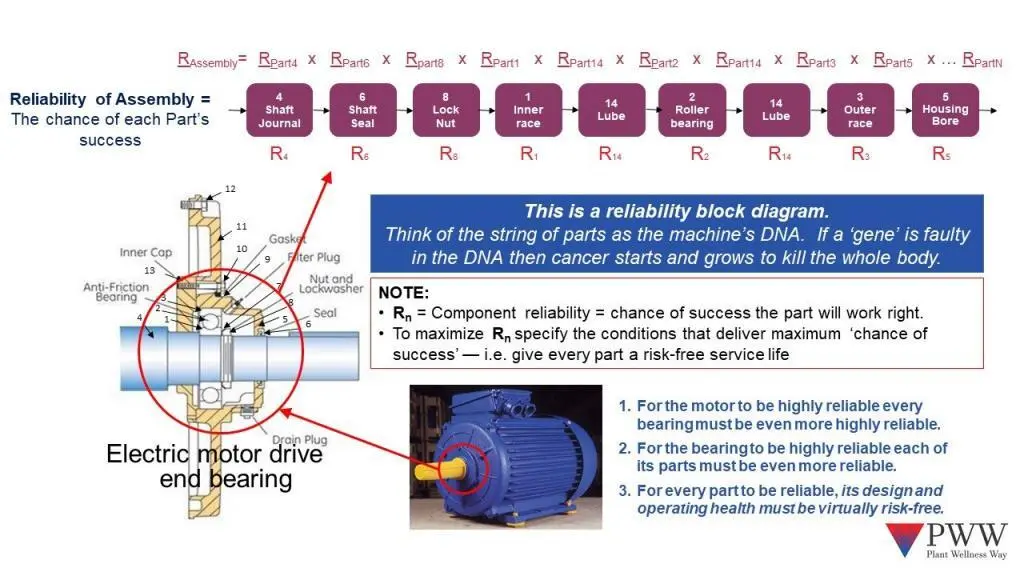
Reliability block diagram of an electric rotor drive end bearing with a detailed cross-section view.
Figure 1. Example Reliability Block Diagram for an electric motor drive end bearing, illustrating how machines are made of parts in a series arrangement.

This is a visual representation of the reliability and risk that exists in this machine sub-assembly. The reliability for each part is notated and used to calculate the reliability for the whole series. For example, if the boxes that represented the lubricant had a reliability of zero, then the reliability of the whole series is zero. This means the whole assembly reliability is zero, and the machine will breakdown. If individual parts contain defects or faults, they will fail at some time in future when the circumstances arise that trigger the defect to become a failure.

Once you have a Reliability Block Diagram, you can do “what-if” scenarios to identify the defects that can happen to each part. Then you can make informed decisions about to how to proactively eliminate the causes of each risk or defect, and by extension, eliminate that cause of failure.

WORK TASKS

Below is an example of a technician repairing bearings. The job requires varies tasks and activities to be performed in sequence. Ideally, he has a comprehensive and clear procedure to follow in which each task, and its sub-activities, are listed and explained. From the procedure we can draw a Reliability Block Diagram of the whole job. Because every job is a series of tasks and activities performed sequentially, we can estimate the reliability of the completed job from the reliability of completing each task. The job reliability equation to use is shown under the work task flow diagram.

In this example, there are only five tasks for the job. Each task is completed one after the other. The job is only done 100% correctly if each task is itself done 100% right. Because the job is a series of tasks and activities performed sequentially, the job is right if, and only if, each task is first done right.
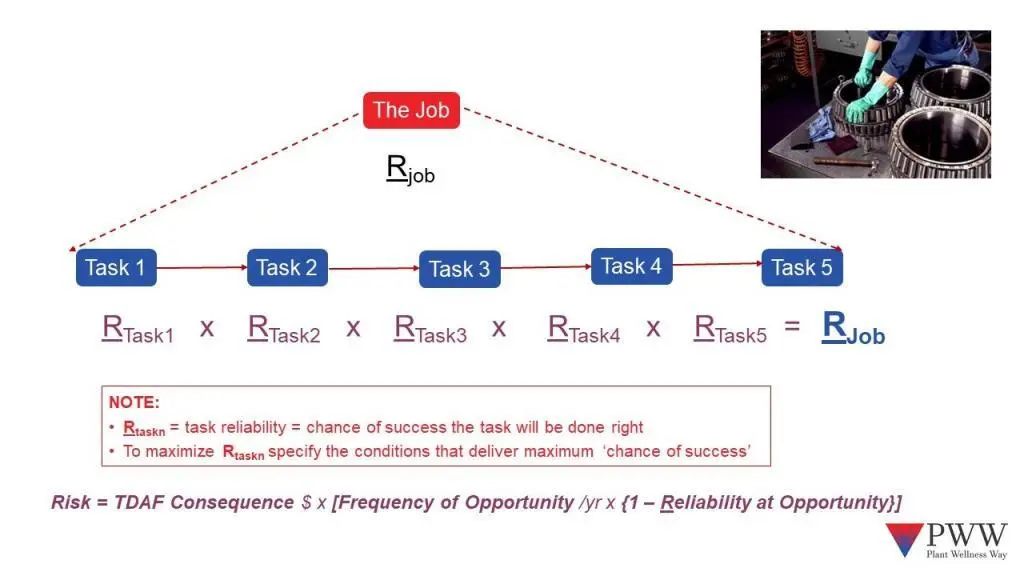
Reliability block diagram with 5 tasks connected in series, with a photo of mechanical equipment in the top right corner.
Slide-29-1024x576.jpg.webp
Figure 2. Example Reliability Block Diagram for a work task, illustrating how work tasks are made of activities in series arrangements

IF A JOB IS A SERIES OF TASKS, WHAT’S YOUR CHANCE OF GETTING THEM ALL RIGHT?

The reliability of a task is the chance that it will be completed correctly. When work tasks are not done right an error or defect is left behind. Each error or defect caused by a task mistake makes the task reliability fall from 100% to a lesser value. If a task reliability is 90%, then for every 10 times the task is done once it will be done wrong. We know from the risk equation shown that unless task reliability is 100%, the error in the task will cause risks in the future. Once a defect is left behind in a job it sits there waiting to become a future problem or failure.

Because work is a series of tasks and activities performed sequentially everyone who does work can produce errors, mistakes, defects, and failures in every task and activity they do. No job is certain of being successful until every task is known to be done right.

We must control the quality of individual work tasks, so they are always completed right, if you want to ensure the job is 100% successfully done.


Filed Under: Articles, Life Cycle Asset Management, on Maintenance Reliability

About Mike Sondalini

In engineering and maintenance since 1974, Mike’s career extends across original equipment manufacturing, beverage processing and packaging, steel fabrication, chemical processing and manufacturing, quality management, project management, enterprise asset management, plant and equipment maintenance, and maintenance training. His specialty is helping companies build highly effective operational risk management processes, develop enterprise asset management systems for ultra-high reliable assets, and instil the precision maintenance skills needed for world class equipment reliability.

« Why Your Assets Aren’t Delivering Value — And How SAMP Fixes That
CEO Disruption »

Leave a Reply Cancel reply

Your email address will not be published. Required fields are marked *

Headshot of Mike SondaliniArticles by Mike Sondalini
in the Life Cycle Asset Management article series

Join Accendo

Receive information and updates about articles and many other resources offered by Accendo Reliability by becoming a member.

It’s free and only takes a minute.

Join Today

Recent Posts

  • CEO Disruption
  • Reliability Block Diagrams Introduction
  • Why Your Assets Aren’t Delivering Value — And How SAMP Fixes That
  • Proportional Hazard Reliability Deterioration? 
  • What Is RCM? Understand It in 90 Seconds!

© 2026 FMS Reliability · Privacy Policy · Terms of Service · Cookies Policy

Book the Course with John
  Ask a question or send along a comment. Please login to view and use the contact form.
This site uses cookies to give you a better experience, analyze site traffic, and gain insight to products or offers that may interest you. By continuing, you consent to the use of cookies. Learn how we use cookies, how they work, and how to set your browser preferences by reading our Cookies Policy.