Accendo Reliability

Your Reliability Engineering Professional Development Site

  • Home
  • About
    • Contributors
    • About Us
    • Colophon
    • Survey
  • Reliability.fm
    • Speaking Of Reliability
    • Rooted in Reliability: The Plant Performance Podcast
    • Quality during Design
    • CMMSradio
    • Way of the Quality Warrior
    • Critical Talks
    • Asset Performance
    • Dare to Know
    • Maintenance Disrupted
    • Metal Conversations
    • The Leadership Connection
    • Practical Reliability Podcast
    • Reliability Hero
    • Reliability Matters
    • Reliability it Matters
    • Maintenance Mavericks Podcast
    • Women in Maintenance
    • Accendo Reliability Webinar Series
  • Articles
    • CRE Preparation Notes
    • NoMTBF
    • on Leadership & Career
      • Advanced Engineering Culture
      • ASQR&R
      • Engineering Leadership
      • Managing in the 2000s
      • Product Development and Process Improvement
    • on Maintenance Reliability
      • Aasan Asset Management
      • AI & Predictive Maintenance
      • Asset Management in the Mining Industry
      • CMMS and Maintenance Management
      • CMMS and Reliability
      • Conscious Asset
      • EAM & CMMS
      • Everyday RCM
      • History of Maintenance Management
      • Life Cycle Asset Management
      • Maintenance and Reliability
      • Maintenance Management
      • Plant Maintenance
      • Process Plant Reliability Engineering
      • RCM Blitz®
      • ReliabilityXperience
      • Rob’s Reliability Project
      • The Intelligent Transformer Blog
      • The People Side of Maintenance
      • The Reliability Mindset
    • on Product Reliability
      • Accelerated Reliability
      • Achieving the Benefits of Reliability
      • Apex Ridge
      • Breaking Bad for Reliability
      • Field Reliability Data Analysis
      • Metals Engineering and Product Reliability
      • Musings on Reliability and Maintenance Topics
      • Product Validation
      • Reliability by Design
      • Reliability Competence
      • Reliability Engineering Insights
      • Reliability in Emerging Technology
      • Reliability Knowledge
    • on Risk & Safety
      • CERM® Risk Insights
      • Equipment Risk and Reliability in Downhole Applications
      • Operational Risk Process Safety
    • on Systems Thinking
      • The RCA
      • Communicating with FINESSE
    • on Tools & Techniques
      • Big Data & Analytics
      • Experimental Design for NPD
      • Innovative Thinking in Reliability and Durability
      • Inside and Beyond HALT
      • Inside FMEA
      • Institute of Quality & Reliability
      • Integral Concepts
      • Learning from Failures
      • Progress in Field Reliability?
      • R for Engineering
      • Reliability Engineering Using Python
      • Reliability Reflections
      • Statistical Methods for Failure-Time Data
      • Testing 1 2 3
      • The Hardware Product Develoment Lifecycle
      • The Manufacturing Academy
  • eBooks
  • Resources
    • Special Offers
    • Accendo Authors
    • FMEA Resources
    • Glossary
    • Feed Forward Publications
    • Openings
    • Books
    • Webinar Sources
    • Journals
    • Higher Education
    • Podcasts
  • Courses
    • Your Courses
    • 14 Ways to Acquire Reliability Engineering Knowledge
    • Live Courses
      • Introduction to Reliability Engineering & Accelerated Testings Course Landing Page
      • Advanced Accelerated Testing Course Landing Page
    • Integral Concepts Courses
      • Reliability Analysis Methods Course Landing Page
      • Applied Reliability Analysis Course Landing Page
      • Statistics, Hypothesis Testing, & Regression Modeling Course Landing Page
      • Measurement System Assessment Course Landing Page
      • SPC & Process Capability Course Landing Page
      • Design of Experiments Course Landing Page
    • The Manufacturing Academy Courses
      • An Introduction to Reliability Engineering
      • Reliability Engineering Statistics
      • An Introduction to Quality Engineering
      • Quality Engineering Statistics
      • FMEA in Practice
      • Process Capability Analysis course
      • Root Cause Analysis and the 8D Corrective Action Process course
      • Return on Investment online course
    • Industrial Metallurgist Courses
    • FMEA courses Powered by The Luminous Group
      • FMEA Introduction
      • AIAG & VDA FMEA Methodology
    • Barringer Process Reliability Introduction
      • Barringer Process Reliability Introduction Course Landing Page
    • Fault Tree Analysis (FTA)
    • Foundations of RCM online course
    • Reliability Engineering for Heavy Industry
    • How to be an Online Student
    • Quondam Courses
  • Webinars
    • Upcoming Live Events
    • Accendo Reliability Webinar Series
  • Calendar
    • Call for Papers Listing
    • Upcoming Webinars
    • Webinar Calendar
  • Login
    • Member Home
Home » Articles » on Product Reliability » Reliability Knowledge » Reliability Importance During Design Phases

by Semion Gengrinovich Leave a Comment

Reliability Importance During Design Phases

Reliability Importance During Design Phases

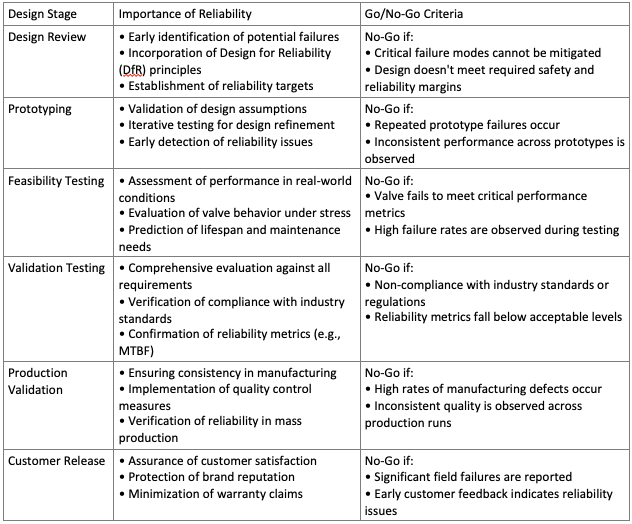
The Importance of Reliability in Product Development: A Case Study of an Electromechanical Valve for EV Battery Temperature Control. In the fast-evolving world of electric vehicles (EVs), the precision and reliability of components such as electromechanical valves are critical. These valves, which control the flow of coolant to manage battery temperature, must perform flawlessly under varying conditions. This article delves into the importance of reliability at each stage of product development, from design review to customer release, and highlights when a project might need to halt due to reliability concerns.

Design Review’s.

Importance of Reliability:

– Early Identification of Potential Failures: During the design review phase, reliability analysis helps identify potential failure modes and their impacts.

– Design for Reliability (DfR): Incorporating reliability principles ensures that the design can withstand operational stresses and environmental conditions.

No-Go Criteria:

– Unresolved Critical Failure Modes: If critical failure modes are identified and cannot be mitigated through design changes, the project should not proceed.

– Inadequate Design Margins: If the design does not meet the required safety and reliability margins, it must be revised.

Prototyping.

Importance of Reliability:

– Validation of Design Assumptions: Prototyping allows for the physical validation of design assumptions and reliability predictions.

– Iterative Testing: Reliability testing during prototyping helps refine the design and improve robustness.

No-Go Criteria:

– Repeated Prototype Failures: If prototypes consistently fail under expected operating conditions, it indicates fundamental design flaws.

– Inconsistent Performance: Variability in prototype performance suggests reliability issues that need addressing before moving forward.

Feasibility Testing.

Importance of Reliability:

– Operational Testing: Feasibility testing assesses the valve’s performance in real-world conditions, ensuring it meets reliability standards.

– Stress Testing: Evaluating how the valve performs under extreme conditions helps predict its lifespan and maintenance needs.

No-Go Criteria:

– Failure to Meet Performance Metrics: If the valve does not meet critical performance metrics such as flow control precision and response time, it should not advance.

– High Failure Rates: A high incidence of failures during feasibility testing indicates that the design is not yet reliable enough for further development.

Validation Testing.

Importance of Reliability:

– Comprehensive Evaluation: Validation testing involves extensive testing to ensure the valve meets all specified requirements and reliability standards.

– Regulatory Compliance: Ensuring the product complies with industry standards and regulations is crucial for market entry.

No-Go Criteria:

– Non-Compliance with Standards: If the valve fails to meet industry standards or regulatory requirements, it cannot proceed to production.

– Unacceptable Reliability Metrics: If reliability metrics such as Mean Time Between Failures (MTBF) are below acceptable levels, further design modifications are needed.

Production Validation.

Importance of Reliability:

– Consistency in Manufacturing: Production validation ensures that the manufacturing process consistently produces reliable valves.

– Quality Control: Implementing rigorous quality control measures helps maintain high reliability in mass production.

No-Go Criteria:

– Manufacturing Defects: High rates of defects during production validation indicate issues with the manufacturing process that must be resolved.

– Inconsistent Quality: Variability in product quality suggests that the production process is not yet stable or reliable.

Customer Release.

Importance of Reliability:

– Customer Satisfaction: Reliable products lead to higher customer satisfaction and reduced warranty claims.

– Brand Reputation: A reliable product enhances the brand’s reputation and customer trust.

No-Go Criteria:

– Field Failures: If initial field tests reveal significant reliability issues, the product release should be delayed until these are resolved.

– Negative Customer Feedback: Early negative feedback regarding reliability can harm the product’s market success and should be addressed before full release.
Conclusion

Reliability is a cornerstone of successful product development, especially for critical components like electromechanical valves in EVs. By rigorously assessing and ensuring reliability at each stage, from design review to customer release, companies can deliver high-quality, dependable products that meet customer expectations and regulatory requirements. Understanding when to halt development due to reliability concerns is crucial for long-term success and brand reputation. By focusing on reliability throughout the product development lifecycle, companies can mitigate risks, enhance product performance, and ensure customer satisfaction. This approach not only leads to better products but also strengthens the company’s position in the competitive EV market.


Filed Under: Articles, on Product Reliability, Reliability Knowledge

About Semion Gengrinovich

In my current role, leveraging statistical reliability engineering and data-driven approaches to drive product improvements and meet stringent healthcare industry standards. Im passionate about sharing knowledge through webinars, podcasts and development resources to advance reliability best practices.

« Replace After MTTF Time To Avoid Failures – Right?

Leave a Reply Cancel reply

Your email address will not be published. Required fields are marked *

Reliability Knowlege series logo Photo of Semion GengrinovichArticles & Videos by Semion Gengrinovich
in the Reliability Knowledge article & video series

Recent Posts

  • Reliability Importance During Design Phases
  • Replace After MTTF Time To Avoid Failures – Right?
  • What is Condition Based Maintenance Strategy?
  • Understanding Risk Profile is Important in Insurance Risk Decisions
  • I Built 4 Powerful Calculators and Made Them Free for Every Reliability Engineer

Join Accendo

Receive information and updates about articles and many other resources offered by Accendo Reliability by becoming a member.

It’s free and only takes a minute.

Join Today

© 2026 FMS Reliability · Privacy Policy · Terms of Service · Cookies Policy

Book the Course with John
  Ask a question or send along a comment. Please login to view and use the contact form.
This site uses cookies to give you a better experience, analyze site traffic, and gain insight to products or offers that may interest you. By continuing, you consent to the use of cookies. Learn how we use cookies, how they work, and how to set your browser preferences by reading our Cookies Policy.