Harnessing the amazing power of sound can transform your predictive maintenance program by placing diagnostic tools in the hands of trained operators.
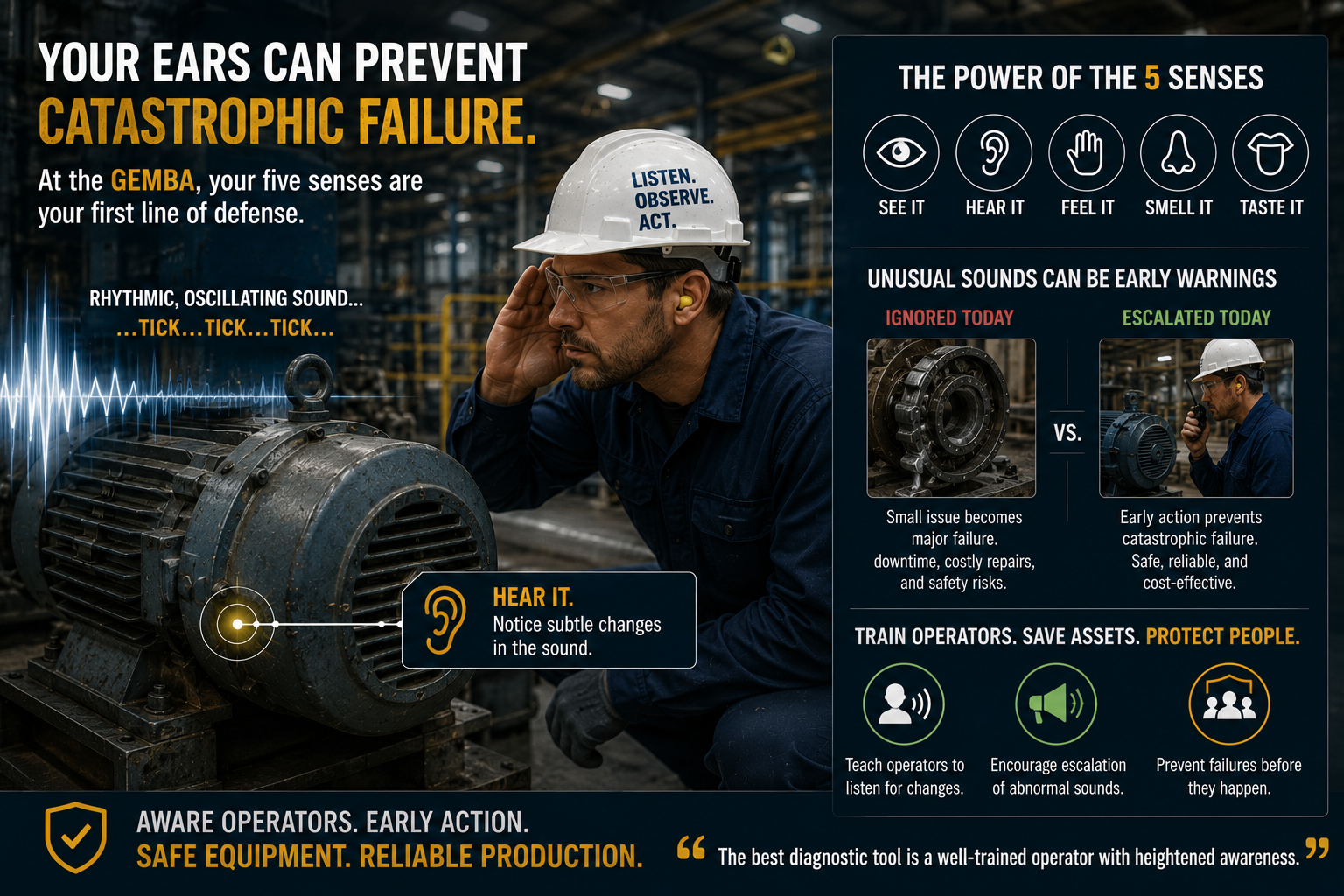
Imagine walking down a production floor and hearing a rhythmic, oscillating sound that is interrupted every third cycle by tick…tick…tick… Would you know something was wrong with the equipment? Would you step closer to the equipment to hear the sound better? Would you escalate the sound to prevent impending catastrophic failure?
Understanding component failure doesn’t always have to rely on expensive diagnostic tools. In fact, one of the most powerful methods we have at our disposal costs nothing: teaching operators to use their five senses at the GEMBA (the place where the work happens).
When operators are trained to observe, listen to, and detect unusual sounds from their equipment like a bearing that sounds like the bad wheel on a grocery cart or the slight tapping of an off-center home fan blade they can take action and escalate the issue before it leads to catastrophic failure.
Sound is one of the most underutilized yet powerful diagnostic tools.
The Power of Sound in Failure Progress
Listen to this sound.
Do you hear it?
At first, it may sound like a normal rotation. But listen closely: there’s an irregular wobble, a faint tapping where the bearing is slightly touching one side and then the other. That is not the sound of healthy machinery. It is the sound of a bearing nearing the end of its life cycle.
A worn bearing like this is just one step away from failure.
Left unchecked, it can cause:
- Shaft misalignment
- Secondary damage to housing and gears
- A chain reaction leading to catastrophic downtime
Why Operator Training Matters
By training operators to recognize these sounds, we shift from reactive firefighting to proactive control.
Imagine this:
- Instead of a bearing failing mid-shift, shutting down production, and creating costly ripple effects…
- The operator identifies the abnormal sound early, escalates it, and maintenance schedules a controlled repair.
This transforms catastrophic, unplanned downtime into a perfectly timed repair.
The Five Senses in Diagnostics
The power of the five senses isn’t science fiction or magic, it’s practical, powerful observation.
While sound is highlighted here, the other senses are equally valuable at the GEMBA:
- Sight: spotting leaks, discoloration, loose bolts, or abnormal vibration.
- Smell: detecting burning oil, overheated insulation, or chemical leaks.
- Touch: feeling abnormal heat, looseness, or excessive vibration.
- Taste (contextual): in food or process industries, detecting contamination issues.
When combined, these senses empower operators to detect failure fingerprints long before machines stop running.
Operator Training Takeaway
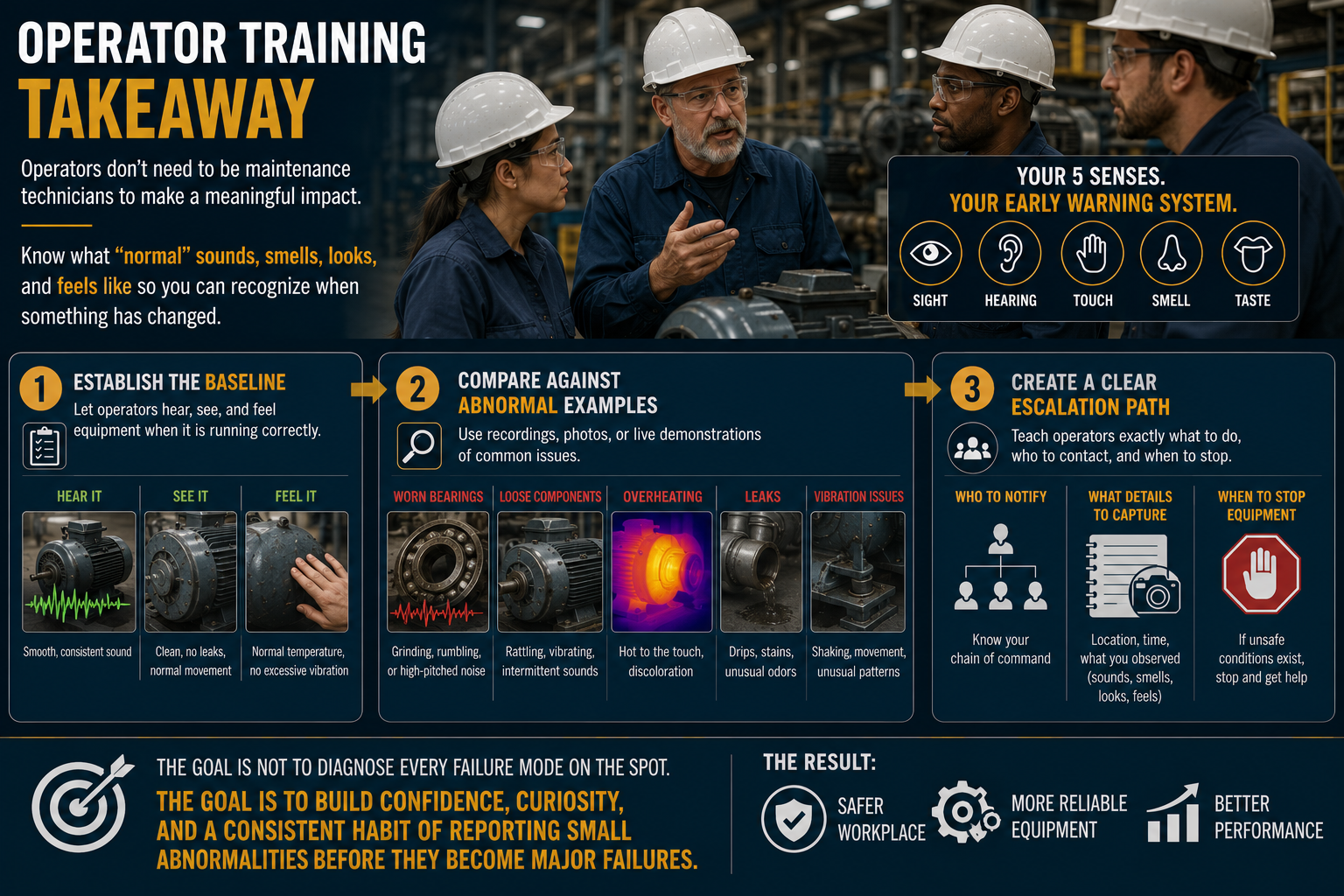
Operators do not need to become maintenance technicians to make a meaningful impact. They need to know what “normal” sounds, smells, looks, and feels like so they can recognize when something has changed.
A simple training approach can include three repeatable steps:
- Establish the baseline: Let operators hear, see, and feel equipment when it is running correctly.
- Compare against abnormal examples: Use recordings, photos, or live demonstrations of worn bearings, loose components, overheating, leaks, or vibration issues.
- Create a clear escalation path: Teach operators exactly who to notify, what details to capture, and when to stop the equipment if conditions appear unsafe.
The goal is not to diagnose every failure mode on the spot. The goal is to build confidence, curiosity, and a consistent habit of reporting small abnormalities before they become major failures.
Conclusion
Failure diagnostics do not always begin with complex equipment, high-end sensors, or advanced analysis.
Often, they begin with something much simpler: an operator who knows the machine, recognizes what “normal” sounds like, and has the confidence to speak up when something changes.
When operators learn to listen for a bearing’s “death rattle,” see discoloration, smell overheating, or feel abnormal vibration, they are no longer passive observers of the process.
They become active guardians of uptime the first line of defense against preventable downtime, secondary damage, and costly production interruptions.
Start small: play the sound at your next training session, ask your operators what they hear, and use that conversation to build awareness, curiosity, and ownership.
That simple question: What do you hear? May be the moment that prevents tomorrow’s failure.
Here is another sound for the floor team to evaluate.
What do you hear this time? What action should you take before it leads to catastrophic Failure?
Do You Know Where Your 24-Hours Go?
Need help understanding why your shift reports fail to reveal where your greatest production losses really occur?
Most shift reports tell you what happened. Very few help you discover why it happened or where your missing minutes actually went.
If your team struggles with recurring downtime, hidden losses, inconsistent communication, or reports that don’t match what operators experienced on the floor, it’s time to investigate the evidence.
Discover Reliability Crime Lab Field Guide: Do You Know Where Your 24 Hours Go? by Kerina Epperly.
Learn how to:
Investigate production losses like a detective.
Uncover the hidden factory and the missing minutes.
Improve operator observations and shift communication.
Connect field evidence with data to find the real causes of lost production.
Available now on Amazon:
https://www.amazon.com/dp/B0FH97GN1M
#Manufacturing #OperationalExcellence #LeanManufacturing #TPM #OEE #ContinuousImprovement #Reliability #Maintenance #RootCauseAnalysis #ManufacturingLeadership
FREE Manufacturing Leadership Workshop
Do You Know Where Your 24 Hours Go?
Every production facility has hidden losses, but do you know where yours are occurring?
Join us for an interactive workshop where we’ll challenge the way you think about OEE, downtime, the hidden factory, and the “missing minutes” that quietly reduce productivity every day. Through practical examples and discussion, you’ll learn how to investigate production losses like a detective and uncover opportunities that traditional reports often miss.
📅 Date: July 21, 2026
📍 Location: Bloomington, Illinois
Whether you’re a plant manager, operations leader, reliability engineer, maintenance professional, continuous improvement leader, or supervisor, you’ll leave with practical tools you can begin using immediately.
Registration is still open!
I look forward to seeing you there!
#Manufacturing #OperationalExcellence #LeanManufacturing #TPM #Reliability #ContinuousImprovement #OEE #ManufacturingLeadership #RootCauseAnalysis #Maintenance
Other articles you may find interesting:
Decoding Early Thermal Stress in Rotating Equipment – Accendo Reliability
Engineering Resilience: Thermal Stress on Shafts – Accendo Reliability



Leave a Reply