
Can agile for software development apply to hardware product development? We begin by summarizing core principles and characteristics of agile for software development.
Agile is a continuous, iterative cycle where design, coding and testing happen in parallel within short sprints. Within each sprint, cross-functional teams work in parallel on planning, design, implementation, testing, and review. Instead of working in linear phases, teams write code in small increments and immediately validate it therefore enabling faster bug detection.
Let’s highlight a few principles of agile as follows:
- stakeholders and developers collaborate daily throughout the project
- evolve requirements iteratively and allow details to emerge over time
- tune/adjust the continuous process to enable technical excellence
- provide early and continuous delivery of valuable software
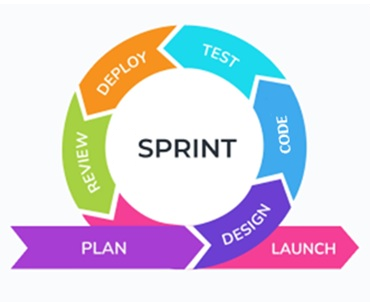
Given the above background, the most highly correlated hardware product development process can be summarized as:
- a design change that is modeled in the system model
- the redesigned part is manufactured (equivalent to coding)
- the part is tested in the finished product/system to validate the change.
Below is an annotated diagram with the applicable hardware development subprocesses.
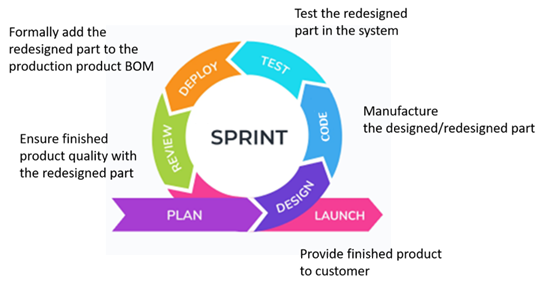
An Agile design change implementation team could perform these functions, especially with rapid design change, part manufacturing (like 3D printed parts) and readily available testing. For example, consider a daily scrum that might involve systems engineering, design, manufacturing, supply chain, test, quality and configuration management.
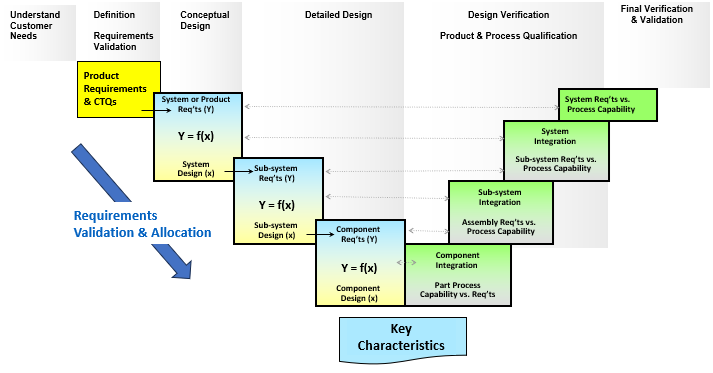
Meanwhile, there are several reasons Agile for hardware development does not apply to new complex systems, however. Recall the following V-diagram inherently lends itself to a waterfall / phase gate process.



Leave a Reply