
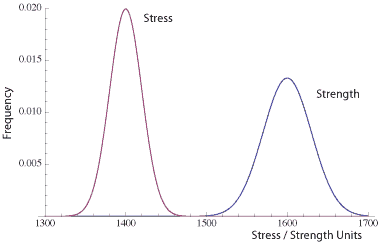
 Ideally, in every design of every component, the stress – strength relationship looks like this figure. The stress is well below the strength. [Read more…]
Your Reliability Engineering Professional Development Site
Ideally, in every design of every component, the stress – strength relationship looks like this figure. The stress is well below the strength. [Read more…]

A guest post by Andrew O’Connor, of Relken Engineering Pty Ltd
Common Cause Failures (CCF) is one of the reasons why a classical reliability model of your system may dangerously underestimate the risk of failure. It directly attacks the benefits of providing redundancy by creating a single point of failure. In fact, studies have shown that CCF events may contribute between 20% – 80% of the unavailability of safety systems within nuclear reactors [Werner 1994]. This post will “Describe this type of failure (also known as common cause mode failure) and how it affects design for reliability. (Understand)” [CRE BOK III.A.4] [Read more…]
Failure mode and effects analysis, or FMEA, is a tool for the identification and prioritization of possible ways a product or process can fail. The intent is to use that information to make improvements to the product or process.
I think of FMEA (and related processes like FMECA, dFMEA, etc.) as structured brainstorms that provide a means to focus on what’s important. [Read more…]

The reliability goal is a key element across the entire product lifecycle. From product definition to determining warranty to judging performance, knowing the goal in clear terms sets the stage for a successful product.
Reliability in engineering terms is the probability of satisfactory product performance within a defined environment over a stated duration. [Read more…]
A reliability block diagram (RBD) for a product that has no redundancy or complex use profile is often very simple. A series system (reliability wise) implies that any one part or element of the product that fails the entire product fails. One might ask if an RBD is even necessary. [Read more…]

Diverging from reliability statistics for a post or two, let’s consider one way which R(t), reliability at time, t, is useful during the design phase of a product. Apportionment is the breakdown or allocation of reliability goals or objectives to elements within the product.
Overall, the product’s reliability is just one number, and it represents what the customer will experience with the product. During design, we often work on subsystems and components. Having a meaningful way to describe the reliability requirements that also assists the team to meet the overall product goal, is, well, useful. [Read more…]

