
Quality Management Systems
Abstract
Dianna and Fred discuss the implementation and effectiveness of Quality Management Systems (QMS) and how they impact organizational performance.
ᐅ Play Episode
Your Reliability Engineering Professional Development Site
Dianna and Fred discuss the implementation and effectiveness of Quality Management Systems (QMS) and how they impact organizational performance.
ᐅ Play Episode

Dianna and Fred discuss customer service and AI: focusing on the impacts and challenges presented by the adoption of Artificial Intelligence (AI) for customer service.
ᐅ Play Episode
Big changes, clearer focus, and more ways to learn together. We’re tightening our cadence to two episodes a month and building monthly themes that travel across the podcast, blog, and a new Substack home—so you can go beyond ideas and into practice with tools, Q&A, and live community sessions.
Here’s what’s new and why it matters. The podcast keeps its familiar format, but now each month has a focused theme that carries into Substack deep dives. Subscribers get comprehensive guides, open Q&A weeks where we answer your specific questions in the comments, and a one-hour live chat each month to pressure-test methods on real scenarios. It’s a smarter learning loop: listen, explore, apply—then come back with better questions. You’ll also get access to the strategy vault filled with templates, worksheets, and facilitation guides.
We’re also thrilled to announce the launch of Pierce the Design Fog, a practical playbook for product, engineering, and UX teams who need structure without losing speed or humanity. With models like the concept space and ADEPT framework, you’ll align cross-functional teams, turn insights into actionable design inputs, and make confident calls under uncertainty. There’s a companion card deck—Concept Quest: Design Discovery—that acts like a portable facilitator, with prompts and instructions to guide workshops. Pre-order before October 14, 2025, to enter the card deck giveaway and bring these methods straight into your team’s next session.
Subscribe to the show, check out the Substack at qualityduringdesign.substack.com, and leave a review to help more builders find us.
How do you balance customer wants with project constraints? If your customer-facing teammates are saying our customers want this, that and the other thing, which ones do we prioritize over others?
Not all features are equal in the eyes of our customers. And not all features are value-added, either.
In this episode, we delve into how to prioritize customer wants using the powerful Kano Model, a tool that maps customer satisfaction against the implementation of product features.
You’ll learn how to differentiate between essential and non-essential features, ensuring that your design truly resonates with your customers. This episode walks through the intricacies of the Kano Model’s two-by-two matrix and the different satisfaction levels represented by various lines and curves.
Too complex? We break it down. Prioritize your features based on their impact to the customer using their voice. Then, consider how well you want to implement that in your design using the Kano Model.
Get ready for practical tips and proven strategies to enhance your product’s value while managing cost, time, and design trade-offs. This episode is an introduction to the Kano Model for design.
We explore the critical transition from concept development to engineering solutions in product development, highlighting quality tools that bridge the gap between customer needs and technical design inputs.

Dianna and Carl discuss team creativity techniques, especially relating to FMEA.
ᐅ Play Episode
It’s important to evaluate the customer’s use process during concept development.
Rather than focusing solely on what your product does, understanding how users will interact with it creates opportunities to design more intuitive, enjoyable experiences. By mapping out the steps users take from beginning to end using process flowcharts, development teams gain clarity on inputs, outputs, and the journey between them.
Whether you need to simplify complex steps, compare competitor approaches, or identify critical-to-quality elements, these analytical methods help prioritize design decisions based on what truly matters to users.
The goal is creating products that feel intuitive and natural, preventing those awkward validation testing moments when engineers want to shout, “You’re doing it wrong!” When we evaluate the use process early, we develop products others love while minimizing costly redesigns and user frustration.

Dianna and Carl discuss the relationship between Hazard Analysis (HA) and Failure Mode and Effects Analysis (FMEA).
ᐅ Play Episode
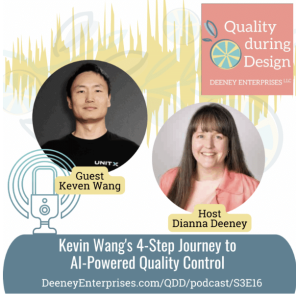 Dianna Deeney interviews Keven Wang from UnitX. Keven shared valuable insights about how AI-powered quality control is revolutionizing factories worldwide, beyond inspection. With over 160 customers benefiting from this technology, Wang’s expertise offers a glimpse into both the present capabilities and future potential of AI in manufacturing.
This interview is part of our series, “A Chat with Cross Functional Experts”. Our focus is speaking with people that are typically part of a cross-functional team within engineering projects.
Keven Wang is the Co-Founder & CEO of UnitX, a leading AI Robotics company automating visual inspection in factories. Keven graduated from Stanford University with a degree in Computer Science concentrating on AI. He has visited 135+ manufactures worldwide helping to improve yield and quality, and holds patents in AI
technology for visual inspection.
Perhaps most surprising is Kevin’s observation that the greatest challenge in AI adoption isn’t technical but human—aligning teams, establishing shared goals, and helping personnel become comfortable with the technology. This insight underscores that successful implementation requires thoughtful change management alongside technical expertise.
[Read more…]
The art of product development is fraught with challenges, but perhaps none is more heartbreaking than hearing negative customer feedback when you thought you were at the finish line.
Picture this all-too-common scenario: after months of development and seemingly thorough customer engagement throughout the process, you finally present your polished product to users only to hear crushing feedback like “I don’t like that” or “That doesn’t work for me.” These late-stage revelations often necessitate extensive redesigns, creating costly delays and team frustration.
This painful experience begs the question: how could we have missed these issues despite our efforts to involve customers along the way?

Dianna and Fred discuss what do Reliability Engineers do?
ᐅ Play Episode

Dianna and Fred discuss a common reliability engineering dilemma: do we have enough data? Is data nirvana achievable?
ᐅ Play Episode
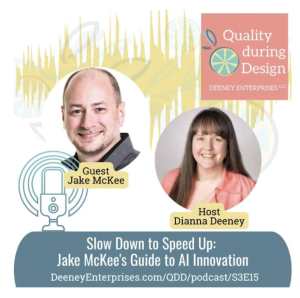 Dianna Deeney interviews Jake McKee to explore AI Experience Design (AIX), the practice of designing relationships between humans and intelligent AI systems, and how it’s reshaping product development in today’s rapidly advancing technological landscape.
In this eye-opening conversation, Jake draws a powerful parallel between today’s AI transformation and the digital transformation of the early 2000s. The key difference? Scale and speed. While the early web had natural boundaries, AI presents an almost limitless frontier advancing at breathtaking pace. This creates unique challenges for product teams caught between executive demands for AI innovation and the practical realities of implementation. Jake explains how this pressure often leads to a predictable cycle of over-reliance followed by algorithm aversion before teams eventually find balance.
Rather than viewing AI as a replacement for human capabilities, Jake advocates for seeing it as a “creative and critical partner” that enhances our thinking and processes. He shares practical examples of how product teams can thoughtfully integrate AI – from using it to test early concepts against customer data to employing it as a collaborative ideation tool. Throughout our discussion, Jake emphasizes that successful AI integration depends on maintaining human relationships at the center of product development, not pushing customers further away behind technological barriers.
This interview is part of our series, “A Chat with Cross Functional Experts”. Our focus is speaking with people that are typically part of a cross-functional team within engineering projects. We discuss their viewpoints and perspectives regarding new products, the values they bring to new product development, and how they’re involved and work with product design engineering teammates. [Read more…]
In product development, we often get caught up in the technical specifications and features we’re creating, forgetting the fundamental reason we’re building products in the first place: to provide benefits that improve users’ lives. This foundational concept of benefits versus features deserves revisiting regularly, especially when we’re deep in the weeds of development work.
 In product development, the “fuzzy front end” of concept development often represents both tremendous opportunity and significant challenge. During this critical phase, teams are tasked with defining problems, understanding customers, and generating solutions—all before any engineering begins.
How we navigate this phase dramatically impacts bottom-line results, market share, customer satisfaction, and whether projects even launch at all.
What makes concept development particularly difficult is that teams typically lack something concrete to discuss. Without prototypes or developed products, conversations can become abstract and unfocused. This challenge is compounded when cross-functional team members approach problems from vastly different perspectives, sometimes unknowingly working to solve entirely different issues altogether.
The traditional approach of gathering everyone in a room for open brainstorming sessions has proven remarkably ineffective. Research confirms what many of us have experienced: teams engaged in unstructured brainstorming typically generate fewer ideas, and those ideas are often of lower quality compared to more structured approaches.
The solution lies in using visual models and templates—structured frameworks that guide the creative process and facilitate meaningful team collaboration.
