
In Part 3 of Beyond the Numbers, I explored how Human Factors can strengthen Reliability Centred Maintenance (RCM) by challenging the assumptions that sit beneath maintenance decisions. RCM may identify an inspection, functional test, condition-monitoring activity, restoration or replacement as the appropriate response to a failure mode. Selecting an appropriate maintenance policy, however, is only part of the challenge.
That requirement must still be translated into work that people can perform.
This is where Maintenance Task Analysis (MTA) becomes important. MTA provides the practical link between a maintenance requirement and the support solution needed to deliver it. But a task can be technically justified and fully documented while still being difficult to perform reliably because of restricted access, ambiguous information, competing demands or the conditions in which the work takes place.
Part 3 asked:
What maintenance should be performed to control failure risk?
This article takes the next step:
Can that maintenance be performed safely, correctly and consistently by real people in real conditions?
What Maintenance Task Analysis Provides
Maintenance Task Analysis develops a maintenance requirement into a defined and supportable activity. It covers preventive and corrective maintenance, recognising that a scheduled inspection or servicing task creates different demands from fault diagnosis, repair and restoration following failure.
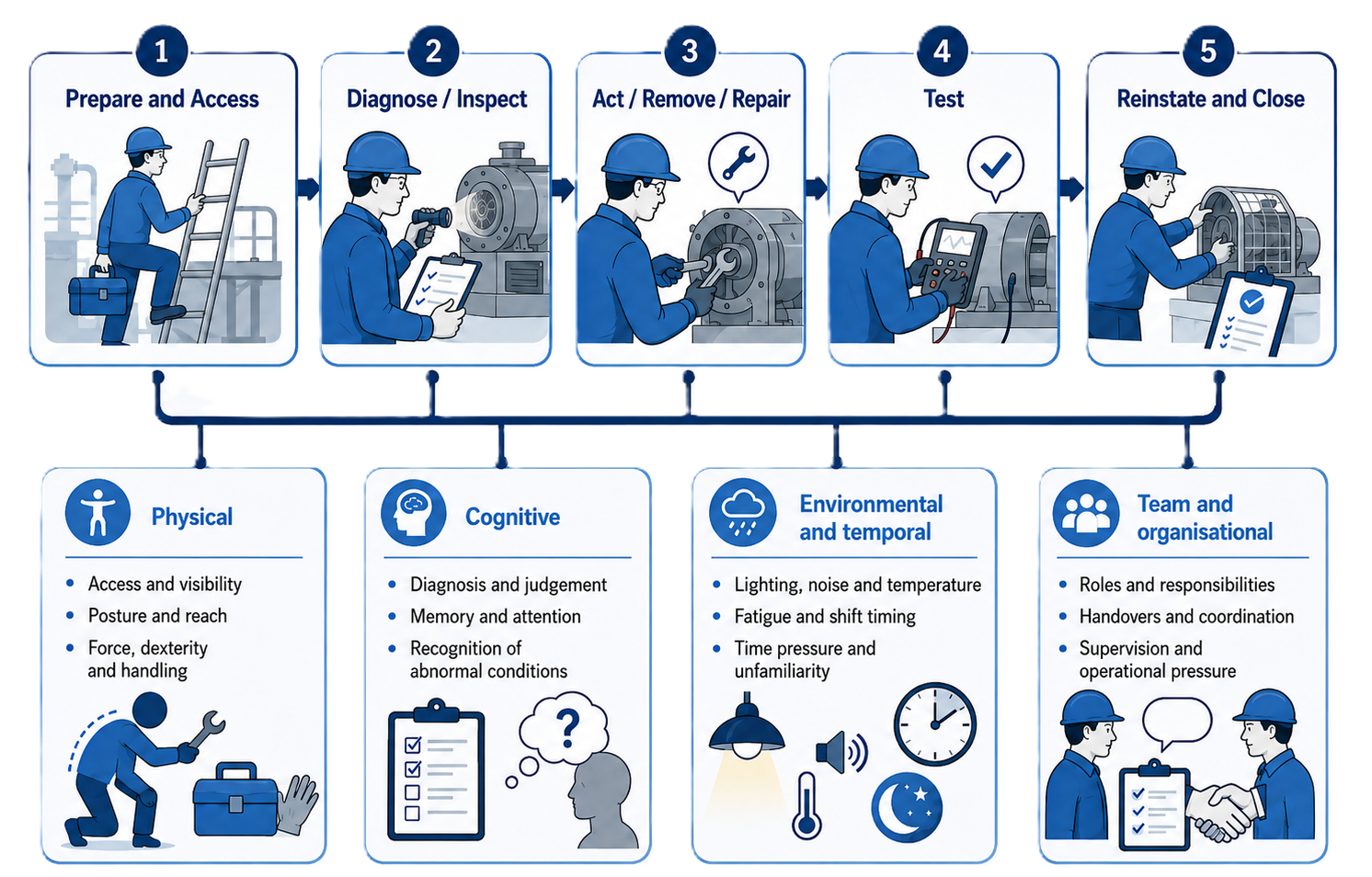
For each task, MTA considers the sequence of work from preparation and access through inspection or fault isolation, removal, replacement or repair, functional testing, reinstatement and close-out. It defines the time and effort involved, the appropriate maintenance level, and the number, skills and competencies of the people required.
The analysis also identifies the tools and test equipment, spares and consumables, facilities, technical information and other resources needed to enable the task. It draws on Reliability and Maintainability analysis, FMECA and RCM to understand what must be addressed, while Level of Repair Analysis helps determine where the work should be undertaken. The resulting task data feeds the wider support solution, including manpower, training, supply support, infrastructure and technical publications.
These outputs may describe a complete task, but completeness does not necessarily demonstrate reliable execution.
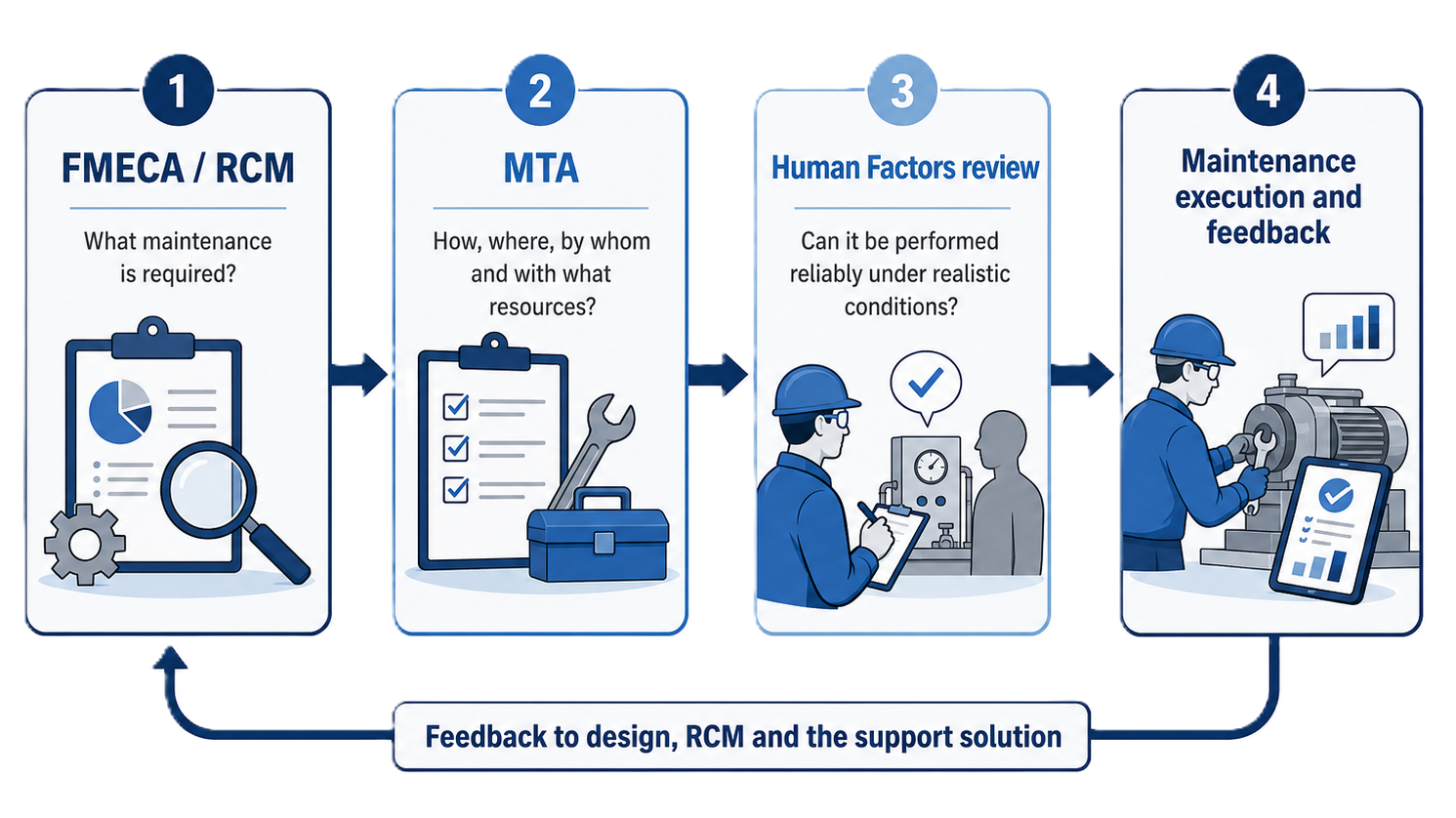
The relationship between reliability analysis, task definition and maintenance execution can be viewed as a connected and iterative process. FMECA and RCM help determine what maintenance is required, while MTA translates that requirement into a defined task and the resources needed to perform it. A Human Factors review then tests whether those arrangements remain realistic under the conditions in which the work will actually take place, with operational feedback informing future changes to the design, maintenance policy and wider support solution.
A Task Description Is Not Necessarily a Task Design
A populated MTA can appear complete while still containing optimistic assumptions about how the work will be performed.
It may assume that access will be unobstructed, the correct component readily identifiable and the required tools, spares and information available at the point of need. Fault indications may be treated as unambiguous even where diagnosis depends on judgement. The task may also assume uninterrupted work, good lighting, reasonable temperatures and a shared understanding of equipment status and acceptance criteria.
Finally, it may assume that once the maintenance action is complete, the system will be correctly reassembled, reconfigured, tested and returned to service.
These are not minor details. UK Health and Safety Executive guidance identifies recurring problems such as incorrect reassembly, wrong replacement items, omitted steps, incorrect settings, incomplete recommissioning and materials left in equipment. Such outcomes are often foreseeable and manageable through maintainability, task design, procedures, resources and communication.
This reinforces the distinction made in Part 3: the existence of a maintenance task does not guarantee that it will reliably control risk. A task may be technically valid and fully documented, yet remain vulnerable because the conditions required for successful execution have not been examined.
The purpose of Human Factors within MTA is therefore not simply to add more detail. It is to challenge the assumptions hidden within that detail and ask whether the task has been designed around the realities of maintenance work rather than an idealised version of how the work is expected to happen.
Understanding Work as Actually Performed
Maintenance plans, procedures and MTA records describe how work is expected to be performed. They represent work as imagined: the intended sequence, resources, timings and controls defined during analysis and planning. The real task may look different.
Understanding work as actually performed requires more than reviewing documentation. It means observing representative maintainers, walking and talking through the task, and examining how the work is completed using the actual equipment, access route, tools, PPE and technical information. This can expose practical demands and dependencies that are difficult to recognise from a task description alone.
Experienced maintainers are essential contributors because they understand how equipment behaves in service and where tasks become difficult. However, familiarity can also hide problems. Someone who has performed a task many times may automatically compensate for poor access or an awkward sequence without recognising the difficulty for a less experienced person.
Walkthroughs should therefore test more than ideal workshop conditions. They should consider the task during normal operation and, where relevant, under degraded, interrupted or time-pressured conditions. They should also explore whether unofficial adaptations or workarounds have developed.
A workaround is not automatically evidence of poor discipline. It may indicate that the formal task, equipment or support arrangements do not reflect operational reality. The aim is not to copy informal practice without question, but to understand why the adaptation exists, what problem it solves and whether the maintenance system should change.
Looking Beyond the Physical Task
Maintenance is often considered primarily in physical terms: can the maintainer reach the equipment, remove the item and complete the work safely? These questions remain essential, but they represent only part of the task. A practical Human Factors review can consider four connected lenses.
A maintenance task can be viewed as a sequence of connected activities, from preparation and access through diagnosis, action, testing and final reinstatement. At every stage, reliable performance depends not only on the technical procedure, but also on the physical, cognitive, environmental and organisational conditions surrounding the work.
Physical and biomechanical demands
Access may technically be possible while still requiring awkward posture, excessive reach, poor visibility or sustained force. Tool clearance may disappear once gloves or other PPE are worn, while component weight or shape may make removal and refitting difficult even when it falls within a nominal handling limit.
Repeated movements, prolonged kneeling, overhead work or sustained grip can increase fatigue and reduce precision. MTA should therefore consider a realistic maintainer population with a range of size, strength, dexterity and experience, rather than an idealised individual.
Cognitive and perceptual demands
Maintenance also involves diagnosis, interpretation and judgement. Fault isolation may require maintainers to combine system indications, test results, historical information and experience before deciding what action to take.
The clarity of indications and acceptance criteria is therefore critical. Similar components or connectors can increase incorrect selection. Steps completed out of sight may rely unnecessarily on memory, while interruptions can disrupt a complex sequence. Inspection tasks may appear straightforward but often depend on recognising an abnormal or borderline condition. MTA should make these decision points and information needs visible.
Environmental and temporal conditions
Lighting, noise, vibration, temperature extremes and confined, exposed or contaminated spaces can increase both physical and cognitive demand. Time also matters. Tasks undertaken late in a shift, during night working or after prolonged activity may be affected by fatigue, while infrequent tasks may be unfamiliar even to competent personnel.
Short maintenance windows, competing work and operational urgency can create pressure to compress checks or depart from the intended sequence. A task developed for calm workshop conditions may be far less reliable when performed in a deployed, exposed or time-critical environment.
Team and organisational demands
Many maintenance tasks depend on more than one person, trade or organisation. Reliable execution requires clear roles, effective coordination and a shared understanding of equipment status. Handovers between shifts, teams or contractors can create gaps in knowledge or responsibility, while simultaneous actions may require careful sequencing.
Supervision, technical advice and escalation routes matter when work does not proceed as expected. Independent verification is only effective when the checker can genuinely challenge the work and understands what must be confirmed. Organisational boundaries and operational pressure may also influence decisions in ways not visible in the task record.
Maintenance reliability does not arise from maintainer competence alone. It emerges from the interaction between people, the task, the equipment, the environment and the organisation as one maintenance system.
Designing for Prevention, Detection and Recovery
A common response to maintenance error is to add more training, reinforce compliance or introduce another procedural warning. Training is important, but it cannot compensate indefinitely for a task that is unnecessarily difficult, ambiguous or vulnerable to error.
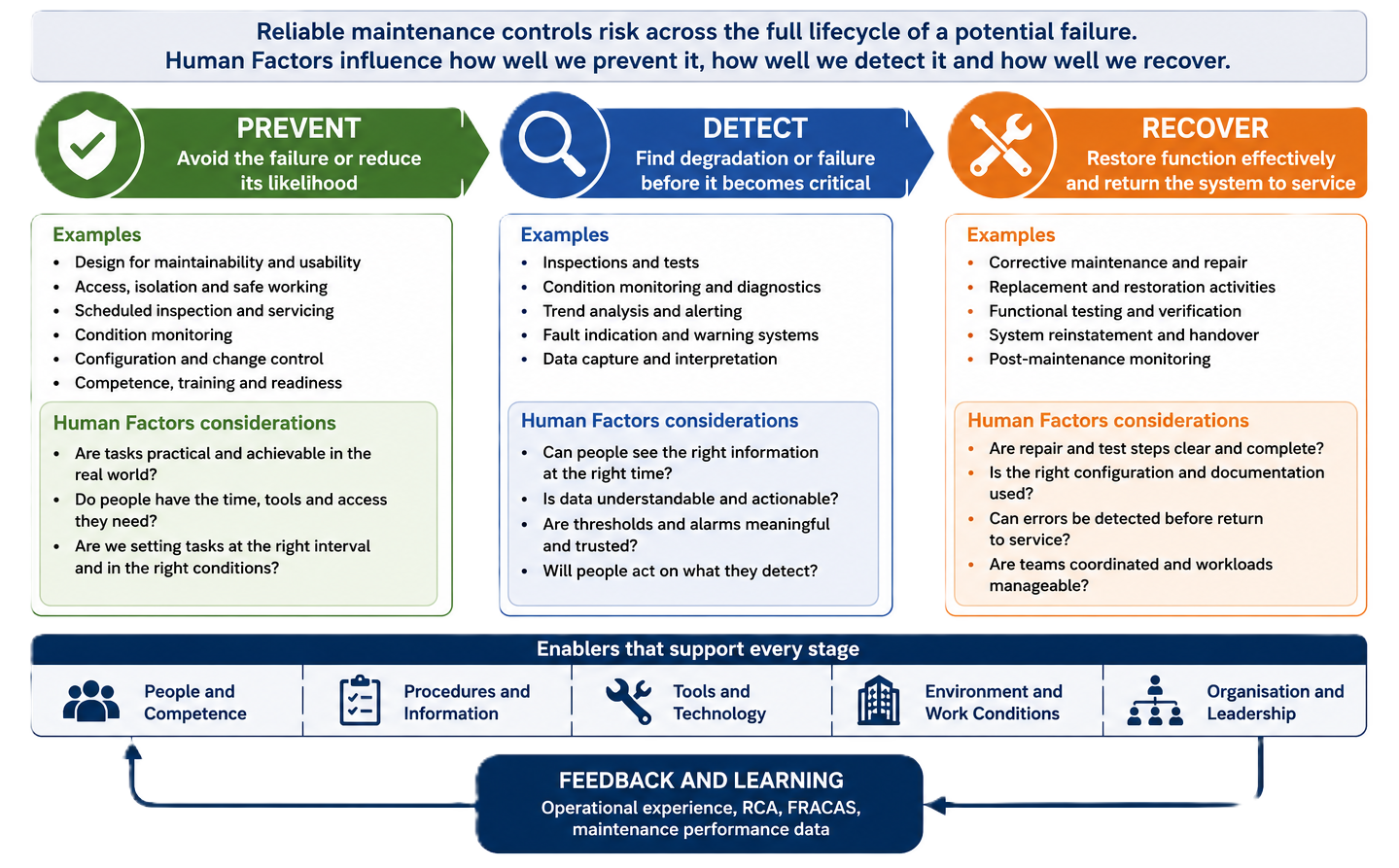
A stronger approach is to design the task and support arrangements so that errors are difficult to make, deviations are likely to be detected and recovery remains possible before the equipment is returned to service.
A resilient maintenance task should not depend on every action being performed perfectly. Instead, the task, equipment and support arrangements should work together to prevent errors where possible, detect deviations before they become consequential, and enable recovery before the system is returned to service.
Make errors difficult to make
The most effective control is often to remove the opportunity for error through design. Keyed or physically differentiated connections can prevent incorrect assembly, while clear and durable identification helps maintainers select the correct component, control or test point. Improved access, visibility and tool clearance reduce the need for awkward compensating actions. Standardised tools and layouts, logical sequencing and the elimination of unnecessary disturbance can reduce complexity and variation.
Make deviations easier to detect
Not every error can be prevented, so the task should make incorrect actions or incomplete work visible. This may include clear, measurable acceptance criteria; recording of torque values, configuration states or test results; component and configuration verification; tool and foreign-object control; and defined hold points before close-up.
Independent checks can be valuable for critical actions, but only where genuinely justified and designed to avoid becoming a routine signature exercise
Make recovery possible before release
Testing should demonstrate that the required function has actually been restored rather than simply confirming that a task step was completed. The response to a failed test should be clear, with access retained until critical checks are complete and escalation routes available when results are unexpected. Where practicable, actions should be reversible and the consequences of incorrect assembly or configuration contained by design.
This can be thought of as maintenance task resilience: not assuming perfect performance, but designing the task so that normal variability does not readily become system failure, unsafe release or loss of operational capability.
MTA as an Input to Design and the Support Solution
Human Factors findings from MTA should influence more than the individual task record. They provide evidence for decisions about equipment layout, accessibility and maintainability, as well as the technical publications or interactive instructions needed to guide the work.
They should also inform tools and support equipment, manpower and team composition, competence requirements and Training Needs Analysis, facilities and environmental controls, spares and handling arrangements, maintenance information systems, and decisions about maintenance level and repair location.
However, this relationship should not be one-way. MTA should not simply accept a difficult design and compensate by adding more people, more tools, longer procedures or additional training. Those responses may increase cost and complexity without addressing the underlying weakness.
Where a task remains unnecessarily demanding, difficult to verify or vulnerable to error, the appropriate output may be a change to the equipment, access arrangements, support concept or maintenance location. In this way, MTA supports an iterative Supportability Analysis process: identifying resources, influencing design and helping optimise the through-life support solution rather than merely documenting its consequences.
The strongest MTA output is therefore not always a more detailed task. Sometimes it is evidence that the task, design or support solution should be changed.
A Proportionate Human Factors Overlay for MTA
Integrating Human Factors into MTA does not require a separate methodology for every task. In many cases, a proportionate review can be built into the existing process using a small number of practical questions:
- Have we observed, or realistically walked through, how the task is or will be performed?
- Are the physical, cognitive and environmental demands credible for the intended maintainer population?
- Are decision points, handovers, checks and restoration activities explicit?
- What conditions could make an incorrect action, omission or misinterpretation more likely?
- How would a deviation be detected before the equipment is returned to service?
- Does the finding require a change to the design, task sequence, tools, procedure, environment, staffing or competence requirements?
For routine tasks with limited consequences, this level of challenge may be sufficient. More complex, unfamiliar or safety-critical tasks may justify structured walkthroughs, usability trials using the actual equipment and technical information, cognitive task analysis, human-error analysis or more formal Human Reliability Analysis.
The level of effort should reflect the consequences of failure, task complexity, novelty, uncertainty and dependence on human judgement. Not every task needs specialist analysis, but critical assumptions should not remain unexamined simply because the MTA record appears complete.
This follows the principle established earlier in the series: incremental integration rather than reinvention. The objective is proportionate assurance that the task can be performed reliably, not the routine creation of additional documentation.
Closing Reflection
A maintenance task is not reliable simply because it has been documented, resourced and placed in a maintenance schedule. It becomes reliable when the task, equipment and working conditions support correct performance, make deviations visible and allow recovery before the system is returned to service.
RCM tells us what maintenance should be performed. MTA tells us how it will be performed. Human Factors helps ensure that this can be achieved by real people, in real conditions, throughout the life of the system.
Even well-designed tasks must continue to learn from operational experience. Procedures, tools, equipment configurations and working conditions change, while maintainers often identify weaknesses that were not visible during initial analysis.
The next challenge is therefore ensuring that, when maintenance does not go as planned, organisations look beyond the label of ‘maintainer error’ and examine the wider system that shaped the outcome. This is where effective feedback, DRACAS and Root Cause Analysis become essential to sustaining and improving maintenance reliability.



Leave a Reply