
Maximum Likelihood Estimation (MLE) is a statistical technique used to estimate the parameters of a model by maximizing the likelihood function, which measures how likely the observed data is under specific parameter values.
The concept was formalized by Sir Ronald Aylmer Fisher between 1912 and 1922, marking a significant breakthrough in statistics. Fisher introduced key ideas such as sufficiency, efficiency, and information, which are central to MLE. Although early ideas about likelihood estimation date back to the 18th century with contributions from Bernoulli and Laplace, Fisher’s work established MLE as a systematic and widely applicable method.
MLE is highly dependent on sample size. Its properties—such as consistency (the ability to converge to true values) and asymptotic normality—are more reliable with larger datasets. For smaller samples, alternative methods like Bayesian inference or regularization may be preferred. MLE typically uses numerical optimization methods rather than automatic differentiation, though modern software tools can incorporate advanced techniques to streamline calculations.
In reliability engineering, MLE is widely used for estimating parameters in failure-time distributions such as Weibull or exponential models. Tools like ReliaSoft’s Weibull++, JMP, and open-source applications such as SFRAT are commonly employed for this purpose. These tools help engineers predict system reliability, assess readiness for deployment, and optimize maintenance schedules by fitting models to observed failure data.
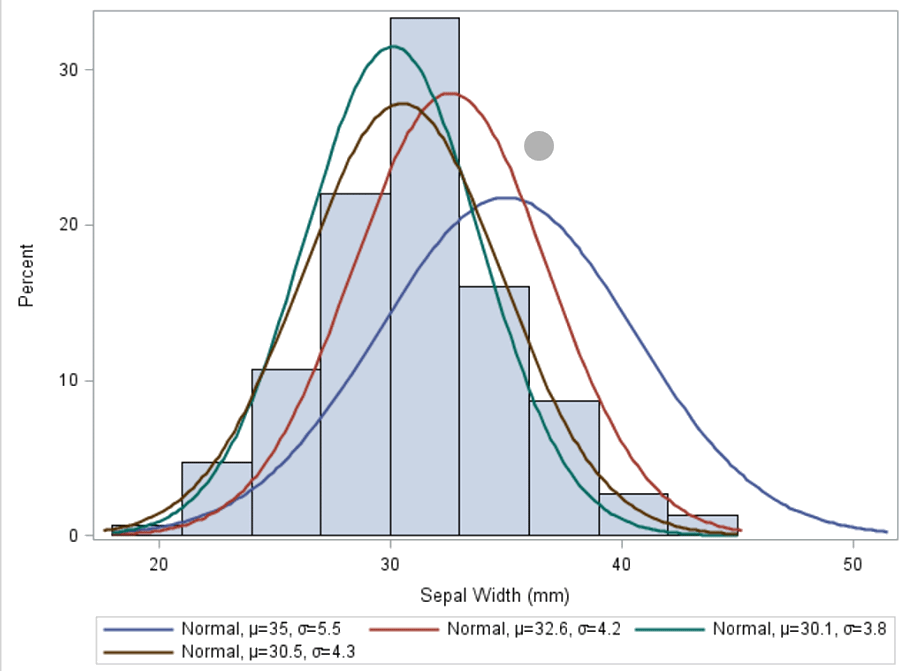
Suppose an engineer wants to estimate the failure rate of a component based on observed failure times. Using MLE, they would fit an exponential (this need to be chose by observed data, it can be Normal, Exp, Weibull et distribution to the data by maximizing the likelihood function. This process provides an estimate for the failure rate that best explains the observed failures and can be used to predict future reliability metrics.
Overall, MLE is a powerful tool for parameter estimation in statistical modeling. It is particularly useful when working with large datasets and provides a systematic approach to fitting models to observed data.



Leave a Reply