A component-level Weibull reliability analysis of the AirPods Pro 2, and a hard look at whether the $29 extended warranty is protection or a profit centre.
I normally write a lot about asset management within the heavy industrial space, but a recent “domestic” applicance failure made me think about the economics and failure characteristics of everyday products- a little off subject, but defintiely on-topic!
My AirPods Pro 2 failed exactly one month after the standard warranty expired. The left earbud’s battery had degraded to the point where it would die within 45 minutes, rendering a $249 product functionally useless. Rather than just buying a new pair, I did what any reliability engineer would: I modelled the failure.
This blog is a component-level Weibull reliability analysis of the AirPods Pro 2nd Generation. I based thiss blog off a paper I wrote and posted to LinkedIn a few months ago.
Six critical failure modes are identified through FMEA, assigned Weibull parameters based on published degradation data and physics-of-failure reasoning, and combined through a series system model. The model is then reconciled with Apple’s disclosed warranty financials and used to answer two questions: what does the failure risk profile actually look like, and is AppleCare+ worth the $29? (my gut feeling tells me no of course, but I’m a pessimist).
Thirteen months
That is how long my AirPods lasted before the left earbud’s battery life dropped below 45 minutes, one month after Apple’s standard warranty expired. The timing felt suspicious. Was I unlucky, or is this a predictable outcome of the design?
AirPods are a unique case study in failure analysis. They sit directly in the ear canal, exposed to earwax, perspiration, body heat and ambient moisture every day. They are charged once or twice daily through tiny pogo-pin contacts. They contain lithium-ion cells so small, roughly 50 mAh per bud, that cycle degradation is measurably faster than in any other Apple product.
These constraints produce an unusually aggressive reliability profile. With battery characteristic lives of 5 to 6 years and a Weibull shape parameter of β = 3.0, AirPods show pronounced wear-out behaviour. The system hazard rate is not flat; it accelerates sharply after the first year, more than quadrupling by year three. My failure at month 13 sits right on the knee of that curve.
Failure mode and effects analysis
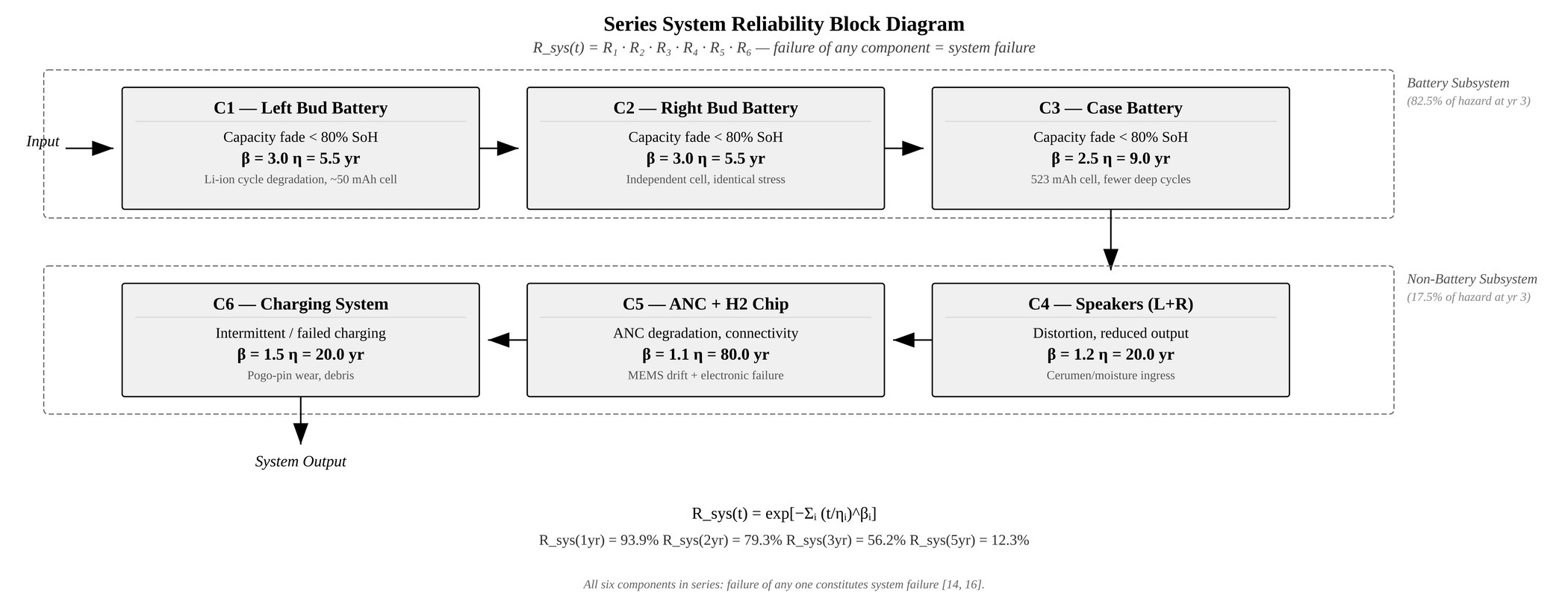
The AirPods Pro 2 consists of three physical units: left earbud, right earbud, and charging case. Failure of any single unit constitutes system failure from the user’s perspective. A dead left bud renders the product unusable even if the right bud and case are perfect. This is a classic series reliability model.
Within that architecture, I identified six independent failure modes as the primary contributors to system unreliability. Each is assigned a Weibull shape parameter (β) and characteristic life (η) based on the physics of the failure mechanism.
| ID | Component | Failure mode | β | η (yr) | Basis |
|---|---|---|---|---|---|
| C1 | Left bud battery | Capacity < 80% | 3.0 | 5.5 | Li-ion cycle degradation, ~365 cycles/yr on 50 mAh cell |
| C2 | Right bud battery | Capacity < 80% | 3.0 | 5.5 | Independent cell, identical stress profile |
| C3 | Case battery | Capacity < 80% | 2.5 | 9.0 | Larger 523 mAh cell, fewer deep cycles |
| C4 | Speakers & drivers | Distortion, low output | 1.2 | 20.0 | Diaphragm fatigue, cerumen/moisture ingress |
| C5 | ANC mics + H2 chip | ANC drift, connectivity | 1.1 | 80.0 | MEMS mic drift, electronic random failure |
| C6 | Charging system | Failed charging | 1.5 | 20.0 | Pogo-pin wear, debris, hinge fatigue |
A note on provenance. No published source reports Weibull parameters for AirPods-class true-wireless components at the subsystem level. The values above are my own engineering estimates, not field-failure statistics. Each was constructed by synthesising published Li-ion degradation data, Weibull fitting studies on commercial cells, MEMS reliability literature, connector fatigue data, reliability standards, and iFixit teardown evidence. As a consistency check, the model’s system-level output is reconciled with Apple’s disclosed warranty financials further down. That check confirms the parameter set produces behaviour consistent with the financial data given a plausible reporting rate, but it does not independently validate the individual parameters.
Why these parameters
Batteries (C1, C2, C3). Lithium-ion capacity fade follows a well-characterised degradation curve modelled accurately by a Weibull distribution with β > 2. Studies fitting Weibull distributions to commercial pouch cells consistently find shape parameters above 2 for capacity-based failure definitions. The β = 3.0 adopted for the bud batteries reflects accelerating degradation after 300 to 500 charge cycles as lithium plating, SEI layer growth and electrolyte decomposition compound. The characteristic life η = 5.5 years comes from the ~50 mAh cell at roughly one full cycle per day, yielding about 2,000 cycles to reach 80% capacity. The case battery uses β = 2.5 and η = 9.0 years because its larger 523 mAh cell undergoes fewer and shallower cycles and runs cooler than the buds, which are heated by the ear canal.
Speakers & drivers (C4). β = 1.2 and η = 20 years. The low shape parameter reflects failures driven primarily by environmental ingress (earwax, moisture) that is somewhat random in timing but accumulates over years, consistent with the mild wear-out characterisation for contamination-driven failure modes.
ANC microphones + electronics (C5). β = 1.1 and η = 80 years. This represents the near-random failure behaviour of mature semiconductors and MEMS sensors. The H2 chip, as a mature CMOS device, has no significant wear-out mechanism within a 5 to 10 year horizon. The silicon will outlast the product by more than a decade.
Charging system (C6). β = 1.5 and η = 20 years. Pogo pins and gold-plated contacts undergo mechanical stress at every insertion; debris progressively degrades contact quality, and the hinge has a finite fatigue life. This represents a moderately increasing hazard rate.
System reliability
Each component’s reliability at time t is the Weibull survival function Ri(t) = exp[−(t/ηi)βi]. For a series system, the system reliability is the product of the component reliabilities.
| Component | Year 1 | Year 2 | Year 3 | Year 4 | Year 5 |
|---|---|---|---|---|---|
| C1 L bud battery | 0.994 | 0.953 | 0.850 | 0.681 | 0.472 |
| C2 R bud battery | 0.994 | 0.953 | 0.850 | 0.681 | 0.472 |
| C3 Case battery | 0.996 | 0.977 | 0.938 | 0.877 | 0.795 |
| C4 Speakers | 0.973 | 0.939 | 0.902 | 0.865 | 0.827 |
| C5 ANC + H2 | 0.992 | 0.983 | 0.973 | 0.964 | 0.954 |
| C6 Charging | 0.989 | 0.969 | 0.944 | 0.914 | 0.883 |
| R (system) | 0.939 | 0.793 | 0.562 | 0.310 | 0.123 |
| F (cumulative) | 6.1% | 20.7% | 43.8% | 69.0% | 87.7% |
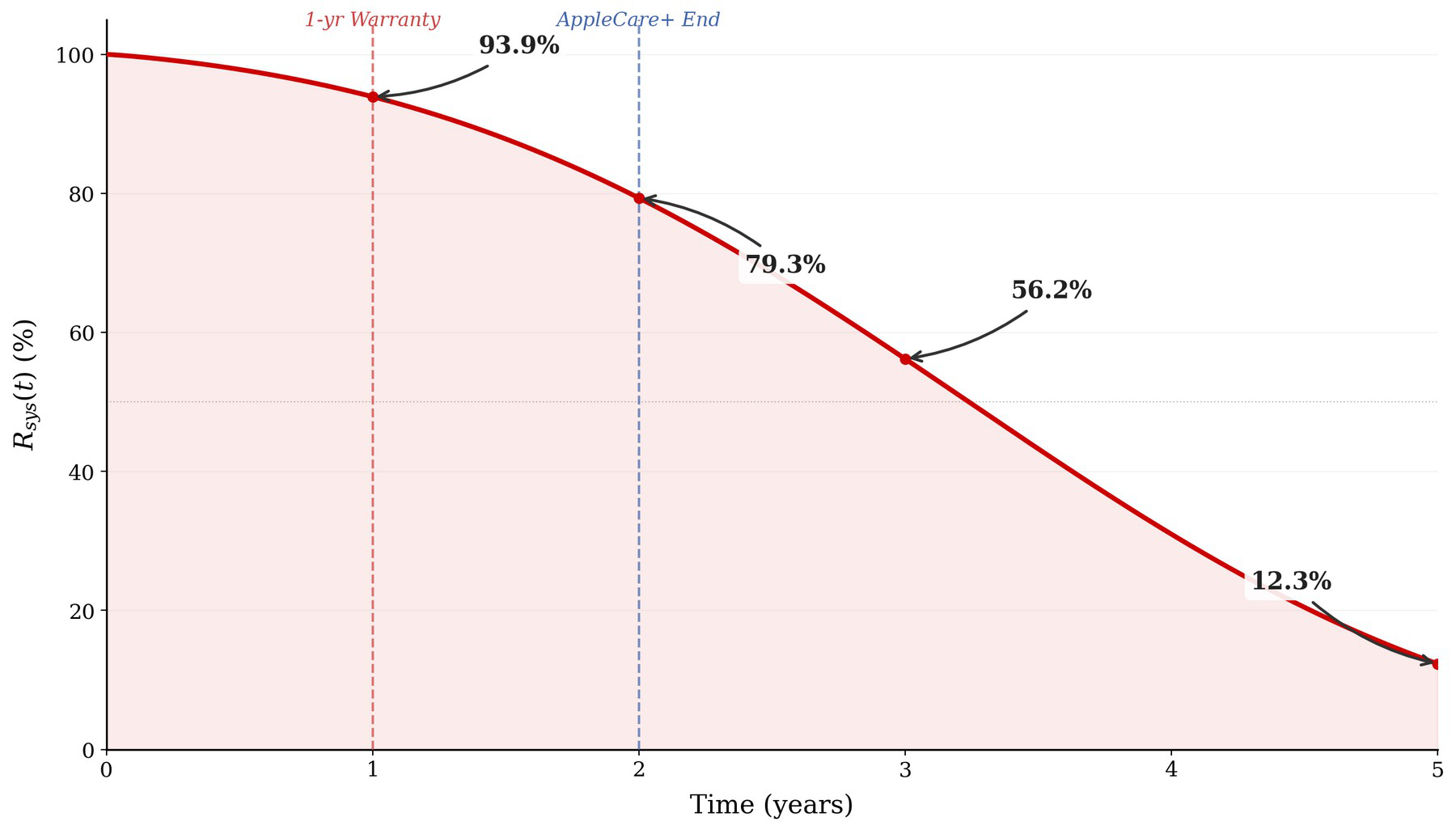
The curve reveals a dramatic decline. At one year, 93.9% of AirPods are still functioning within specification, which means my failure at month 13 placed me among the unluckiest 6%. By year two, reliability drops to 79.3%. By year three, only 56.2% remain functional, a coin flip. By year five, fewer than one in eight units are operating at original specification.
Where the failures come from
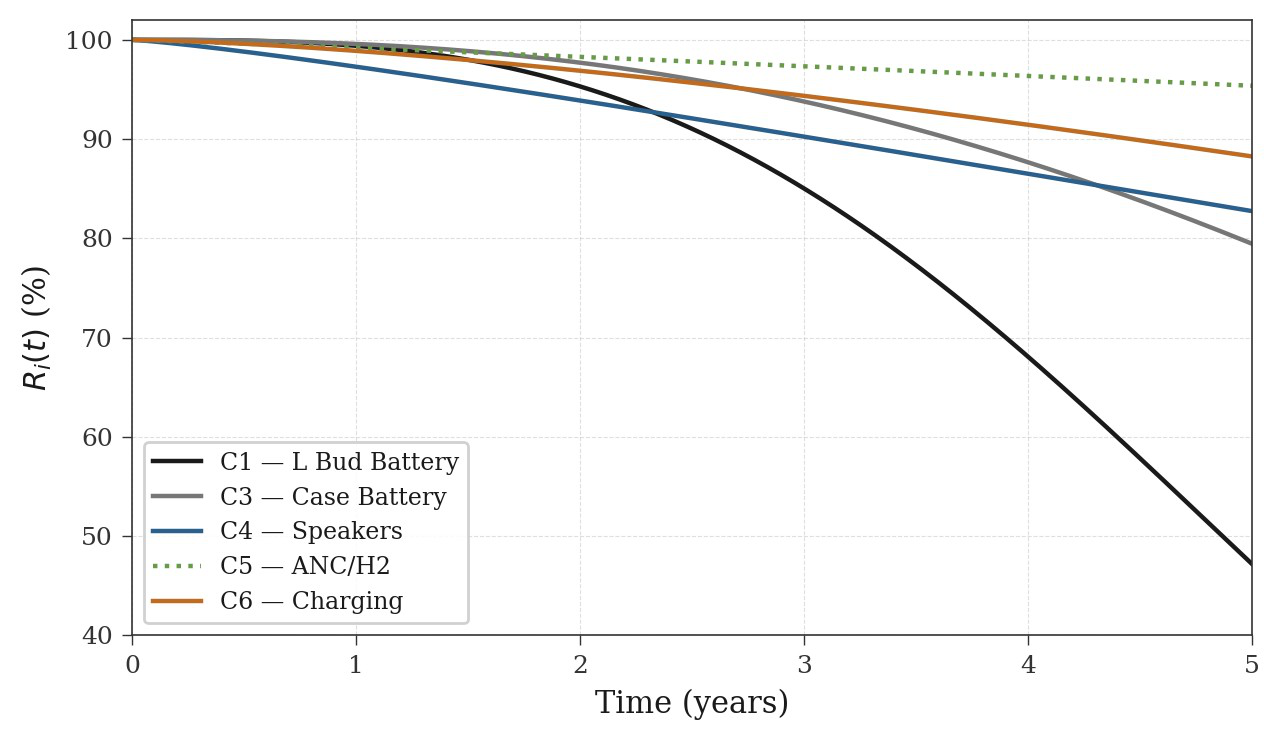
The system hazard rate, the sum of the component hazard rates, reveals both the magnitude and the source of the failure acceleration.
| Component | Year 1 | Year 2 | Year 3 | % of total (Yr 3) |
|---|---|---|---|---|
| C1 L bud battery | 1.80 | 7.21 | 16.23 | 35.4% |
| C2 R bud battery | 1.80 | 7.21 | 16.23 | 35.4% |
| C3 Case battery | 1.03 | 2.91 | 5.35 | 11.7% |
| C4 Speakers | 3.30 | 3.79 | 4.11 | 9.0% |
| C5 ANC + H2 | 0.89 | 0.95 | 0.99 | 2.2% |
| C6 Charging | 1.68 | 2.37 | 2.91 | 6.3% |
| System total | 10.50 | 24.44 | 45.80 | 100% |
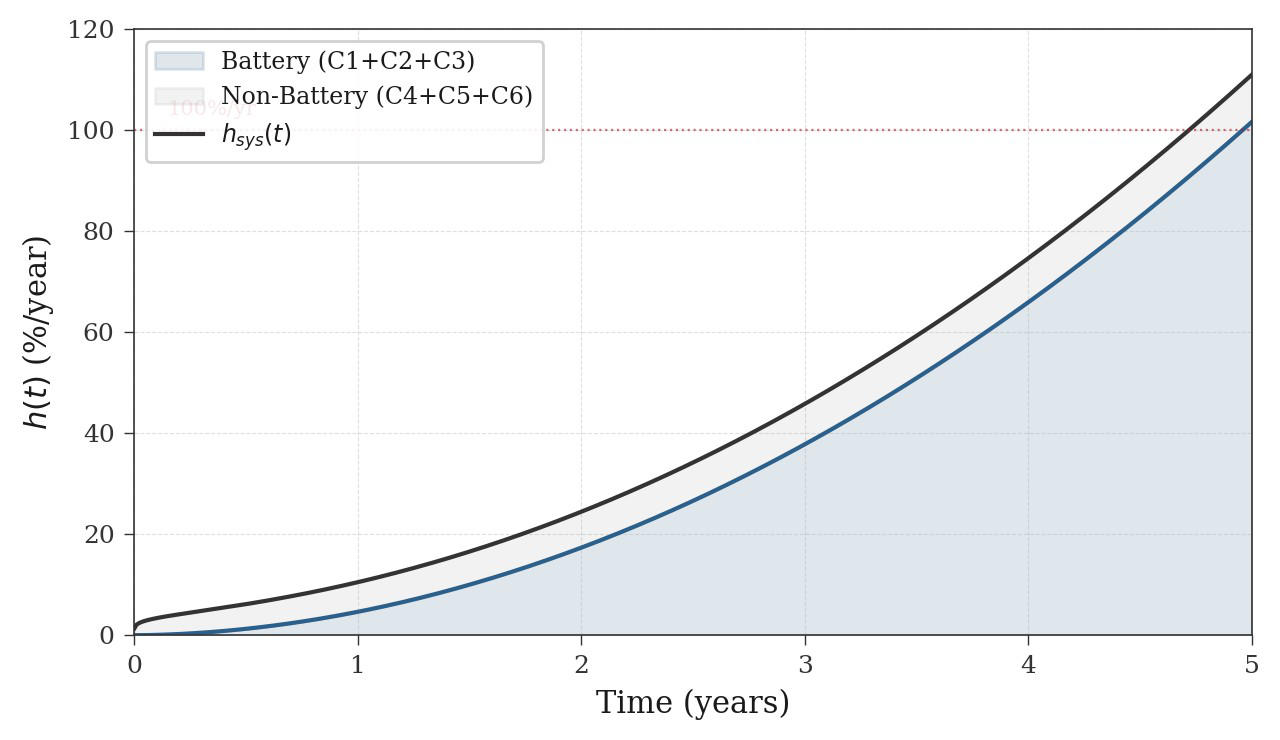
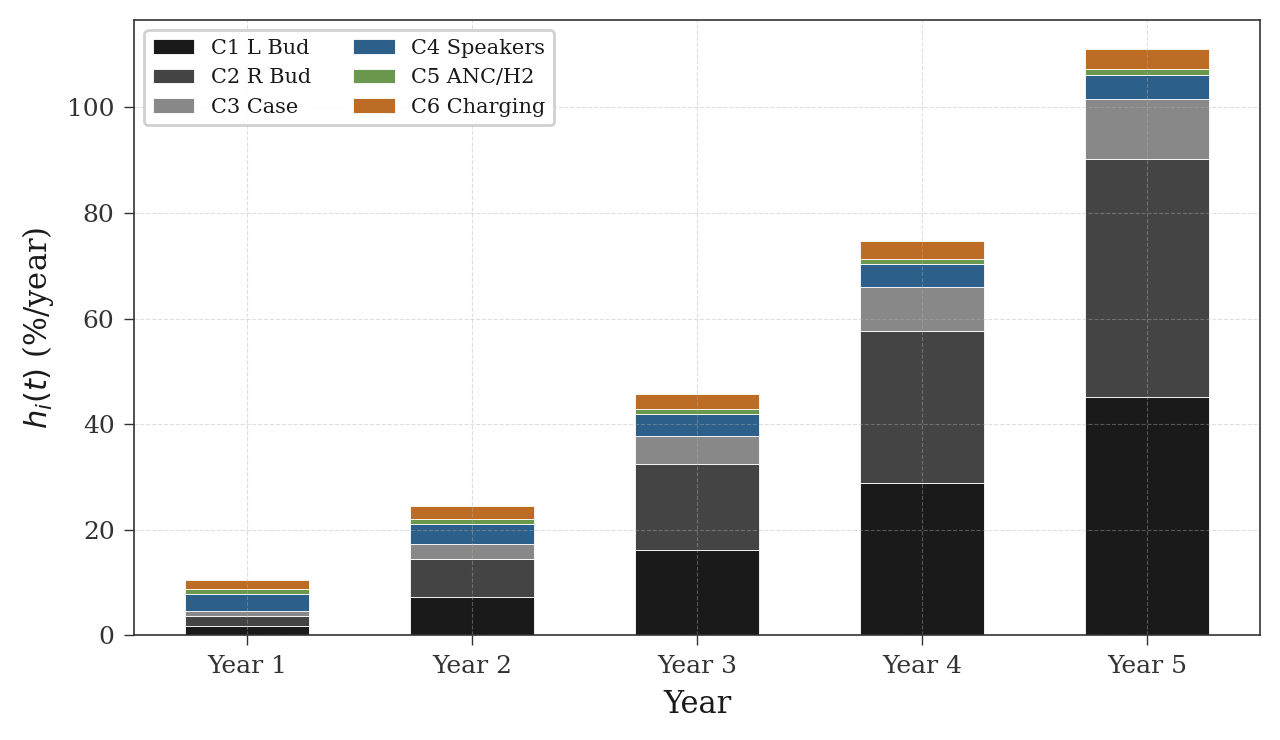
Three observations emerge.
The hazard rate quadruples. The system hazard accelerates from 10.5%/year at year one to 45.8%/year at year three, a factor of 4.4. AirPods are not on the flat part of the bathtub curve; they are firmly on the wear-out slope.
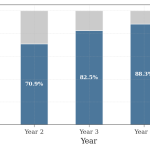
Batteries dominate. At year one, batteries contribute 44.2% of total system hazard. By year two, 70.9%. By year three, 82.5%. The bud batteries alone account for 70.9% at year three. Every other failure mode is secondary.
The electronics are irrelevant. The ANC/H2 chip contributes less than 1%/year of hazard at every time point. With β = 1.1 and η = 80 years, it will outlast the product by more than a decade. The silicon is not the problem. The chemistry is.
Why Apple’s warranty stops at 12 months
The warranty period solve determines the maximum duration a manufacturer can offer free cover without exceeding a target reliability threshold.
| Reliability threshold | Warranty period | Assessment |
|---|---|---|
| 97.0% | 7.5 months | Below Apple’s 12-month warranty |
| 95.0% | 10.6 months | Marginal for 12 months |
| 90.0% | 16.1 months | Supports 12 months with margin |
At the industry-standard 97% threshold, the model supports a warranty of only 7.5 months, well short of Apple’s actual 12 months. Apple’s one-year warranty corresponds to 93.9% system reliability, which means Apple accepts roughly a 6% failure rate within the warranty period. My AirPods dying at month 13 was right on the edge.
So why offer 12 months despite a 6% predicted failure rate? Three things reconcile it. First, not all predicted failures generate claims: the financial reconciliation below implies a claims reporting rate around 42%, so only about 2.6% of units are actually replaced. Second, many early “failures” in the model are below the user’s perception threshold at 12 months; a 5% capacity loss is measurable but not noticeable. Third, the internal replacement cost is low (about $55), so even a 2.6% claims rate is under 1% of revenue.
Reconciling the model with Apple’s financials
A reliability model is only as credible as its empirical anchoring. The model predicts a 6.09% failure rate at 12 months, yet Apple’s company-wide warranty expense is only 0.90% of product revenue. The two numbers cannot be compared directly: the model predicts technical failures, while Apple reports financial cost. But they can be approximately reconciled.
Working backwards from a target warranty cost of 0.90% of the blended AirPods ASP ($170), against a 6.09% predicted failure rate and a $55 internal replacement cost, gives an implied claims reporting rate of about 46%. I adopt α = 42%, rounded conservatively.
Transparency note. This reporting rate is not independently measured. The derivation is, in effect, circular: the model has one free parameter, Apple’s data provides one equation, and the parameter is solved to make them match. It is a calibration, not an independent validation. The 0.90% figure is also a company-wide blend across all Apple hardware; no AirPods-specific figure is public. If AirPods’ true warranty cost differs from the blend, the implied rate shifts: at 1.5% of revenue it rises to ~75%, at 0.5% it falls to ~23%. A 42% rate means roughly three in five predicted failures do not generate a claim within the warranty window, which is plausible: early battery degradation is often imperceptible, many users blame software, and the friction of a service visit deters marginal claims. The model’s value lies in the shape of the curve and the dominance of battery degradation, both of which are insensitive to the exact rate.
| Metric | Value |
|---|---|
| Annual units sold (all variants) | 66 million |
| Blended ASP | $170 |
| Product revenue | $11.22 billion |
| 1-year failure rate (Weibull) | 6.09% |
| Claims reporting rate (α) | 42% |
| Effective claims rate | 2.56% |
| Internal replacement cost | $55 |
| Annual warranty claims | $93 million |
| As % of product revenue | 0.83% |
| As % of gross profit (30% margin) | 2.8% |
At $93 million in claims on $11.2 billion in revenue, the warranty consumes just 2.8% of the product’s gross profit, well within the industry guideline of keeping warranty costs below 10% of profit. The one-year warranty is financially sustainable despite the 6% predicted failure rate.
AirPods are a consumable
The hazard decomposition makes the implication unavoidable. AirPods are not a durable electronic product with an occasional failure mode. They are a consumable whose lifespan is governed by electrochemistry.
| Year | Battery h(t) | System h(t) | Battery share |
|---|---|---|---|
| 1 | 4.63%/yr | 10.50%/yr | 44.2% |
| 2 | 17.34%/yr | 24.44%/yr | 70.9% |
| 3 | 37.80%/yr | 45.80%/yr | 82.5% |
| 4 | 65.93%/yr | 74.65%/yr | 88.3% |
| 5 | 101.66%/yr | 111.00%/yr | 91.6% |
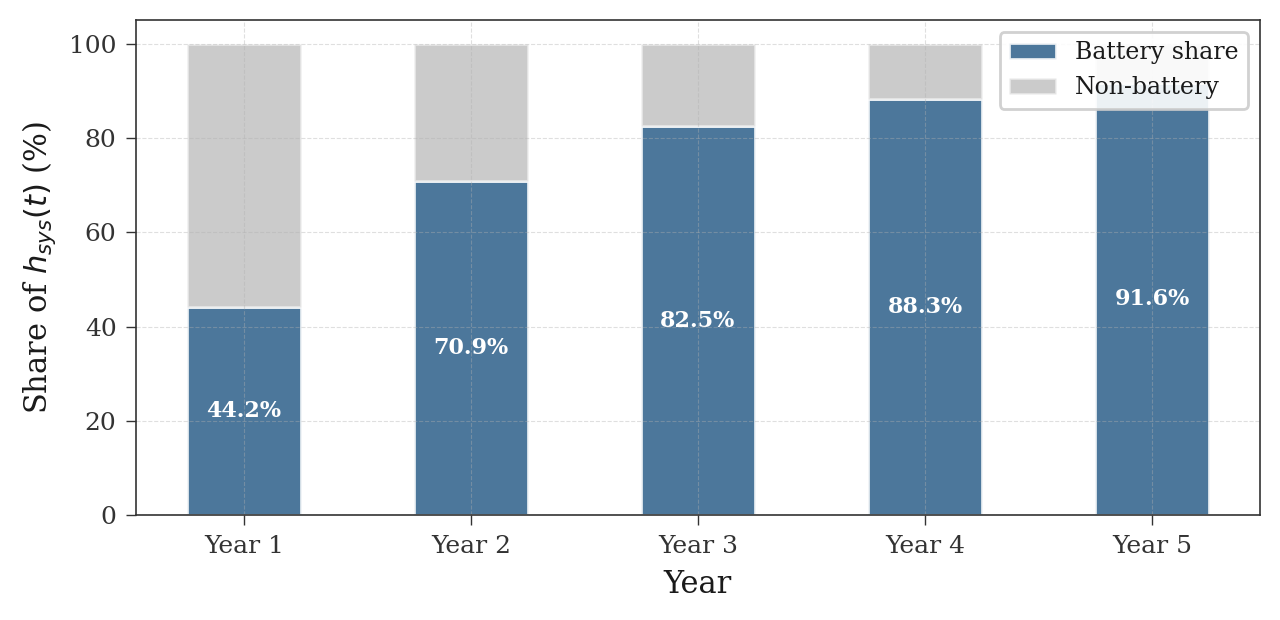
By year five, each bud battery’s hazard rate alone exceeds 90%/year. The product is bounded not by electronic component failure, which would take decades, but by battery chemistry, which takes two to four years. When the battery dies the product is functionally unserviceable. Apple offers replacement at $49 to $89 per bud, but at that price many people simply buy a new pair. This creates a predictable two-to-three year replacement cycle that sustains 60 to 70 million units of annual demand. The product is engineered to a chemical clock, and the clock starts ticking the moment the shrink-wrap comes off.
AppleCare+ does not extend the life of the product. It covers a window during which battery degradation transitions from imperceptible to noticeable. Most claims fall in the second year, when the battery has done 500 to 700 cycles and capacity has dropped to 80–85%. After year two the cover expires and you face the buy-new-or-repair decision, which at $49–$89 per bud against $249 for a new pair increasingly favours buying new.
So is AppleCare+ worth it?
AppleCare+ for Headphones costs $29 for two years. The product warranty covers year 0 to 1, so the incremental risk Apple takes on is the conditional failure probability during year 1 to 2, given the unit survived year one.
Pcond = 1 − R(2)/R(1) = 1 − 0.7934 / 0.9391 = 15.52%
Among AirPods that survive their first year, roughly one in six will fail during the second, driven entirely by the battery wear-out modes entering their steep phase. This is the number that matters most for the decision.
For Apple, it’s a very good business
| Line item | Calculation | Amount |
|---|---|---|
| Premium collected | Fixed price | $29.00 |
| Defect claims (yr 1–2) | 15.52% × 42% × $55 | $3.58 |
| Accidental damage (net) | 7% × ($55 − $29) | $1.82 |
| Total claims cost | $5.40 | |
| Admin / overhead | 8% of premium | $2.32 |
| Total cost per policy | $7.72 | |
| Profit per policy | $29.00 − $7.72 | $21.28 |
| Gross margin | 73.4% |
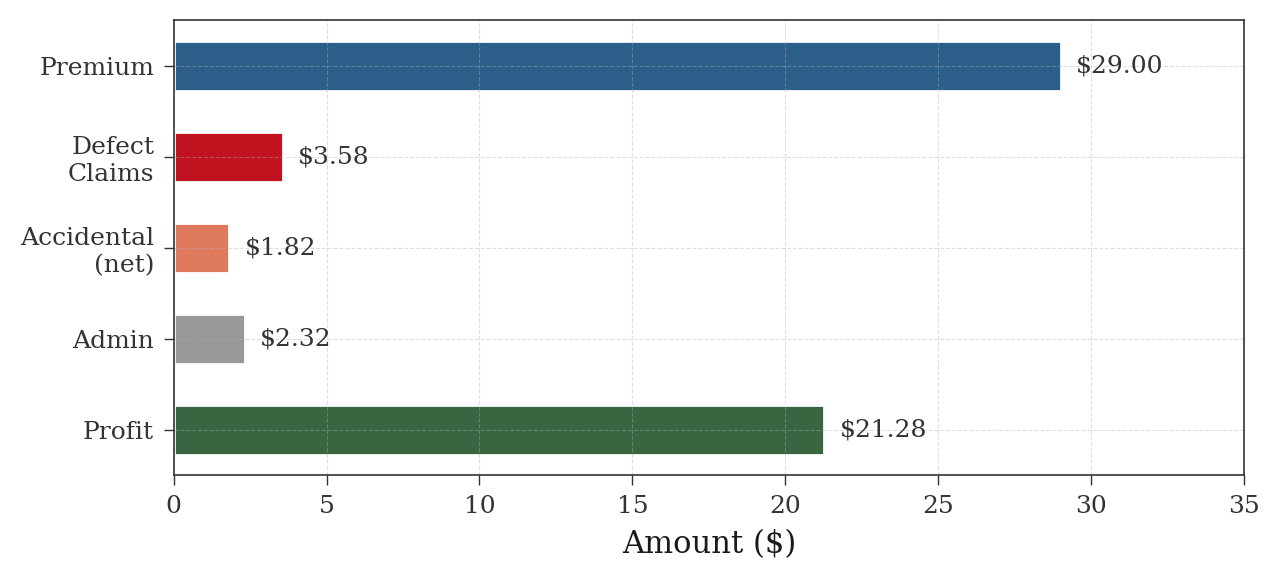
At scale, with a 15% attachment rate across 66 million annual units, that’s 9.9 million policies, $287 million in revenue and $211 million in profit at the same 73.4% margin. The economics run on a simple asymmetry: the $29 price was set to feel psychologically low, below the cost of a single out-of-warranty replacement, while the $55 internal cost and moderate claim rates send most of the premium straight to profit.
For you, it isn’t
Your expected benefit from AppleCare+ is the conditional failure probability times the out-of-pocket cost it avoids: 15.52% × $89 = $13.81. The premium is $29. The net expected value is −$15.19 per purchase. You pay roughly twice what you can expect to receive. For AppleCare+ to break even at this failure rate, it would need to cover a repair costing $187 or more; the actual out-of-warranty earbud replacement is $89.
Insurance exists to protect against catastrophic, unaffordable losses. An $89 earbud replacement is neither.
The case sharpens for repeat buyers. AirPods are a consumable on a two-to-three year cycle, so a long-term customer buys many pairs. Over five purchases (about 12 years), AppleCare+ costs $145 in premiums. The expected number of year-two failures across those five pairs is 0.78, meaning on average one out-of-pocket repair at $89, with about a 43% chance of needing none at all. Self-insuring saves an expected $76 over five purchases, and $152 over ten. The law of large numbers progressively favours the self-insurer.
The one scenario where AppleCare+ approaches rational is the single-purchase, highly loss-averse buyer who would replace the whole $249 pair rather than a single $89 bud. There the expected saving is 15.52% × $249 = $38.64, which beats the $29 premium. But that person is making two suboptimal decisions at once, and the advantage is slim.
Conclusions
1. AirPods exhibit severe wear-out-dominated failure behaviour. The system hazard accelerates from 10.5%/year at year one to 45.8%/year at year three, a 4.4× increase, while reliability drops from 93.9% to 56.2%. The hazard curve is climbing steeply by the time the warranty expires.
2. Battery degradation is overwhelmingly dominant. By year three, lithium-ion capacity fade accounts for 82.5% of total system hazard. The electronics contribute under 1%/year. AirPods do not fail because their electronics fail. They fail because their chemistry expires.
3. AirPods are functionally a consumable. The median unit reaches functional end-of-life between years two and three. By year five, reliability is 12.3%. The lifespan is bounded by a chemical clock running on a two-to-three year cycle.
4. Apple’s one-year warranty is financially sustainable. The model predicts 6.09% of units fail within the warranty period. Reconciled with Apple’s blended warranty cost, that implies a ~42% claims reporting rate, so three in five technical failures never generate a claim. The warranty sits exactly where the hazard curve is still manageable and the exposure contained.
5. AppleCare+ is not worth buying, especially for repeat customers. Your expected benefit is $13.81 per purchase against a $29 premium. For Apple, the programme returns $21.28 per policy and $211 million a year. Over five purchases, skipping it saves an expected $76.
My AirPods failed at month 13. The model places cumulative failure probability at 6.09% by month 12, rising sharply after. I was not unlucky. I was a data point on the steep part of a well-characterised wear-out curve, one month past the threshold Apple chose as the boundary of its financial exposure. The one-year warranty is not arbitrary; it is the inflection point where the hazard transitions from tolerable to accelerating, and Apple knows the curve better than its customers do.
Should I have bought AppleCare+? No. The model says don’t buy it, the maths says don’t buy it.



Leave a Reply