
Guest Post by Malcolm Peart (first posted on CERM ® RISK INSIGHTS – reposted here with permission)
One man’s meat is another man’s poison” as coined over 2000 years ago by the Roman poet Lucretius still rings true today. In these days of recycling, it’s akin to “one man’s trash is another man’s treasure”. But what about toxicity?
Everything is toxic! It’s just a matter of concentration and tolerance. Just look at oxygen and water, both are essential to human life, but both can kill if there’s too much or too little of either. Oscar Wilde, amongst others, is attributed with saying, “Everything in moderation, including moderation” providing a modern-day qualification to Socrates’ original of ‘nothing in excess”. But moderation or excess are matters of opinion.
‘Toxicity’ in the workplace has been seen as a bad thing since it was first raised in the 1960s. Dictionarily it’s the quality of “being poisonous” or “being very harmful or unpleasant in a pervasive or insidious way”. In organizational terms it is generally recognized that toxic environments occur where there is bullying and harassment. But even happiness has been considered toxic. In the movie Patch Adams the future Dr Adams is accused of being disruptive because of “excessive happiness”! Toxicity, like beauty can be in the eye of the beholder.
If we look at nature, we find that ‘toxicity’ is all but rare. Just look at Poison Ivy and a host of other plants, as well as certain birds, amphibians, fish and insects. Some environments, like deep sea smokers are extremely acidic but promote their own ecosystems and exclusive life forms which, although somewhat bizarrely, thrive. Even the Dead Sea, once thought ‘dead’ due to its alkalinity, has its own inhabitants albeit microbes. People too, as in the natural world, have different thresholds to toxicity and, depending on both their perception and tolerance, they can either flourish or flounder.
Signs & Symptoms
The signs and symptoms of toxicity in the workplace are well documented. The Internet can provide millions of hits in milliseconds. Toxic environments are characterized by abuse, be it physical or intellectual, coupled with harassment and discrimination. People are alienated and they may well leave leading to high staff turnover, others tolerate things and stay, and, others can thrive
Early signs can include people not talking to each other, the formation of cliques, and less than constructive behaviour. Destructive arguments can ensue with a focus on looking for problems rather than solutions and arguing the difficulties which, as Winston Churchill once said ‘argue themselves’. Gossip can prevail and offices, rather than buzzing with activity become morgues of lifelessness. People are kept ‘out of the loop’ rather than in it, information is withheld, and communication is secretive and guarded.
The reluctance to communicate openly and share information is characterised by statements such as, ‘it’s on the server’, “I sent an email on that”, and “everybody knows about this” or ‘didn’t you get the WhatsApp?’ The absence of open and transparent communication is akin to dumb insolence which is reinforced with meaningless statements of intent such as ‘you have my support’, or ‘I hear what you say’ and ‘we are right behind you’. Ultimately this is passive aggressive behaviour that verges on insubordination; a far cry from providing straightforward and honest opinions and communicating properly.
From a chemical perspective, toxicity has its extremes in causticity (alkalinity) and acidity and, just like people, very few things are ‘neutral’. Caustic substances are characterised by being ‘sour and slippery’ while acidic ones are ‘bitter and sticky’; again, just like some people. In any group of individuals, we will find a range of behaviour but for an acceptable environment this range needs to be managed. As with chemistry, caustic people in an acidic environment will produce a destructive reaction, and vice versa. And when people clash, depending on the degree, we will have conflict which is, perhaps, the most overt sign of a toxic environment.
Conflict & Cure
Conflict is not always a bad thing and depending on the context and who is contributing to the interaction it’s considered to be constructive. Unfortunately, conflict can also be destructive and there is an escalating continuum:
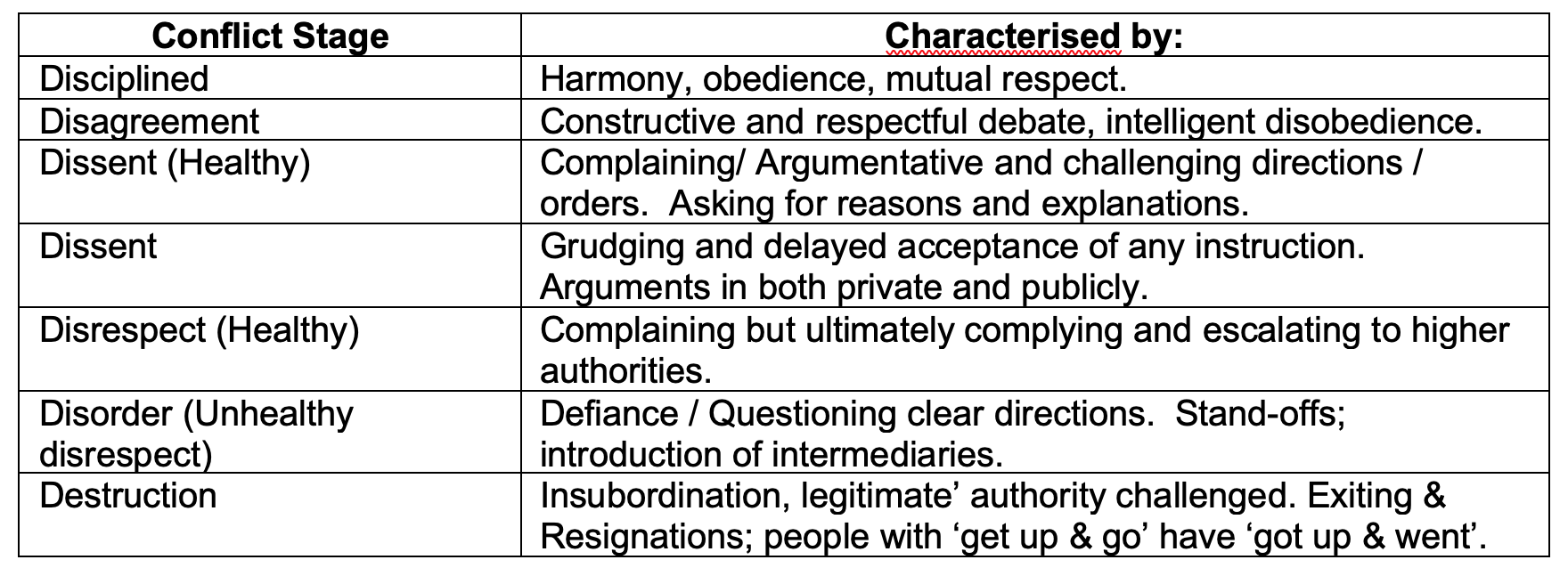
Discipline and associated harmony are not always possible. People have differing views which may not account for changing situations. There’s always more than one way to skin a cat and, depending on the situation, some counterpoint is inevitable. When such counterpoint moves from being constructive to unnecessarily argumentative with a proliferation of Devil’s Advocates, toxic behaviour may well have emerged. Dealing with toxicity, as with any other sign of conflict, is best done quickly and with radical candor.
Attempting to deal with conflict by forcing may well result in factionalisation of any group. The alternative of avoiding and withdrawing, or smoothing or compromising does little to deal with the conflict. These approaches merely allow any toxicity to fester and become more pervasive and concentrated resulting in further imbalance.
Dealing with toxicity is not for the faint-hearted. It requires a belief in one’s ability and the confidence to have courage in one’s convictions. It also requires an inward look at one’s own attitude and behaviour and your own toxicity. Are you defending against parasites who are draining an organisation’s lifeblood, or attacking a potential predator who is seeking to control the organisation? It’s a fine line but requires anybody at the helm to take responsibility, no matter why things have eventuated, understand the situation and its changing nature, re-establish a working environment and introduce stability by leading through example.
In theory an equilibrium will be reached. However, in actuality, some people will fall by the wayside and for the preservation of healthy and productive work environment some toxic compounds (people) will need to be ‘let go’ to establish equilibrium and discipline.
Conclusions
Relationships, no matter what their basis, are not always a love-in where everything is sweetness and light. There will be contrary views, but these should not be destructive. Counterviews are healthy and assist in ensuring that the best decisions are being made and the most appropriate actions are taken. Should people stray outside of acceptable behaviour, then toxicity may result which, if left unchecked may result in a slow, but ever quickening path to loss of people with a positive attitude and the demise of an organization.
Toxicity can be a matter of opinion depending on one’s tolerance. It is, as in nature, a defence mechanism. On one hand it’s a defence against the dark art of satisfactory underperformance or preserving an exclusive standard. On the other, toxicity may be used to defend against change no matter whether the change is for the better or for worse.
Exclusive work environments can appear toxic to outsiders or those who attempt to join. However, once accepted into any inner sanctum and the prevailing culture, all can be peachy. It’s all about how people fit into an environment, or don’t. This ‘fit’ can mean the difference between a toxic reaction or mutual acceptance. Perhaps it’s a matter of “one person’s toxicity can be another person’s survivability”.
Bio:
Malcolm Peart is an UK Chartered Engineer & Chartered Geologist with over thirty-five years’ international experience in multicultural environments on large multidisciplinary infrastructure projects including rail, metro, hydro, airports, tunnels, roads and bridges. Skills include project management, contract administration & procurement, and design & construction management skills as Client, Consultant, and Contractor.



Leave a Reply