Accendo Reliability

Your Reliability Engineering Professional Development Site

  • Home
  • About
    • Contributors
    • About Us
    • Colophon
    • Survey
  • Reliability.fm
    • Speaking Of Reliability
    • Rooted in Reliability: The Plant Performance Podcast
    • Quality during Design
    • Reliability 4.0
    • CMMSradio
    • Way of the Quality Warrior
    • Critical Talks
    • Asset Performance
    • Dare to Know
    • Maintenance Disrupted
    • Metal Conversations
    • The Leadership Connection
    • Practical Reliability Podcast
    • Reliability Gang
    • Reliability Hero
    • Reliability Matters
    • Reliability it Matters
    • Maintenance Mavericks Podcast
    • Women in Maintenance
    • Accendo Reliability Webinar Series
  • Articles
    • CRE Preparation Notes
      • Reliability Bites
    • NoMTBF
    • on Leadership & Career
      • Advanced Engineering Culture
      • ASQR&R
      • Engineering Leadership
      • Managing in the 2000s
      • Product Development and Process Improvement
    • on Maintenance Reliability
      • Aasan Asset Management
      • AI & Predictive Maintenance
      • Asset Management in the Mining Industry
      • CMMS and Maintenance Management
      • CMMS and Reliability
      • Conscious Asset
      • EAM & CMMS
      • Everyday RCM
      • History of Maintenance Management
      • Life Cycle Asset Management
      • Maintenance and Reliability
      • Maintenance Management
      • Plant Maintenance
      • Process Plant Reliability Engineering
      • RCM Blitz®
      • ReliabilityXperience
      • Rob’s Reliability Project
      • The Intelligent Transformer Blog
      • The People Side of Maintenance
      • The Reliability Crime Lab
      • The Reliability Mindset
    • on Product Reliability
      • Accelerated Reliability
      • Achieving the Benefits of Reliability
      • Apex Ridge
      • Beyond the Numbers
      • Breaking Bad for Reliability
      • Field Reliability Data Analysis
      • Metals Engineering and Product Reliability
      • Musings on Reliability and Maintenance Topics
      • Product Validation
      • Reliability by Design
      • Reliability Competence
      • Reliability Engineering Insights
      • Reliability in Emerging Technology
      • Reliability Knowledge
    • on Risk & Safety
      • CERM® Risk Insights
      • Equipment Risk and Reliability in Downhole Applications
      • Operational Risk Process Safety
    • on Systems Thinking
      • The RCA
      • Communicating with FINESSE
    • on Tools & Techniques
      • Big Data & Analytics
      • Experimental Design for NPD
      • Innovative Thinking in Reliability and Durability
      • Inside and Beyond HALT
      • Inside FMEA
      • Institute of Quality & Reliability
      • Integral Concepts
      • Learning from Failures
      • Progress in Field Reliability?
      • R for Engineering
      • Reliability Engineering Using Python
      • Reliability Reflections
      • Statistical Methods for Failure-Time Data
      • Testing 1 2 3
      • The Hardware Product Develoment Lifecycle
      • The Manufacturing Academy
  • eBooks
  • Resources
    • Special Offers
    • Accendo Authors
    • FMEA Resources
    • Glossary
    • Feed Forward Publications
    • Openings
    • Books
    • Webinar Sources
    • Journals
    • Higher Education
    • Podcasts
  • Courses
    • Your Courses
    • 14 Ways to Acquire Reliability Engineering Knowledge
    • Live Courses
      • Introduction to Reliability Engineering & Accelerated Testings Course Landing Page
      • Advanced Accelerated Testing Course Landing Page
    • Integral Concepts Courses
      • Reliability Analysis Methods Course Landing Page
      • Applied Reliability Analysis Landing Page
      • Statistics, Hypothesis Testing, & Regression Modeling Course Landing Page
      • Measurement System Assessment Course Landing Page
      • SPC & Process Capability Course Landing Page
      • Design of Experiments Course Landing Page
    • The Manufacturing Academy Courses
      • An Introduction to Reliability Engineering
      • Reliability Engineering Statistics
      • An Introduction to Quality Engineering
      • Quality Engineering Statistics
      • FMEA in Practice
      • Process Capability Analysis course
      • Root Cause Analysis and the 8D Corrective Action Process course
      • Return on Investment online course
    • Industrial Metallurgist Courses
    • FMEA courses Powered by The Luminous Group
      • FMEA Introduction
      • AIAG & VDA FMEA Methodology
    • Barringer Process Reliability Introduction
      • Barringer Process Reliability Introduction Course Landing Page
    • Fault Tree Analysis (FTA)
    • Foundations of RCM online course
    • Reliability Engineering for Heavy Industry
    • How to be an Online Student
    • Quondam Courses
  • Webinars
    • Upcoming Live Events
    • Accendo Reliability Webinar Series
  • Calendar
    • Call for Papers Listing
    • Upcoming Webinars
    • Webinar Calendar
  • Login
    • Member Home
Home » Articles » on Maintenance Reliability » Life Cycle Asset Management » Achieving Highly Reliable Systems

by Mike Sondalini Leave a Comment

Achieving Highly Reliable Systems

Achieving Highly Reliable Systems

There are only two ways to get high system reliability: meeting outstanding task quality performance standards so excellence is done everywhere, and by building parallel arrangements where the failure of one has no impact on system performance. Both are done in a PWW EAM System-of-Reliability

Equipment can be configured in series or in parallel arrangements. A series arrangement is when one item or task connects sequentially to the next. It takes only one item to fail in a series arrangement and the whole system will fail. Exceptionally reliable individual equipment is needed to experience a high-reliability system with a series arrangement.

Parallel arrangements are when each item is arranged as a companion, one duplicates another. In this circumstance, exceptionally reliable systems can be formed even if individual equipment has poor reliability.

A system is formed when equipment is combined to do a duty. For example, when a pump, coupling, and electric motor are connected they form a series system used to move liquid through pipes from one point to another.
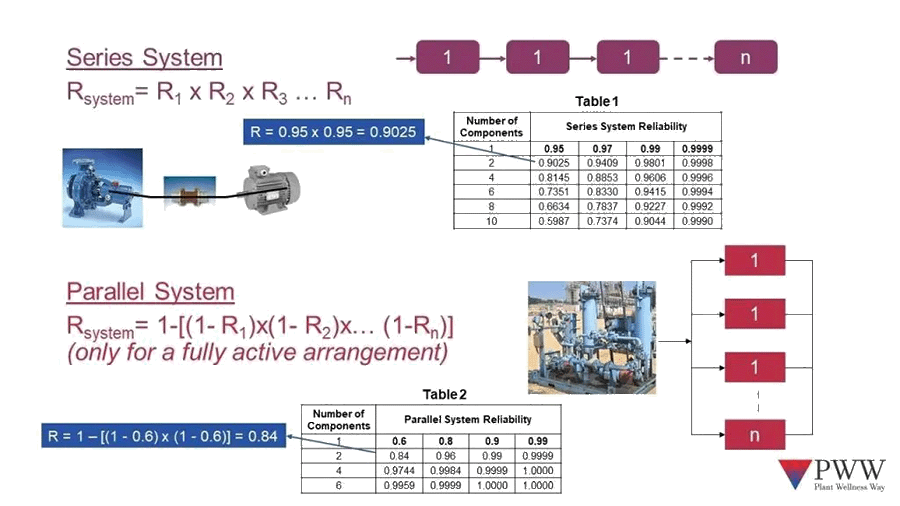
Reliability engineering concept with series and parallel system configurations.
Figure 1. Sample Reliability Block Diagrams, Reliability Equations and Reliability Calculations for both a Series System and Parallel System.

Series System Reliability

The standard EAM strategy is to first use preventative and predictive maintenance to reduce breakdown occurrences. Then proactive maintenance is used to improve reliability by keeping plant and equipment healthy. This process to high reliability is often called “the journey”. With this approach the journey can take 5 or more years before substantial gains in availability and lower maintenance costs are achieved.

Plant Wellness Way EAM creates an EAM strategy that captures the full plant and equipment availability possible. It simplifies and speeds up designing and constructing an EAM system which is focused on making the greatest operating profit. As a result, low maintenance costs and high equipment availability are automatic and natural outcomes of the way your business and people work.

Parallel System Reliability

The other way to combine equipment is as a parallel system arrangement. An example of this is when two filter stations operate in parallel. 

This can be configured to work in one of two ways. One is the duty circuit taking the full service, and the other is the standby doing no work, but ready to come online when the duty goes offline. This set up is known as a duty and standby configuration, or a standby redundancy. The other arrangement is where both circuits operate together and share the service load. If one circuit goes offline the remaining circuit can handle the full duty. This operating philosophy is called a fully active arrangement.

As shown in Table 2, Figure 1, when two components of 0.6 reliability operate in parallel in a fully active arrangement the system reliability is 0.84. When six separate systems of 0.6 reliability are paralleled, the system reliability is 0.996. By putting equipment in parallel you create a more reliable system because when one item fails the other item continues delivering the duty.

When you use equipment, there are only two ways to get a highly reliable system. If it is a series system, then every piece of equipment in the arrangement must be exceptionally reliable. The other way is to duplicate the system and have a complete second system in parallel, ready to replace the first system when it fails.

Filed Under: Articles, Life Cycle Asset Management, on Maintenance Reliability

About Mike Sondalini

In engineering and maintenance since 1974, Mike’s career extends across original equipment manufacturing, beverage processing and packaging, steel fabrication, chemical processing and manufacturing, quality management, project management, enterprise asset management, plant and equipment maintenance, and maintenance training. His specialty is helping companies build highly effective operational risk management processes, develop enterprise asset management systems for ultra-high reliable assets, and instil the precision maintenance skills needed for world class equipment reliability.

« Building A Better 5-Why → The 5-Why+
Organizational Toxicity: Offensive? Or Defensive? »

Leave a Reply Cancel reply

Your email address will not be published. Required fields are marked *

Headshot of Mike SondaliniArticles by Mike Sondalini
in the Life Cycle Asset Management article series

Join Accendo

Receive information and updates about articles and many other resources offered by Accendo Reliability by becoming a member.

It’s free and only takes a minute.

Join Today

Recent Posts

  • Organizational Toxicity: Offensive? Or Defensive?
  • Achieving Highly Reliable Systems
  • Building A Better 5-Why → The 5-Why+
  • Unit 4: The Essentials of Documenting Failure Effects in RCM
  • The Top Ten Ways to Express Asset Value

© 2026 FMS Reliability · Privacy Policy · Terms of Service · Cookies Policy

Book the Course with John
  Ask a question or send along a comment. Please login to view and use the contact form.
This site uses cookies to give you a better experience, analyze site traffic, and gain insight to products or offers that may interest you. By continuing, you consent to the use of cookies. Learn how we use cookies, how they work, and how to set your browser preferences by reading our Cookies Policy.
