
Accendo Reliability

Your Reliability Engineering Professional Development Site

  • Home
  • About
    • Contributors
    • About Us
    • Colophon
    • Survey
  • Reliability.fm
    • Speaking Of Reliability
    • Rooted in Reliability: The Plant Performance Podcast
    • Quality during Design
    • Reliability 4.0
    • CMMSradio
    • Way of the Quality Warrior
    • Critical Talks
    • Asset Performance
    • Dare to Know
    • Maintenance Disrupted
    • Metal Conversations
    • The Leadership Connection
    • Practical Reliability Podcast
    • Reliability Gang
    • Reliability Hero
    • Reliability Matters
    • Reliability it Matters
    • Maintenance Mavericks Podcast
    • Women in Maintenance
    • Accendo Reliability Webinar Series
  • Articles
    • CRE Preparation Notes
      • Reliability Bites
    • NoMTBF
    • on Leadership & Career
      • Advanced Engineering Culture
      • ASQR&R
      • Engineering Leadership
      • Managing in the 2000s
      • Product Development and Process Improvement
    • on Maintenance Reliability
      • Aasan Asset Management
      • AI & Predictive Maintenance
      • Asset Management in the Mining Industry
      • CMMS and Maintenance Management
      • CMMS and Reliability
      • Conscious Asset
      • EAM & CMMS
      • Everyday RCM
      • History of Maintenance Management
      • Life Cycle Asset Management
      • Maintenance and Reliability
      • Maintenance Management
      • Plant Maintenance
      • Process Plant Reliability Engineering
      • RCM Blitz®
      • ReliabilityXperience
      • Rob’s Reliability Project
      • The Intelligent Transformer Blog
      • The People Side of Maintenance
      • The Reliability Crime Lab
      • The Reliability Mindset
    • on Product Reliability
      • Accelerated Reliability
      • Achieving the Benefits of Reliability
      • Apex Ridge
      • Beyond the Numbers
      • Breaking Bad for Reliability
      • Field Reliability Data Analysis
      • Metals Engineering and Product Reliability
      • Musings on Reliability and Maintenance Topics
      • Product Validation
      • Reliability by Design
      • Reliability Competence
      • Reliability Engineering Insights
      • Reliability in Emerging Technology
      • Reliability Knowledge
    • on Risk & Safety
      • CERM® Risk Insights
      • Equipment Risk and Reliability in Downhole Applications
      • Operational Risk Process Safety
    • on Systems Thinking
      • The RCA
      • Communicating with FINESSE
    • on Tools & Techniques
      • Big Data & Analytics
      • Experimental Design for NPD
      • Innovative Thinking in Reliability and Durability
      • Inside and Beyond HALT
      • Inside FMEA
      • Institute of Quality & Reliability
      • Integral Concepts
      • Learning from Failures
      • Progress in Field Reliability?
      • R for Engineering
      • Reliability Engineering Using Python
      • Reliability Reflections
      • Statistical Methods for Failure-Time Data
      • Testing 1 2 3
      • The Hardware Product Develoment Lifecycle
      • The Manufacturing Academy
  • eBooks
  • Resources
    • Special Offers
    • Accendo Authors
    • FMEA Resources
    • Glossary
    • Feed Forward Publications
    • Openings
    • Books
    • Webinar Sources
    • Journals
    • Higher Education
    • Podcasts
  • Courses
    • Your Courses
    • 14 Ways to Acquire Reliability Engineering Knowledge
    • Live Courses
      • Introduction to Reliability Engineering & Accelerated Testings Course Landing Page
      • Advanced Accelerated Testing Course Landing Page
    • Integral Concepts Courses
      • Reliability Analysis Methods Course Landing Page
      • Applied Reliability Analysis Landing Page
      • Statistics, Hypothesis Testing, & Regression Modeling Course Landing Page
      • Measurement System Assessment Course Landing Page
      • SPC & Process Capability Course Landing Page
      • Design of Experiments Course Landing Page
    • The Manufacturing Academy Courses
      • An Introduction to Reliability Engineering
      • Reliability Engineering Statistics
      • An Introduction to Quality Engineering
      • Quality Engineering Statistics
      • FMEA in Practice
      • Process Capability Analysis course
      • Root Cause Analysis and the 8D Corrective Action Process course
      • Return on Investment online course
    • Industrial Metallurgist Courses
    • FMEA courses Powered by The Luminous Group
      • FMEA Introduction
      • AIAG & VDA FMEA Methodology
    • Barringer Process Reliability Introduction
      • Barringer Process Reliability Introduction Course Landing Page
    • Fault Tree Analysis (FTA)
    • Foundations of RCM online course
    • Reliability Engineering for Heavy Industry
    • How to be an Online Student
    • Quondam Courses
  • Webinars
    • Upcoming Live Events
    • Accendo Reliability Webinar Series
  • Calendar
    • Call for Papers Listing
    • Upcoming Webinars
    • Webinar Calendar
  • Login
    • Member Home
Home » Articles » on Risk & Safety » CERM® Risk Insights » World Economic Forum 2022 Risk Assessment Report

by Greg Hutchins Leave a Comment

World Economic Forum 2022 Risk Assessment Report

World Economic Forum 2022 Risk Assessment Report

Guest Post by James Kline (first posted on CERM ® RISK INSIGHTS – reposted here with permission)

Every year for over twenty years, the World Economic Forum has conducted a Global Risks Perception Survey.  The 2023 survey was conducted between September 7 and October 5, 2022. The responses are from over 12,000 business leaders in 21 countries.

In the survey, Global Risk is defined as “the possibility of the occurrence of an event or conditions which, if it occurs, would negatively impact a significant portion of global GDP, population, or natural resources.” (1)

The respondents were asked to look at the issue of risk on several levels.

1..Volitility
2. Severity – likely impact over a one-, two-, and ten-year horizon.
3. Consequence – potential impact.
4. Risk preparedness and governance – current effectiveness of ability to manage risk.
5. Qualitative Knowledge – identifying new or emerging risks.

Risks

In 2022 there were 32 global risks listed. The 2023 survey added two risks associated with economic geopolitical and environmental trends. These were a: Cost of Living crisis and b: Misinformation and disinformation.  A slight change was made on a climate risk. The risk “Climate action failure” was separated into a: Failure of climate-change adaptation” and b: Failure to mitigate climate change.

The identified risks from the responses are grouped into two basic categories. These are short term and long term. Short-term risks are generally those which might occur within the next two years. Long-term risks are those likely to occur within the next ten years.

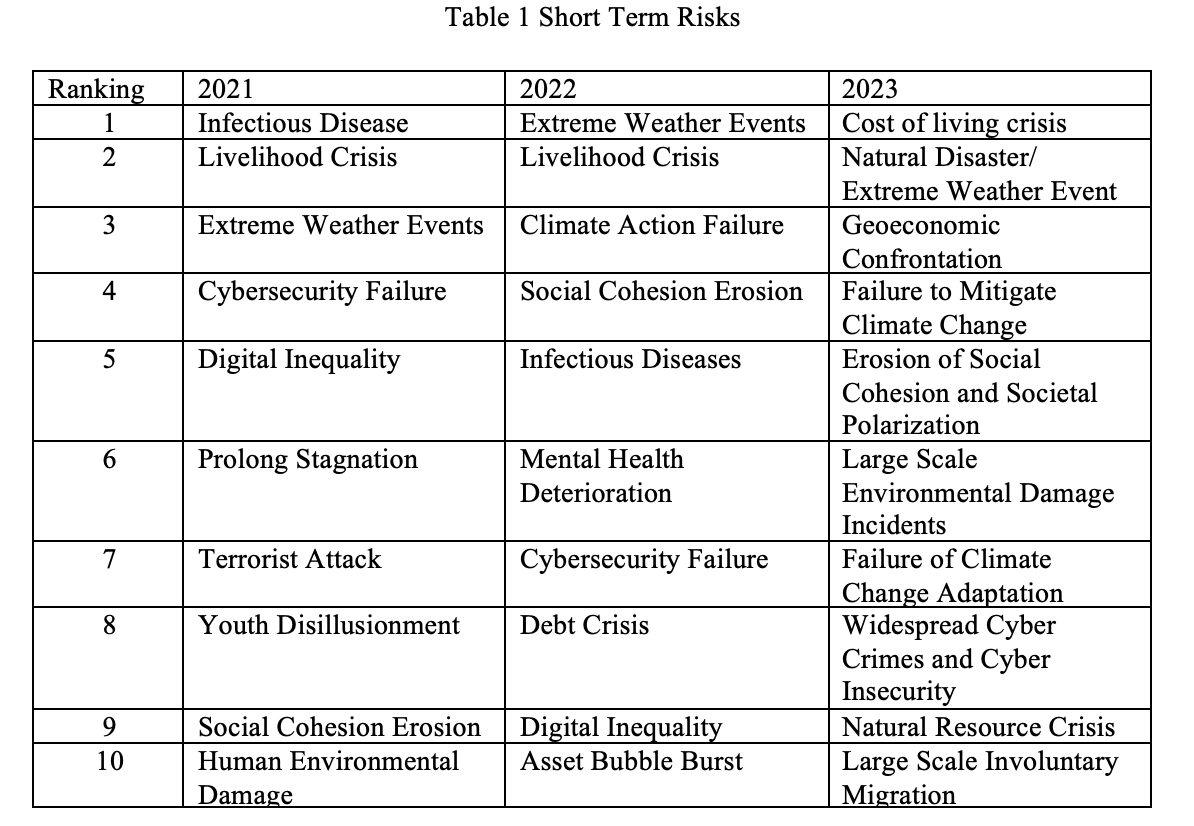
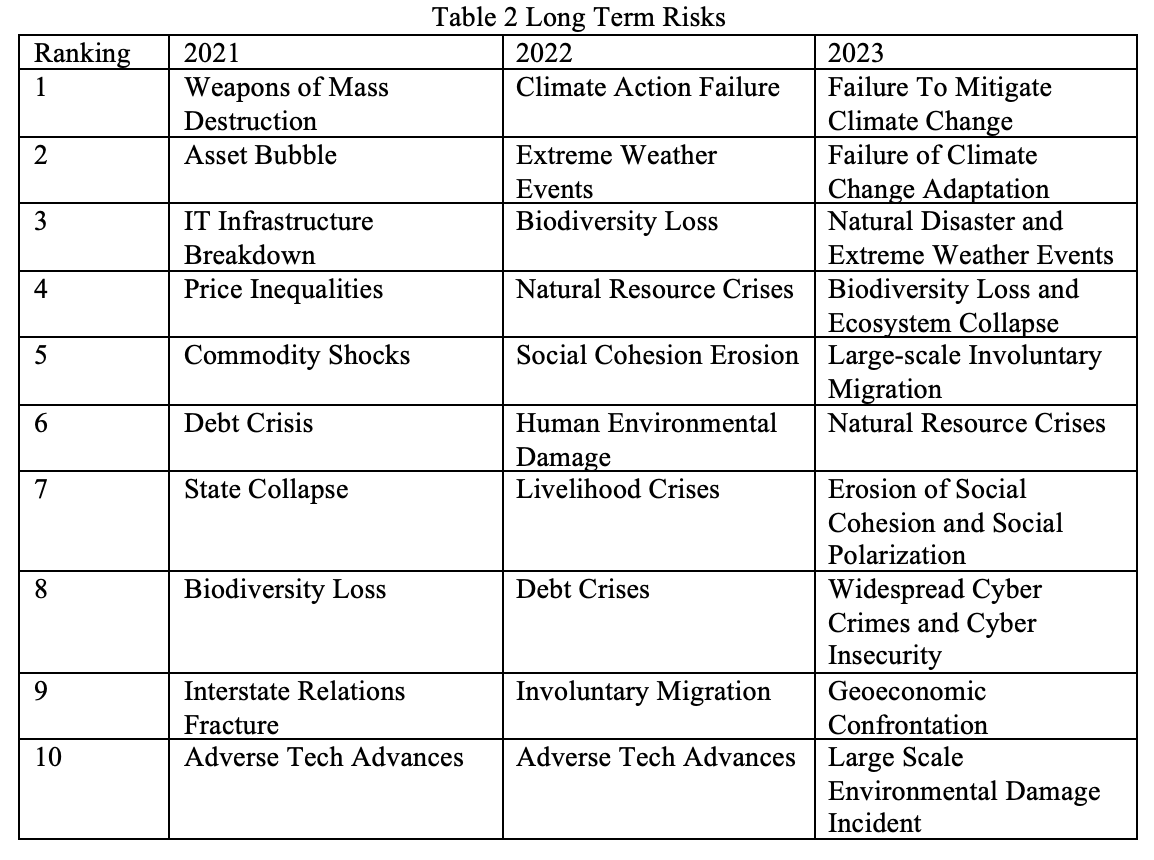
Tables 1 and 2 below show the short-term and long-term risks for 2023, 2022 and 2021. It should be noted that in 2022 and 2021 risks were identified as 2 years, 2-5 years, and 5-10 years. Thus, to make the comparison with 2023, the 2021, and 2022, the 2-5 years, and 5-10 years risks have been combined and ranked based on the percentages regardless of anticipated incident of occurrence.
Assessment

If one compares the 2021 and 2022 short-term risks, four out of ten risks appear in both years. These are Livelihood Crisis, Extreme Weather Events, Cybersecurity Failure and Digital Inequality. Of these only two, Widespread Cyber Crimes and Cyber Insecurity, and Natural Disaster/ Extreme Weather Event appear in the top ten short-term 2023 risks. Comparing the 2022 and 2023 top ten short-term risks indicates that four Natural Disaster/ Extreme Weather Event, Failure to Regulate Climate Change, Widespread Cyber Crimes and Cyber Insecurity are carried over.

The point is that except for climate change and cybersecurity, the short-terms risks jump around from year to year. This makes it difficult to determine whether the exclusion of an individual risk from the top ten is the result of mitigative actions or more of the popular perception of the times. For instance, in 2020 only two of the top ten short-term risks were climate related. By 2023 half were climate related.

With respect to the long-term risks the same trend is apparent. In 2020 only one was climate related. That was Biodiversity Loss. By 2023 six were climate related risks.

This trend towards an emphasis on climate related risks is something I noted in a 2019 CERM article. (2) In fact, except for cyber security, there is no risk in the top ten which can be linked to an organization or which an organization can reasonably mitigate. The emphasis is on state actors and government action.

The Executive Summary points out the complexity of the situation state actors face.

“As 2023 begins, the world is facing a set of risks that feel both wholly new and eerily familiar. We have seen a return of “older” risk -inflation, cost-of-living crises, trade wars, capital outflows from emerging markets, widespread social unrest, geopolitical confrontation and the specter of nuclear warfare -which of nuclear warfare – which few of this generation’s business leaders and public policy-maker have experienced. These are being amplified by comparatively new developments in the global risk landscape, including unstainable levels of debt, a new era of low growth, low global investment and de-globalization, a decline in human development after decades of progress, rapid and unconstrained development of dual-use (civilian and military) technologies, and growing pressure of climate change impact and ambitions in an ever-shrinking window for transition to a 1.5°C world.” (3)

How the emphasis on climate related risks compared to the other risks plays out politically has yet to be determined. What is clear, the World Economic Forum is emphasizing climate risk.

Endnotes

  1. The Global Risk Report 2023, World Economic Forum, page 5, hppts://www.weforum.org/report/global-risks-report-2023.
  2. Kline, James J., 2019, World Economic Forum Risk Assessment Survey, CERM Insights #240, May 10, 2019.
  3. The Global Risk Report 2023, The Global Risk Report 2023, page 6, hppts://www.weforum.org/report/global-risks-report-2023.

BIO:

James J. Kline has a PhD from Portland State University. He has worked for the federal, state, and local government. He has consulted on economic, quality and workforce development issues. He has authored numerous articles on quality and risk management. His book “Enterprise Risk Management in Government: Implementing ISO 31000:2018” is available on Amazon. He edited “Quality Disrupted” which is also available on Amazon. He can be contacted on LinkedIn or jamesjk1236@outlook.com

Filed Under: Articles, CERM® Risk Insights, on Risk & Safety

About Greg Hutchins

Greg Hutchins PE CERM is the evangelist of Future of Quality: Risk®. He has been involved in quality since 1985 when he set up the first quality program in North America based on Mil Q 9858 for the natural gas industry. Mil Q became ISO 9001 in 1987

He is the author of more than 30 books. ISO 31000: ERM is the best-selling and highest-rated ISO risk book on Amazon (4.8 stars). Value Added Auditing (4th edition) is the first ISO risk-based auditing book.

« What is Operational Excellence?
Death by a Thousand Resets »

Leave a Reply Cancel reply

Your email address will not be published. Required fields are marked *

CERM® Risk Insights series Article by Greg Hutchins, Editor and noted guest authors

Join Accendo

Receive information and updates about articles and many other resources offered by Accendo Reliability by becoming a member.

It’s free and only takes a minute.

Join Today

Recent Articles

  • Death by a Thousand Resets
  • World Economic Forum 2022 Risk Assessment Report
  • What is Operational Excellence?
  • Neutrosophic Reliability Estimation Without Lifetime Data?
  • Unit 6: Failure Consequences and Proactive Maintenance in RCM

© 2026 FMS Reliability · Privacy Policy · Terms of Service · Cookies Policy

Book the Course with John
  Ask a question or send along a comment. Please login to view and use the contact form.
This site uses cookies to give you a better experience, analyze site traffic, and gain insight to products or offers that may interest you. By continuing, you consent to the use of cookies. Learn how we use cookies, how they work, and how to set your browser preferences by reading our Cookies Policy.
