
Guest Post by Bill Pomfret (first posted on CERM ® RISK INSIGHTS – reposted here with permission)
Everyone comes to their workplace with the expectation, and often a clear plan, for an incident/accident-free day. And many times, the day goes just as planned, however 2.3 million people do not return home after work, they are killed by work related accidents and occupational exposures and diseases every single day, this corresponds to over 6000 deaths every single day.
That is only the tip of the iceberg, in addition there are around 340 million occupational accidents and another 160 million victims of work-related illnesses annually, many of which are life changing, not only to the victim, but often for whole families
These events are often sudden; someone or something is in the wrong place at the wrong time, and at that moment, perhaps only a split second, an incident or accident takes place.
To better understand the importance of accident/incident investigation, let’s dig deeper into the “WHY” question…
- WHY should accidents and incidents, no matter how small, be reported?
- WHY we should investigate, and finally
- WHY did this event happen? How can we prevent it from happening again?
What Is the Difference Between an Incident and Accident?
“Accident” or “Incident”? You may have heard these terms used interchangeably at your workplace. Or perhaps each refers to a separate type of event. Safety Projects International Inc uses the following definitions,
Accident definition: An accident is an undesired event that results in physical harm to people, damage to property, or loss to process,
Incident Definition: An incident is an event, which under slightly different circumstances, could have resulted in physical harm to people, damage to property or loss to process, all accidents are incidents, but not all incidents are accidents.
An undesired event that interrupts the completion of an activity, and that may (or may not) include injury or property damage
Pretty close to the same thing, you may say. And a bit confusing, as well! To avoid confusion, we are going to move away from the term “accident”.
Here’s why. “Accident”, implies that “fate or chance” is involved. When the root cause of an event is examined, it is usually determined that the event was predictable and could have been prevented.
Top Reasons to Investigate A Workplace Incident
During the last three decades of my career, I have been conducting health & safety audits, and reviewing thousands of reports and investigations of incidents and accidents, I find it difficult to comprehend why almost 50% do not find the true causes, which is an opportunity lost. Incident Investigation is a valuable tool for developing your company’s Health & Safety Management System. As your company continues to look for ways to improve workplace safety, we need to encourage all your workers to report every incident, even the minor ones! This practice will play a huge role in preventing the terrible erosion of workplace deaths, injury disease and waste, and plays an important part in building a proactive safety program and a positive safety culture.
- A) What are the “WHYs” for reporting and investigating incidents?
- B) Most importantly, by investigating we find out the cause of incidents and prevent similar incidents in the future. As a result,
1) The workplace becomes safer,
2) Management commitment to safety is reinforced
3) Worker buy-in to the safety program increases.
4) Investigations provide your management with valuable information for the day-to-day operation of the company such as:
- Fulfills any legal requirements
- Determines the cost of an incident
- Determines compliance with applicable regulations (e.g., occupational health and safety, criminal, etc.)
- Processing workers’ compensation claims
Who Should Conduct the Workplace Investigation Process?
Who is involved in the investigation can impact the information gathered and therefore, the end results. The priority is getting the best possible picture of what really happened and how future recurrence can be avoided.
Remember, workplace investigations are about prevention, the supervisor is normally considered the best person to investigate, because it his area and his responsibility, remember, we are not finding fault! Start to build confidence in the reporting and investigation process by including input from the most knowledgeable people within the company.
Start off by determining who is best qualified to conduct the workplace investigation. Will the investigation be conducted by an individual or by a group?
Ensure that, whether individually or collectively, the following skills and experience are included:
- experienced in incident causation models,
- experienced in investigative techniques,
- knowledgeable of any legal or organizational requirements,
- knowledgeable in occupational health and safety fundamentals,
- knowledgeable in the work processes, procedures, persons, and
- industrial relations environment for that situation,
- able to use interview and other person-to-person techniques effectively (such as mediation or conflict resolution),
- knowledgeable of requirements for documents, records, and data collection; and
- able to analyze the data gathered to determine findings and reach recommendations.
The severity of the incident will usually dictate the resources and personnel involved such as:
- Safety advisors and Safety Coordinator
- Union representatives, if applicable
- Members of your Joint Health and Safety Committee or Safety Rep
- The “boots on the ground” supervisors and workers offer a valuable perspective when assessing the causal factors and determining corrective actions. Encouraging input from your worker provides your company with a complete picture of the incident. The overall connection with safety increases as more value is placed on worker involvement in the investigation process.
- In the case of serious workplace incidents, you may bring in “outside” experts or be required to involve local government, the police or WCB. Be sure to have a plan in place to coordinate the involvement of these authorities.
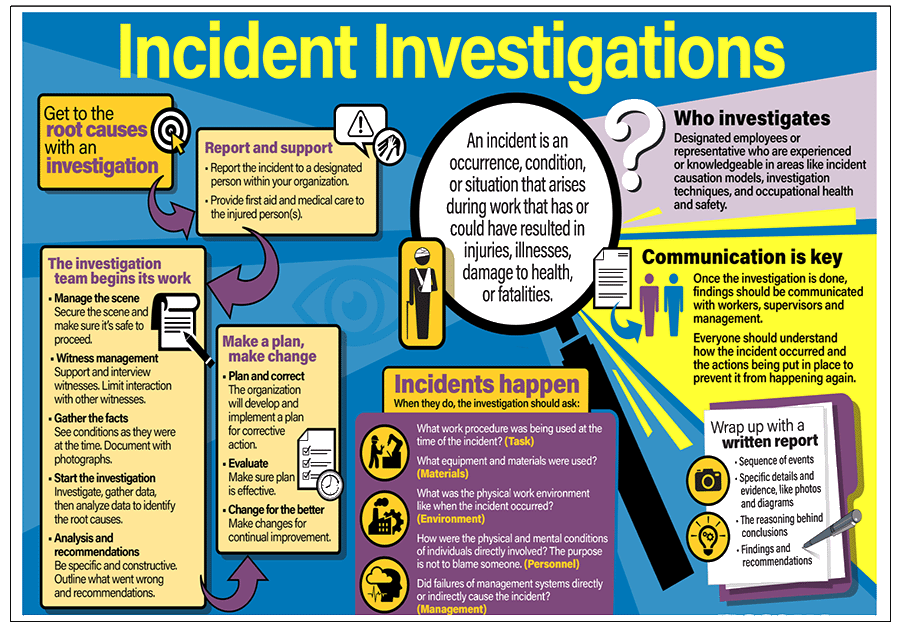
Why The Root Cause Is Vital to Workplace Investigations
Now you have gathered all your data and have a clear picture of what took place. Getting to the bottom of the “WHY” is the next step!
What is the “root cause” and how is it determined? What are other “causal factors” and how do they play into the incident?
Root Cause:
A factor that caused a nonconformance and should be permanently eliminated through process improvement. The primary driver of the event.
Causal Factors:
These are the secondary drivers of the evens. The unintended contributors to an incident “ that if eliminated would have either prevented the occurrence of the incident or reduced its severity or frequency”. Finding the causal factors often takes digging down and looking beyond the obvious.
Even the most simple and straightforward incidents rarely have one single cause. The most successful investigations require moving away from “tunnel vision”. Examine all the possible causes and, using the information gathered, ask questions…lots of questions. And when you are done… ask more questions!
- Was the worker distracted? If yes, why was the worker distracted?
- Was a safe work procedure being followed? If not, why not?
- Were safety devices in order? If not, why not?
- Was the worker trained? If not, why not?
What Steps to Follow In A Workplace Incident Investigation
When an incident occurs on the job site, time is of the essence. As little time as possible should be lost between the time of the incident and the beginning of the investigation.
The 3 key steps to conducting a successful investigation are Reporting, Investigation, and Action Plan!
Reporting:
- Reporting the incident
- Providing first aid or medical aid to the injured
- Secure the scene and take the necessary steps to prevent further damage or injury
When an incident occurs, remembering the necessary information to include in the Incident Report can be daunting. Digitized safety programs like Safety Evolution’s safety software offers a reporting process that helps gather and submit all the necessary information seamlessly.
Investigation:
- Scene management and assessment (ensure the site is safe for investors)
- Witness Management – provide support, encourage openness by not finding fault or blame, conduct interviews, and maintain the confidentiality of witness statements.
- Investigate and collect data including photos, diagrams, and recent inspections
- Analyze the data and identify the root causes
- Report the findings and supply recommendations.
Action Plan:
- Develop an action plan for the corrective actions coming out of the investigation
- Implement the plan by assigning actions, setting a time frame for completion, and conducting follow up
- Determine if the corrective actions are adequate and effective.
- Look for changes that could be made for the ongoing improvement of safety in your workplace.
- Review the finding of the investigation with workers in toolbox talks or safety meetings. Encourage suggestions and input. It is rare that an event has never happened before. The causes and corrections of prior incidents can shed new light and increase the likelihood that the investigation will prevent similar incidents in the future.
Bio:
Dr. Bill Pomfret of Safety Projects International Inc who has a training platform, said, “It’s important to clarify that deskless workers aren’t after any old training. Summoning teams to a white-walled room to digest endless slides no longer cuts it. Mobile learning is quickly becoming the most accessible way to get training out to those in the field or working remotely. For training to be a successful retention and recruitment tool, it needs to be an experience learner will enjoy and be in sync with today’s digital habits.”
Every relationship is a social contract between one or more people. Each person is responsible for the functioning of the team. In our society, the onus is on the leader. It is time that employees learnt to be responsible for their actions or inaction, as well. And this takes a leader to encourage them to work and behave at a higher level. Helping employees understand that they also need to be accountable, visible and communicate what’s going on.



Leave a Reply