AN ENTERPRISE ASSET MANAGEMENT SYSTEM UNITES OPERATIONS, ENGINEERING, MAINTENANCE, AND THE SUPPLY CHAIN ACROSS THE ASSET LIFE CYCLE TO MEET CORPORATE BUSINESS OBJECTIVES AND PRODUCE HIGH PLANT AVAILABILITY AT THE LOWEST LIFETIME COST AND MOST OPERATING PROFIT
—
An enterprise asset management system needs asset reliability improvement processes throughout the life cycle that ensure utmost reliability and eliminate the need for maintenance. You can do that with a Plant Wellness Way EAM System-of-Reliability
What exactly is an Enterprise Asset Management System?
Enterprise Asset Management began its life in Europe in the 1980’s as Terotechnology. Terotechnology is defined in BS 3811 as, “a combination of management, financial, engineering, and other practices applied to physical assets in pursuit of economic life-cycle costs “. These days ‘costs’ would be replaced by profits. The achievement of all those requirements needs an Enterprise Asset Management System.
The standard continues with: “Its practice is concerned with the specification and design for reliability and maintainability of plant, machinery, equipment, buildings and structures, with their installation, commissioning, maintenance, modification and renewal, and with feedback of information on design, performance and costs.”
Terotechnology adopted practices based primarily upon maximizing life-cycle profits of all functions including Operations and Maintenance through equipment failure data collection, failure data analysis, profit optimization, and feedback to Original Equipment Manufacturers to improve machinery designs.
By the 1990s the global interest in achieving high reliability of operational assets caused the word ‘Terotechnology’ to be replaced with the more acceptable ‘Enterprise Asset Management’, shortened to EAM. There was clear implication by using the phrase ‘Enterprise Asset Management’ that the entire company was involved in its accomplishment.
To achieve an organization’s strategic plan the five interfaces of human assets, information assets, intangible assets, financial assets and physical assets have to be managed holistically. From this realization important interactions and relationships emerge throughout the asset life cycle that must always be borne in mind. The principal interfaces for successful physical asset management is the important relationship between those who operate the assets and those who ensure their ongoing availability.
Notwithstanding this, the Figure below, showing the five interfaces in a business, indicates that because of the holistic and interactive nature of life cycle asset management processes, EVERYBODY in the organization has a part to play in the maximum sustainable availability and utilization of your enterprise physical assets. And to do that needs use of an enterprise asset management system.
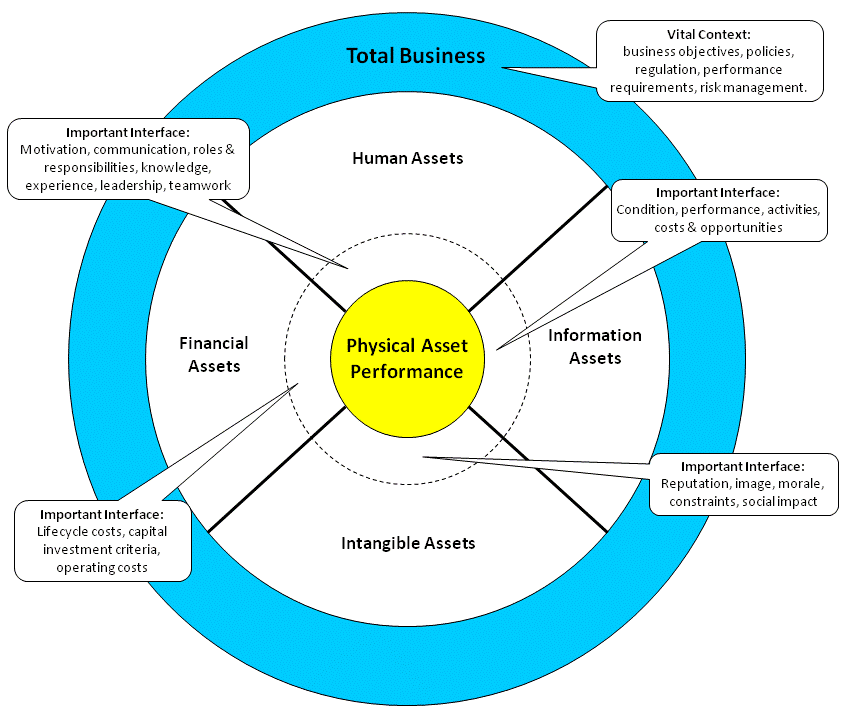
Although human factors such as leadership, motivation and culture are intangible assets they are critical to the successful achievement of asset management and require due consideration. This applies to how an organization treats its managers, employees, contractors and suppliers in all asset management life cycle phases.
The principal benefits of having an Enterprise Asset Management System, in no particular order, include:
- Enhanced customer satisfaction from improved performance and control of product or service delivery to the required standards
- Improved health, safety and environmental performance
- Optimized return on investment and/or growth through efficient stewardship of assets
- The ability to demonstrate best value for money within a constrained funding regime
- Evidence, in the form of controlled and systematic processes, to demonstrate legal, regulatory and statutory compliance
- Improved risk management and corporate governance, and a clear audit trail for the appropriateness of decisions taken and their associated risks
- Improved corporate image, the benefits of which may include enhanced shareholder value, improved marketability of product/service, greater staff satisfaction and more efficient and effective procurement from the supply chain
- The ability to demonstrate that sustainability is actively considered as part of asset utilization and selection
To be effective, asset management must be combined with a quality management system and embrace the process of continual improvement and the methodology of Plan – Do – Check – Act.
The concepts and duties of operations, engineering, finance and maintenance must not be seen in isolation. It is essential they be seen in the context of getting the most out of operating assets with minimum operational costs. This optimization can only be realized when Finance, Engineering, Operations and Maintenance are working in Partnership across the life cycle with a shared and common responsibility toward this goal.
To go down the path of optimization it is necessary to first identify what measures will be used to determine an ‘optimized asset utilization’ state. There must be an integration of the inputs from economics, engineering, operations, reliability, maintenance, safety regulatory, procurement, risk to develop the appropriate operational and maintenance strategies.
Some organizations may justify the development of teams that take these inputs and develop criteria for performance and costs in conjunction with corporate business objectives. Inevitably these must be in the form of financial benchmarks for the use of senior executives. These criteria must take into account the life time financial impact that any asset installed has on installation, development, production, quality, safety, hazardous waste disposal, maintenance, purchasing, and final disposal. However, it is equally important that the optimization model identify in quite specific detail where losses are taking place and what it costs not to take action on these. Appropriate measures, or performance indicators, must be used that serve the practical purposes of production and maintenance.
The process of getting world class asset reliability and performance has also become known as Operational Excellence. No matter what you call it—Terotechnology, Operational Excellence, or Enterprise Asset Management—it requires a significant change in attitude, thinking, and methods at all levels in the organization. The organization will need:
- A Change in Philosophy: FROM detecting problems and fixing them TO preventing failures from happening in the first place
- The realization that ‘Good’ is no longer good enough – excellence is to be expected
- Belief that most machinery problems are preventable
- Everyone in the organization has a proactive role
The essential elements involved in the process of change and development to Enterprise Asset Management success will always involve gaining more knowledge, developing higher skills, seeing a wider, holistic perspective, and the continuous seeking of excellence. To achieve the necessary organizational integration the right information, knowledge, processes, practices, and procedures will live in the organization’s Enterprise Asset Management System.
To get a world class Enterprise Asset Management System fast a company needs correct guidance to build the most effective financial, operational, engineering, and maintenance processes interlinked by their EAM system. When you want to build a world class EAM system for world class operational performance you can design and create it with a Plant Wellness Way EAM System-of-Reliability.



Leave a Reply