
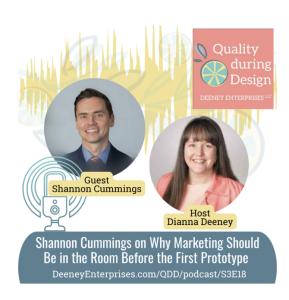
Shannon Cummings on Why Marketing Should Be in the Room Before the First Prototype (A Chat with Cross-Functional Experts)
You’ve probably been there: a team of brilliant engineers, a clear roadmap, and months of work, only to launch a product that no one uses. The customer needs were never fully understood. Marketing showed up too late. The “why” got lost in the “how.”
This isn’t a failure of talent. It’s a failure of process. And more often than not, it’s because marketing (so often seen as a “support” function) wasn’t part of the conversation until it was too late.
In this episode, Dianna Deeney speaks with Shannon Cummings, a seasoned product and marketing strategist who’s spent his career bridging the gap between Marketing, Product, and Engineering. He’s launched life-changing medical devices, cut development time in half, and done it all by bringing marketing into the room before the first prototype.
This interview is part of our series, “A Chat with Cross Functional Experts”. Our focus is speaking with people that are typically part of a cross-functional team within engineering projects.
About Shannon
Shannon Cummings is a seasoned product and marketing strategist who helps organizations bring clarity to complex markets and build products that truly resonate with customers. He’s known for bridging the gap between Marketing, Product, and Engineering: translating customer insight into actionable product direction and strengthening cross‑functional alignment.
What Shannon and Dianna Talk About
Shannon doesn’t just talk about alignment. He lives it. He shares how early customer insight, shared processes, and intentional collaboration aren’t just “nice to have”. Instead, they’re essential for building products that matter.
You’ll walk away with:
- A clear framework for involving marketing early in product development
- Real-world examples of how cross-functional teams achieve breakthrough results
- One actionable step you can take today to reduce misalignment and build better products, faster
This isn’t about adding more meetings. It’s about building smarter teams, where everyone speaks the same language, and everyone is working toward the same goal.
Some of the main takeaways from our discussion:
Start with the “Why” — Not the Prototype
Product development should begin with understanding the customer, not with building something.
Shannon emphasizes that the true beginning of any project isn’t when engineers start sketching designs. It’s when the team goes out to understand the problem. Without a clear definition of *who* you’re solving for and *what* they truly need, you’re building in the dark. A well-defined voice of customer (VOC) and market position are the foundation of every successful product.
Action Step: Before any design work begins, answer: Who is this for? What problem are we solving? Why does it matter?
Marketing Is a Co-Creator — Not a Support Function
Marketing isn’t just about messaging or launch plans. It’s about shaping the product from the start.
Shannon challenges the outdated idea that marketing is “after the fact.” Instead, he advocates for marketing teams to be deeply involved in discovery, customer research, and early-stage decision-making. When marketers help define the problem and prioritize features, the product becomes more focused, customer-centric, and market-ready.
Action Step: Invite your marketing lead into discovery and design discussions *before* the first prototype.
The Best Teams Are “Indistinguishable” — Marketing and Engineering Are One
When departments blur, innovation thrives.
Shannon shares that the most successful projects he’s worked on had teams where you couldn’t tell who was marketing and who was engineering. This happens when engineers help gather customer insights and marketers contribute to design decisions. The result? Faster decisions, better alignment, and stronger team chemistry.
Action Step: Create joint customer interviews or design sprints where marketing and engineering co-lead.
Define the “One Thing” — Then Stick to It
Great products don’t do everything. They do one thing exceptionally well.
Shannon credits the book *The One Thing* for helping him focus on what truly matters. In product development, teams often try to solve too many problems at once. The key is to identify the core customer need and build around it. Everything else becomes a “nice to have”, not a must-have.
Action Step: At every stage gate, ask: “Is this helping us solve the one thing that matters?”
Process Is the Foundation — Not Just a Checklist
Alignment doesn’t happen by accident. It needs structure.
Shannon stresses that the biggest failure isn’t bad data, it’s the lack of a defined process. When marketing and engineering follow aligned, stage-gate processes, teams know what’s expected, when to deliver, and how to collaborate. A strong process ensures that customer insights are gathered, validated, and acted on, before design begins.
Action Step: Map out a shared process with clear stage gates and required inputs from marketing, engineering, and product.
Be Ready to Pivot — But Only with Data and Team Alignment
Market shifts happen. The key is responding with discipline, not panic.
When a competitor enters the market or customer needs evolve, teams can’t just react blindly. Shannon shares that even the best-laid plans need adjustment—but only when backed by solid data and team consensus. The marketer’s role becomes the voice of discipline: “We can’t do everything. Let’s focus on what matters.”
Action Step: Build in regular “check-in” points to assess assumptions and realign if needed—without derailing the project.
Relationships Are the Glue — Not Just Processes
Technical alignment fails without human connection.
Shannon puts it simply: “I spend more time with my coworkers than I do with my wife.” Building trust, empathy, and mutual respect with your marketing and engineering counterparts isn’t “soft”—it’s essential. When teams know each other, they can have hard conversations, give feedback, and hold each other accountable without friction.
Action Step: Schedule informal check-ins—coffee, lunch, or a quick 1:1—to build trust and rapport.
Launch Success Starts Long Before Launch Day
The launch isn’t the end. It’s the beginning of the story.
Shannon believes the best teams don’t just build a product. They build a story around it. Marketing’s role extends beyond launch: it includes customer education, training, and even involving engineers in customer feedback loops. When the team understands how the product performs in the real world, it fuels the next round of innovation.
Action Step: Include engineers in post-launch customer feedback sessions or field visits.
Final Thought from Shannon:
“The best teams are the ones where you can’t tell who’s marketing and who’s engineering. They’re all working toward the same goal: solving the right problem, for the right people, in the right way.”
Contact Shannon
The best way to contact Shannon Cummings is on LinkedIn. Follow him for his thoughtful posts.
Shannon’s Recommendation
Book: The ONE Thing: The Surprisingly Simple Truth Behind Extraordinary Results: Amazon Link
Other podcast episodes you might like:
Slow Down to Speed Up: Jake McKee’s Guide to AIX (A Chat with Cross-Functional Experts)
Social Dynamics within Engineering with Yakira Mirabito (A Chat with Cross-Functional Experts)


Leave a Reply