
The Weibull distribution is a versatile statistical model that has become a cornerstone in reliability engineering and quality management. Developed by Swedish mathematician Waloddi Weibull in 1937, it was initially used to model the distribution of material strength, particularly the yield strength of materials. Weibull presented this distribution to the American Society of Mechanical Engineers (ASME) in 1951, marking a significant milestone in its adoption.

Find the 1951 paper, “A Statistical Distribution Function of Wide Applicability,” online via McGill University.
Initially met with skepticism, the Weibull distribution gained widespread recognition in the 1970s when the U.S. Air Force adopted it for aircraft failure analysis. The 1980s saw a surge in its use as quality management principles became more prominent in manufacturing. Its ability to model both early failures and wear-out periods made it essential for preventive maintenance and quality control. Today, it is widely used across various industries, including aerospace, electronics, and medicine.
Mathematical Properties and Flexibility
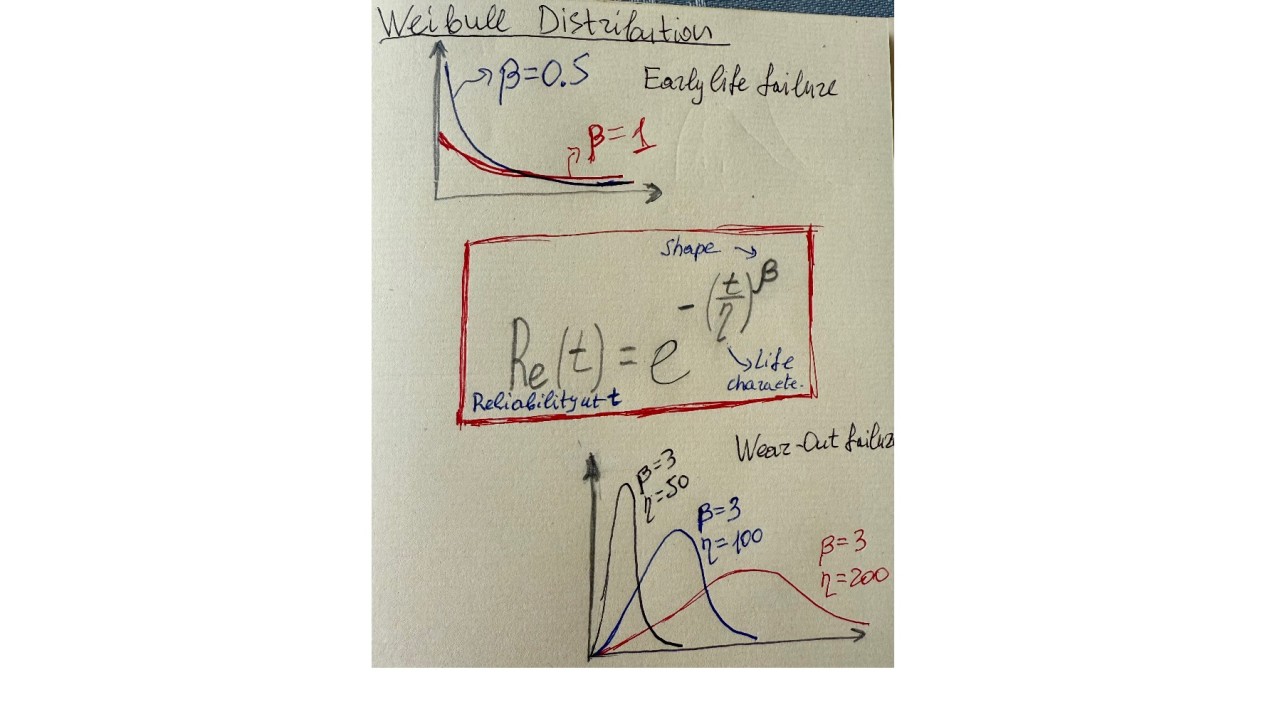
The Weibull distribution is characterized by its shape and scale parameters, which allow it to model a wide range of failure patterns. The shape parameter, often denoted as β, determines the distribution’s shape and can indicate whether the failure rate is decreasing, constant, or increasing over time. For instance, when β = 1, the Weibull distribution is equivalent to the exponential distribution, which models constant failure rates. With β near 3, it approximates a normal distribution, making it highly adaptable for different data sets.
The Weibull reliability function is:
$$ \displaystyle\large F\left(t\right)=1-e^{-\left(\frac{t}{\eta}\right)^{\beta}} $$Where:
- $-R\left(t\right)-$ is the reliabiltiy at time $-t-$.
- $-\eta-$ is the scale parameter (characteristic life).
- $-\beta-$ is the shape parameter.
The Weibull distribution can be compared to other distributions like the lognormal and normal distributions. Unlike the Weibull, the lognormal distribution is best suited for data with large variances and when the logarithm of the data follows a normal distribution. The normal distribution, while symmetric, does not offer the same level of flexibility as the Weibull in modeling skewed data. The Weibull’s ability to fit various shapes makes it a preferred choice for reliability analysis and quality control applications.
Modern Applications and Integration
Today, the Weibull distribution is integrated into methodologies like Six Sigma, where it is used for process improvement and reliability enhancement.
Scenario: A manufacturing company producing electronic components wants to improve the reliability of its products using Six Sigma methodology. The company has noticed a significant number of early failures in its new line of circuit boards.
Objective: To use the Weibull distribution to analyze failure patterns, predict future failures, and optimize maintenance schedules to enhance product reliability.
Steps:
1. Data Collection: Collect failure time data for the circuit boards.Include both complete and censored data (e.g., units still operational at the end of the study).
2. Weibull Analysis: Use statistical software (e.g., Minitab) to fit the Weibull distribution to the collected data. Estimate the shape parameter (β) and scale parameter (η) using maximum likelihood estimation.
3. Interpretation: If β < 1, it indicates early failures or infant mortality, suggesting a need for improved quality control during manufacturing. If β = 1, failures are random, indicating a stable process but potential for random defects. If β > 1, failures are due to wear-out, suggesting the need for preventive maintenance.
Modern statistical software packages include tools for Weibull analysis, making it more accessible for quality professionals. Its applications extend beyond manufacturing to fields such as meteorology and hydrology, demonstrating its versatility and utility in modeling diverse types of data. The Weibull distribution remains a fundamental tool in reliability engineering, offering insights into failure patterns and helping to optimize maintenance schedules and product lifecycles.



Leave a Reply