
Accendo Reliability

Your Reliability Engineering Professional Development Site

  • Home
  • About
    • Contributors
    • About Us
    • Colophon
    • Survey
  • Reliability.fm
    • Speaking Of Reliability
    • Rooted in Reliability: The Plant Performance Podcast
    • Quality during Design
    • Reliability 4.0
    • CMMSradio
    • Way of the Quality Warrior
    • Critical Talks
    • Asset Performance
    • Dare to Know
    • Maintenance Disrupted
    • Metal Conversations
    • The Leadership Connection
    • Practical Reliability Podcast
    • Reliability Gang
    • Reliability Hero
    • Reliability Matters
    • Reliability it Matters
    • Maintenance Mavericks Podcast
    • Women in Maintenance
    • Accendo Reliability Webinar Series
  • Articles
    • CRE Preparation Notes
      • Reliability Bites
    • NoMTBF
    • on Leadership & Career
      • Advanced Engineering Culture
      • ASQR&R
      • Engineering Leadership
      • Managing in the 2000s
      • Product Development and Process Improvement
    • on Maintenance Reliability
      • Aasan Asset Management
      • AI & Predictive Maintenance
      • Asset Management in the Mining Industry
      • CMMS and Maintenance Management
      • CMMS and Reliability
      • Conscious Asset
      • EAM & CMMS
      • Everyday RCM
      • History of Maintenance Management
      • Life Cycle Asset Management
      • Maintenance and Reliability
      • Maintenance Management
      • Plant Maintenance
      • Process Plant Reliability Engineering
      • RCM Blitz®
      • ReliabilityXperience
      • Rob’s Reliability Project
      • The Intelligent Transformer Blog
      • The People Side of Maintenance
      • The Reliability Crime Lab
      • The Reliability Mindset
    • on Product Reliability
      • Accelerated Reliability
      • Achieving the Benefits of Reliability
      • Apex Ridge
      • Beyond the Numbers
      • Breaking Bad for Reliability
      • Field Reliability Data Analysis
      • Metals Engineering and Product Reliability
      • Musings on Reliability and Maintenance Topics
      • Product Validation
      • Reliability by Design
      • Reliability Competence
      • Reliability Engineering Insights
      • Reliability in Emerging Technology
      • Reliability Knowledge
    • on Risk & Safety
      • CERM® Risk Insights
      • Equipment Risk and Reliability in Downhole Applications
      • Operational Risk Process Safety
    • on Systems Thinking
      • The RCA
      • Communicating with FINESSE
    • on Tools & Techniques
      • Big Data & Analytics
      • Experimental Design for NPD
      • Innovative Thinking in Reliability and Durability
      • Inside and Beyond HALT
      • Inside FMEA
      • Institute of Quality & Reliability
      • Integral Concepts
      • Learning from Failures
      • Progress in Field Reliability?
      • R for Engineering
      • Reliability Engineering Using Python
      • Reliability Reflections
      • Statistical Methods for Failure-Time Data
      • Testing 1 2 3
      • The Hardware Product Develoment Lifecycle
      • The Manufacturing Academy
  • eBooks
  • Resources
    • Special Offers
    • Accendo Authors
    • FMEA Resources
    • Glossary
    • Feed Forward Publications
    • Openings
    • Books
    • Webinar Sources
    • Journals
    • Higher Education
    • Podcasts
  • Courses
    • Your Courses
    • 14 Ways to Acquire Reliability Engineering Knowledge
    • Live Courses
      • Introduction to Reliability Engineering & Accelerated Testings Course Landing Page
      • Advanced Accelerated Testing Course Landing Page
    • Integral Concepts Courses
      • Reliability Analysis Methods Course Landing Page
      • Applied Reliability Analysis Landing Page
      • Statistics, Hypothesis Testing, & Regression Modeling Course Landing Page
      • Measurement System Assessment Course Landing Page
      • SPC & Process Capability Course Landing Page
      • Design of Experiments Course Landing Page
    • The Manufacturing Academy Courses
      • An Introduction to Reliability Engineering
      • Reliability Engineering Statistics
      • An Introduction to Quality Engineering
      • Quality Engineering Statistics
      • FMEA in Practice
      • Process Capability Analysis course
      • Root Cause Analysis and the 8D Corrective Action Process course
      • Return on Investment online course
    • Industrial Metallurgist Courses
    • FMEA courses Powered by The Luminous Group
      • FMEA Introduction
      • AIAG & VDA FMEA Methodology
    • Barringer Process Reliability Introduction
      • Barringer Process Reliability Introduction Course Landing Page
    • Fault Tree Analysis (FTA)
    • Foundations of RCM online course
    • Reliability Engineering for Heavy Industry
    • How to be an Online Student
    • Quondam Courses
  • Webinars
    • Upcoming Live Events
    • Accendo Reliability Webinar Series
  • Calendar
    • Call for Papers Listing
    • Upcoming Webinars
    • Webinar Calendar
  • Login
    • Member Home
Home » Articles » on Tools & Techniques » The Manufacturing Academy » Downtime Frequency and Duration

by Ray Harkins Leave a Comment

Downtime Frequency and Duration

Downtime Frequency and Duration

This article is adapted from Chapter 6 of my book, Measuring Manufacturing Effectiveness.

The book examines how manufacturing organizations define and use performance metrics, and how those measurement choices influence decisions, priorities, and behavior on the shop floor and in management. While the chapters are organized as a cohesive framework, each one is written to address a specific aspect of manufacturing effectiveness and can be read independently.

Chapter 6 focuses on a critical but often oversimplified topic: downtime.

Most organizations track downtime in some form, but far fewer distinguish meaningfully between how often downtime occurs and how long it lasts. These two dimensions — frequency and duration — are frequently combined, averaged, or summarized in ways that mask important operational realities.

This chapter explores why separating downtime frequency from downtime duration matters, how each dimension points to different underlying causes, and how failing to distinguish between them can lead to ineffective or misdirected improvement efforts.

Downtime Frequency and Duration

Availability depends jointly on interruption frequency and recovery duration. These dimensions describe different operational behaviors.

  • Frequent short interruptions indicate lower MTBF and lower MTTR
  • Infrequent long interruptions indicate higher MTBF and higher MTTR

Both patterns may produce similar total downtime while creating markedly different production environments. Availability alone does not distinguish between these behaviors; MTBF and MTTR together provide the necessary context.

Frequent Short Interruptions

With a lower MTBF and MTTR, production is repeatedly interrupted and restarted. Individual events are brief, but cumulative disruption is significant.

This pattern is often normalized at the operator level. Interruptions may be described as resets, nuisance stops, or momentary faults, and without an automated data collection system, are inconsistently recorded. As a result, reported downtime may understate the true impact on production flow and stability.

Operational consequences of frequent short interruptions include:

  • Fragmented production
  • Repeated ramp-up losses
  • Increased operator workload
  • Erosion of standard work
  • Increased susceptibility to quality instability

Although recovery is rapid, the production system rarely operates in a sustained steady state.

Infrequent Long Interruptions

With a higher MTBF and MTTR, failures are rare but highly disruptive. These events are typically visible to supervision and management and trigger formal response processes.

Despite their severity, infrequent long interruptions are often easier to plan around. Production schedules can be adjusted, resources reassigned, and corrective actions documented. These events are almost always captured accurately in downtime reporting.

Figure 5 illustrates the key differences between the interruption types.

Equal Downtime, Different Operational Reality

Systems with equal total downtime can impose very different operational demands.

Frequent interruptions impose continuous cognitive and procedural load on operators and supervisors. Infrequent interruptions impose episodic disruption but allow extended periods of uninterrupted production.

Total downtime does not distinguish between these realities. Downtime behavior does.
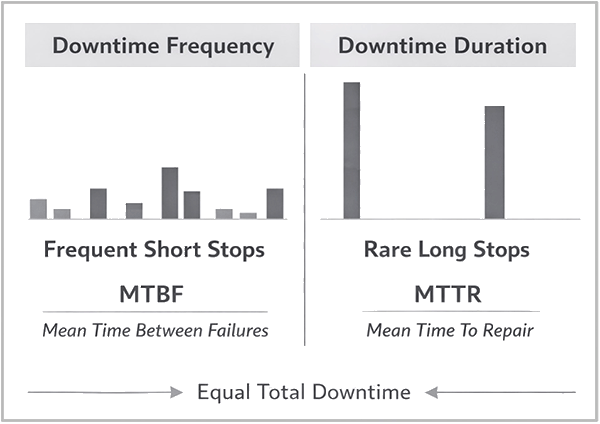
Reliability engineering graph comparing downtime frequency and duration, illustrating MTBF and MTTR
Figure 5: Downtime Frequency versus Downtime Duration

Secondary Effects of Downtime Behavior

Downtime behavior influences performance and quality beyond its direct impact on availability.

Frequent interruptions increase the likelihood of:

  • Performance loss during repeated ramp-up
  • Quality loss during restart and stabilization
  • Operator workarounds
  • Informal adjustments that bypass standard controls

These effects are often misclassified as performance inefficiency or quality problems, when their origin lies in interruption behavior.

Matching Improvement Strategy to Downtime Behavior

Effective improvement requires alignment between downtime behavior and corrective action.

  • Frequent interruptions indicate the need for reliability improvement and robustness
  • Long interruptions indicate the need for improved maintainability and recovery capability

Treating all downtime as equivalent leads to misdirected effort and limited improvement.

Availability as a Management Lever

Availability reflects decisions made across design, maintenance strategy, staffing, training, and operational authority. It is not a passive outcome.

In many operations, reducing MTTR yields faster and more predictable gains than attempting to eliminate failures entirely. Incremental reductions in recovery time, applied repeatedly, can recover more production capacity than eliminating infrequent failure modes.

Availability establishes the ceiling for performance and quality. If equipment cannot run when scheduled, downstream improvements have no effective domain.

Key Takeaways

  • Availability loss arises from both interruption frequency and recovery duration, which describe fundamentally different operational behaviors.
  • Frequent short interruptions and infrequent long interruptions can produce similar total downtime while creating very different production environments.
  • Total downtime alone does not capture downtime behavior; MTBF and MTTR together provide the necessary context.
  • Frequent interruptions disproportionately disrupt flow, increase ramp-up losses, and elevate risk of performance and quality instability.
  • Effective improvement requires matching corrective action to downtime behavior rather than treating all downtime as equivalent.

Understanding how downtime occurs is as important as knowing how much downtime occurs, because behavior and totals together determine its operational impact.

This chapter is part of Measuring Manufacturing Effectiveness, a 12-chapter framework that examines how manufacturing performance metrics are defined, interpreted, and used to guide improvement and decision-making.

The complete book brings these ideas together into a coherent measurement system, supported by figures, equations, and practical examples that place topics like downtime, Availability, Performance, and Quality into a broader operational context.

If you’d like access to the full framework, the book is available on Amazon here:

If you purchase Measuring Manufacturing Effectiveness through this link, it helps support the ongoing work of Accendo Reliability, which has generously hosted this serialized release.

Ray Harkins is the General Manager of Lexington Technologies in Lexington, North Carolina. He earned his Master of Science from Rochester Institute of Technology and his Master of Business Administration from Youngstown State University. He also teaches 60+ quality, engineering, manufacturing, and business-related courses such as Quality Engineering Statistics, Reliability Engineering Statistics, Failure Modes and Effects Analysis (FMEA), and Root Cause Analysis and the 8D Corrective Action Process through the online learning platform, Udemy.

Filed Under: Articles, on Tools & Techniques, The Manufacturing Academy

About Ray Harkins

Ray Harkins is a senior manufacturing professional with over 25 years of experience in manufacturing engineering, quality management, and business analysis.

During his career, he has toured hundreds of manufacturing facilities and worked with leading industry professionals throughout North America and Japan.

« Instilling Energy Confidence
The People Skills of a Good Reliability Engineer »

Leave a Reply Cancel reply

Your email address will not be published. Required fields are marked *

Logo for The Manufacturing Acadamey headshot of RayArticle by Ray Harkins
in the The Manufacturing Academy article series

Join Accendo

Receive information and updates about articles and many other resources offered by Accendo Reliability by becoming a member.

It’s free and only takes a minute.

Join Today

Recent Posts

  • The FINESSE Accessibility Checklist Removes a Pervasive Communication Barrier
  • Ethics in Reliability Engineering – Practical Dilemmas, not Theory
  • The People Skills of a Good Reliability Engineer
  • Downtime Frequency and Duration
  • Instilling Energy Confidence

© 2026 FMS Reliability · Privacy Policy · Terms of Service · Cookies Policy

Book the Course with John
  Ask a question or send along a comment. Please login to view and use the contact form.
This site uses cookies to give you a better experience, analyze site traffic, and gain insight to products or offers that may interest you. By continuing, you consent to the use of cookies. Learn how we use cookies, how they work, and how to set your browser preferences by reading our Cookies Policy.
