Predictive Maintenance, Condition Monitoring, and Condition Based Maintenance have not been clearly defined and we are looking to begin a dialogue to create a standard definition for these terms. Join us as we begin our discussion. [Read more…]
Your Reliability Engineering Professional Development Site
Predictive Maintenance, Condition Monitoring, and Condition Based Maintenance have not been clearly defined and we are looking to begin a dialogue to create a standard definition for these terms. Join us as we begin our discussion. [Read more…]

I was recently giving a presentation for IEEE at MIT Lincoln Labs here in the Boston area. The topic was one of my favorites, my new playground, Use Case 7 ! The crowd loved the idea of expanding how we access use cases and came up with great examples. and experiences, of their own. They found many areas in their work where the Use Case 7 exercise may yield some interesting insight.

The QFD concept is widely known, yet appears to be used infrequently. Too time consuming for the value, but it is a “good idea.” There are several schools of thought, and certainly practical approaches for implementation that can provide needed business solutions. This video introduces the topic. If you want help with implementation, or with training – contact us to obtain the break throughs available. [Read more…]

The term resilience is used in reports and studies by numerous government agencies and international institutions. For instance, in 20014 the Organization forEconomic Cooperation and Development issued a report entitled “OECD Reviews ofRisk Management Policies: Boosting Resilience Through Innovative Risk Governance”. [Read more…]

In a meeting the other day, the presenter was talking about a range of different failures for the product in question. She talked about each issue, a bit about the failure analysis, yet didn’t reveal which failures occurred more or less often.
She did provide a handout with a listing of the problems in order of the product field age and listing of the failure name (component or system involved). So, I grabbed a piece of paper to create a frequency table so I could quickly determine which problems occurred more often than others. [Read more…]
 I recently had the pleasure to interview Doug Stangier, co-author of Preventive Maintenance Made Simple. This is another excellent book in the Made Simple series, published by ReliabilityWeb. During the interview, Doug not only provides insights into his book but also into what world class Preventive Maintenance looks like. Anyone new to maintenance and reliability, or seasoned experts can benefit from this great book. Without further delay, here is the interview with Doug.

I have worked in the field of reliability for a good many years. I have presented both beginner and advanced reliability engineering courses. I have even read several books. 🙂 But, across all this, component redundancy has never been explained beyond simple serial and parallel configurations.
So, it was a shock to my system to be presented with a scenario that couldn’t be solved using a simple parallel system.
My previous work had challenged me only as far as:
But now I was being challenged by a network that was none of these.

Guest Post by Robert Pojasek (first posted on CERM ® RISK INSIGHTS – reposted here with permission)
In 2012, ISO’s ‘Joint Technical Coordinating Group’ (JTCG) completed work to provide a high-level structure, text, and common terms and definitions for all future and revised management system standards. All Technical Committees developing management system standards were required to follow Annex SL found in the ISO/IEC Directives, Part 1, Annex SL[i].
As we approach 2019, it is abundantly clear that the high-level structure mandate has been followed by the Technical Committees with mixed results. All the new and revised management systems used the 10-clause structure and all of them include the same definition of risk and risk management. However, the way risk management was used in the different management system standards varied considerably. What can an organization learn from this exercise? [Read more…]
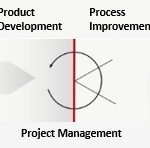
In reviewing several previous articles in this article series, it’s apparent there is much in common with product development, project management and process improvement.
Let’s look at a brief list that considers a structured approach vs. unstructured
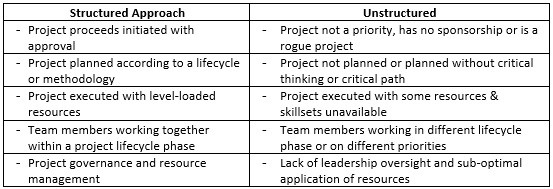
While this list is pretty “high-level” it reveals the importance of project leadership, governance and management. A structured approach (for example a phase-gate structure, DMAIC or agile/scrum) enables management and planning, which enables governance and governance enables leadership.
Some structured approaches may be more suitable than others depending on the type of project. However, any structure (with leadership, governance and management in mind) is probably better than none.

When an objective requires a tool to be used, that is idea. Certain projects can greatly benefit from use of Monte Carlo analysis. This in depth knowledge can create solutions where it is not readily apparent. If you are considering going this far, we can help you decide if the value is worthwhile. And we can help you apply it in a simple yet powerful way. [Read more…]
 In the previous articles, we looked at what type of analysis to use to evaluate the effectiveness of the PMs and if they are cost effective. Once the PMs have been optimized to ensure they are addressing the right failure modes, then they need to be made efficient. Below is an excerpt from a recent article in SMRP’s Solutions Magazine on how to make PM efficient using the lean tools.

We’ve all seen it…a filing cabinet full of project management plans and procedures from the last job that people have tried to adapt and modify to meet the current project. Amazing that such a plethora can give the impression of effectiveness and, to a skeptic, surprising if they are relevant, read or assimilated. [Read more…]

The clever Dr. John Snow mapped cholera cases during the epidemic of 1854 on a street map of the area. This type of mapping now called a measles chart, or defect location check sheet, or defect map, is useful when exploring the effect of location data.
The name measles chart may have come from the habit of using an image of drawing of a product and adding small red dots to signify defect locations.

Statistical Process Control is about addressing business needs. It is not about charts. It is not even about control. It is about focused learning and taking action. Our successful implementation history means that we can help you too! [Read more…]

“. . . not everything that can be counted counts” Albert Einstein
A key, but often missed, step in FMEA preparation is to identify and prioritize the functions that relate to the item being analyzed. These become candidate functions to be brought into the FMEA.