
Accendo Reliability

Your Reliability Engineering Professional Development Site

  • Home
  • About
    • Contributors
    • About Us
    • Colophon
    • Survey
  • Reliability.fm
    • Speaking Of Reliability
    • Rooted in Reliability: The Plant Performance Podcast
    • Quality during Design
    • Reliability 4.0
    • CMMSradio
    • Way of the Quality Warrior
    • Critical Talks
    • Asset Performance
    • Dare to Know
    • Maintenance Disrupted
    • Metal Conversations
    • The Leadership Connection
    • Practical Reliability Podcast
    • Reliability Gang
    • Reliability Hero
    • Reliability Matters
    • Reliability it Matters
    • Maintenance Mavericks Podcast
    • Women in Maintenance
    • Accendo Reliability Webinar Series
  • Articles
    • CRE Preparation Notes
      • Reliability Bites
    • NoMTBF
    • on Leadership & Career
      • Advanced Engineering Culture
      • ASQR&R
      • Engineering Leadership
      • Managing in the 2000s
      • Product Development and Process Improvement
    • on Maintenance Reliability
      • Aasan Asset Management
      • AI & Predictive Maintenance
      • Asset Management in the Mining Industry
      • CMMS and Maintenance Management
      • CMMS and Reliability
      • Conscious Asset
      • EAM & CMMS
      • Everyday RCM
      • History of Maintenance Management
      • Life Cycle Asset Management
      • Maintenance and Reliability
      • Maintenance Management
      • Plant Maintenance
      • Process Plant Reliability Engineering
      • RCM Blitz®
      • ReliabilityXperience
      • Rob’s Reliability Project
      • The Intelligent Transformer Blog
      • The People Side of Maintenance
      • The Reliability Crime Lab
      • The Reliability Mindset
    • on Product Reliability
      • Accelerated Reliability
      • Achieving the Benefits of Reliability
      • Apex Ridge
      • Beyond the Numbers
      • Breaking Bad for Reliability
      • Field Reliability Data Analysis
      • Metals Engineering and Product Reliability
      • Musings on Reliability and Maintenance Topics
      • Product Validation
      • Reliability by Design
      • Reliability Competence
      • Reliability Engineering Insights
      • Reliability in Emerging Technology
      • Reliability Knowledge
    • on Risk & Safety
      • CERM® Risk Insights
      • Equipment Risk and Reliability in Downhole Applications
      • Operational Risk Process Safety
    • on Systems Thinking
      • The RCA
      • Communicating with FINESSE
    • on Tools & Techniques
      • Big Data & Analytics
      • Experimental Design for NPD
      • Innovative Thinking in Reliability and Durability
      • Inside and Beyond HALT
      • Inside FMEA
      • Institute of Quality & Reliability
      • Integral Concepts
      • Learning from Failures
      • Progress in Field Reliability?
      • R for Engineering
      • Reliability Engineering Using Python
      • Reliability Reflections
      • Statistical Methods for Failure-Time Data
      • Testing 1 2 3
      • The Hardware Product Develoment Lifecycle
      • The Manufacturing Academy
  • eBooks
  • Resources
    • Special Offers
    • Accendo Authors
    • FMEA Resources
    • Glossary
    • Feed Forward Publications
    • Openings
    • Books
    • Webinar Sources
    • Journals
    • Higher Education
    • Podcasts
  • Courses
    • Your Courses
    • 14 Ways to Acquire Reliability Engineering Knowledge
    • Live Courses
      • Introduction to Reliability Engineering & Accelerated Testings Course Landing Page
      • Advanced Accelerated Testing Course Landing Page
    • Integral Concepts Courses
      • Reliability Analysis Methods Course Landing Page
      • Applied Reliability Analysis Landing Page
      • Statistics, Hypothesis Testing, & Regression Modeling Course Landing Page
      • Measurement System Assessment Course Landing Page
      • SPC & Process Capability Course Landing Page
      • Design of Experiments Course Landing Page
    • The Manufacturing Academy Courses
      • An Introduction to Reliability Engineering
      • Reliability Engineering Statistics
      • An Introduction to Quality Engineering
      • Quality Engineering Statistics
      • FMEA in Practice
      • Process Capability Analysis course
      • Root Cause Analysis and the 8D Corrective Action Process course
      • Return on Investment online course
    • Industrial Metallurgist Courses
    • FMEA courses Powered by The Luminous Group
      • FMEA Introduction
      • AIAG & VDA FMEA Methodology
    • Barringer Process Reliability Introduction
      • Barringer Process Reliability Introduction Course Landing Page
    • Fault Tree Analysis (FTA)
    • Foundations of RCM online course
    • Reliability Engineering for Heavy Industry
    • How to be an Online Student
    • Quondam Courses
  • Webinars
    • Upcoming Live Events
    • Accendo Reliability Webinar Series
  • Calendar
    • Call for Papers Listing
    • Upcoming Webinars
    • Webinar Calendar
  • Login
    • Member Home
Home » Articles » on Tools & Techniques » The Manufacturing Academy » Planned and Unplanned Downtime: Choice Versus Condition

by Ray Harkins Leave a Comment

Planned and Unplanned Downtime: Choice Versus Condition

Planned and Unplanned Downtime: Choice Versus Condition

This article is adapted from Chapter 8 of my book, Measuring Manufacturing Effectiveness.

The book explores how manufacturing organizations define and use performance metrics, and how those definitions influence operational decisions, improvement efforts, and management behavior. While the chapters form a connected framework, each is written to address a specific aspect of manufacturing effectiveness and can be read independently.

Performance loss is often described in overly simple terms—the equipment is running slower than it should. While speed is certainly part of the story, this narrow view hides a much broader set of losses that affect output, flow, and stability.

Chapter 8 expands the discussion of performance loss beyond basic speed shortfalls. It examines how interruptions, minor stops, micro-downtime, variability, and operating practices contribute to lost performance—even when equipment appears to be running continuously.

By broadening how performance loss is defined and observed, this chapter aims to improve how organizations diagnose problems and select effective improvement actions.

Planned and Unplanned Downtime: Choice Versus Condition

Downtime reduces available production time, but not all downtime has the same meaning. The distinction between planned and unplanned downtime is fundamental to interpreting availability, prioritizing improvement, and assigning responsibility.

Planned downtime reflects deliberate operational choices. Unplanned downtime reflects system condition and instability.

Confusing the two leads to incorrect conclusions and ineffective improvement actions.

Definitions and Scope

Planned downtime consists of production interruptions that are intentionally scheduled and expected. Typical examples include preventive maintenance, changeovers, cleaning, validation, and inspections.

Unplanned downtime consists of production interruptions that occur unexpectedly after the schedule has been established. Typical examples include breakdowns, unexpected stops, waiting for parts or support, and emergency troubleshooting.

Only unplanned downtime directly reduces availability.

Planned downtime reduces scheduled production time; unplanned downtime reduces available production time.

Planned Downtime as an Operational Decision

Planned downtime reflects how an organization chooses to operate and protect its assets. It is a function of production strategy, maintenance policy, and risk tolerance.

Planned downtime is typically:

  • Visible
  • Anticipated
  • Budgeted
  • Optimized deliberately

Reducing planned downtime without understanding its purpose can increase unplanned downtime later. Preventive maintenance, for example, consumes scheduled time but reduces failure frequency and recovery duration.

Planned downtime is therefore not a reliability failure. It is a management decision.

Unplanned Downtime as a System Signal

Unplanned downtime reflects system behavior under operating conditions. It indicates instability, insufficient robustness, or inadequate recovery capability.

Unplanned downtime is typically:

  • Disruptive
  • Unpredictable
  • Operationally expensive
  • Difficult to schedule around

Because it occurs after production has been scheduled, unplanned downtime directly reduces availability and cascades into performance and quality losses.

Unplanned downtime is not a planning problem. It is a diagnostic signal.

Why the Distinction Matters

Treating planned and unplanned downtime as equivalent obscures root causes.

Reducing planned downtime may improve utilization on paper while increasing failure frequency. Reducing unplanned downtime improves availability without compromising system health.

Availability metrics are meaningful only when downtime is classified by intent. Recall Figure 3 from chapter 5 that illustrates this distinction:
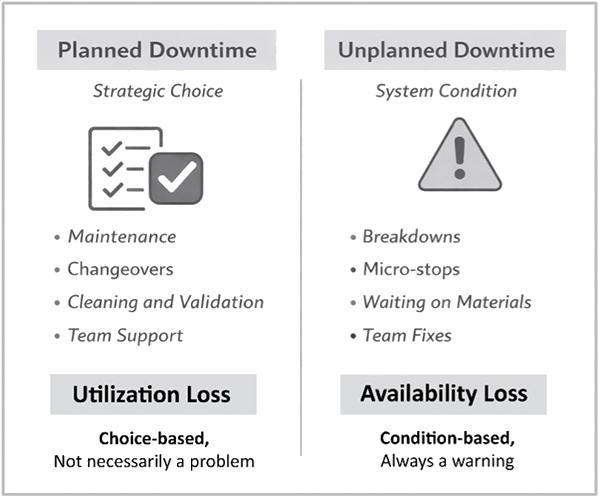
Planned vs Unplanned Downtime: Understanding the differences between strategic choices and system conditions.
Figure 3: Planned Downtime versus Unplanned Downtime

Misinterpretations to Avoid

Several common errors arise when downtime is not properly classified:

  • Treating preventive maintenance as lost productivity
  • Penalizing planned changeovers
  • Aggregating all downtime into a single improvement target
  • Assigning blame for downtime without considering intent

These practices discourage necessary protective actions and encourage short-term optimization at the expense of stability.

Planned Downtime and Capacity Planning

Planned downtime of the facility and equipment defines the gap between calendar time and scheduled production time. It establishes the realistic operating envelope of the system.

From a capacity perspective, planned downtime answers the question:

How much time is intentionally reserved for non-production activities?

This boundary is where OOE diverges from TEEP. Planned downtime reduces utilization but does not indicate inefficiency.

Unplanned Downtime and System Health

Unplanned downtime governs the transition from scheduled production time to available production time. It reflects the combined effects of reliability and maintainability.

From an effectiveness perspective, unplanned downtime answers the question:

How reliably does the system execute the plan?

Persistent unplanned downtime indicates structural issues that cannot be resolved through scheduling or staffing alone.

Strategic Implications

Effective organizations treat planned and unplanned downtime differently:

  • Planned downtime is reviewed for efficiency and necessity
  • Unplanned downtime is investigated for cause and trend

Improvement efforts are aligned accordingly.

Attempts to maximize utilization by compressing planned downtime without addressing unplanned downtime typically degrade long-term effectiveness.

Key Takeaways

  • Planned downtime is a strategic choice. Unplanned downtime is a warning that reflects system instability. Confusing the two undermines both planning and improvement.
  • Only unplanned downtime reduces availability.
  • Planned downtime defines utilization; unplanned downtime defines execution.
  • Treating all downtime equivalently leads to incorrect conclusions. Effective improvement depends on classifying downtime by intent.

This chapter is part of Measuring Manufacturing Effectiveness, a 12-chapter framework that examines how manufacturing performance metrics shape decision-making and improvement efforts.

The complete book brings together all chapters, along with figures, equations, and examples that place Availability, Performance, and Quality losses within a broader system of manufacturing measurement.

If you’d like access to the full framework, the book is available on Amazon here.

If you purchase Measuring Manufacturing Effectiveness through this link, it helps support the ongoing work of Accendo Reliability, which has generously hosted this serialized release.

Ray Harkins is the General Manager of Lexington Technologies in Lexington, North Carolina. He earned his Master of Science from Rochester Institute of Technology and his Master of Business Administration from Youngstown State University. He also teaches 60+ quality, engineering, manufacturing, and business-related courses such as Quality Engineering Statistics, Reliability Engineering Statistics, Failure Modes and Effects Analysis (FMEA), andRoot Cause Analysis and the 8D Corrective Action Process through the online learning platform, Udemy.

Filed Under: Articles, on Tools & Techniques, The Manufacturing Academy

About Ray Harkins

Ray Harkins is a senior manufacturing professional with over 25 years of experience in manufacturing engineering, quality management, and business analysis.

During his career, he has toured hundreds of manufacturing facilities and worked with leading industry professionals throughout North America and Japan.

« Cultural Mass, Indispensability, and Performance
Core Failure: The Case of the Melting Generator »

Leave a Reply Cancel reply

Your email address will not be published. Required fields are marked *

Logo for The Manufacturing Acadamey headshot of RayArticle by Ray Harkins
in the The Manufacturing Academy article series

Join Accendo

Receive information and updates about articles and many other resources offered by Accendo Reliability by becoming a member.

It’s free and only takes a minute.

Join Today

Recent Posts

  • Does Your FMEA Study Go Far Enough?
  • Core Failure: The Case of the Melting Generator
  • Planned and Unplanned Downtime: Choice Versus Condition
  • Cultural Mass, Indispensability, and Performance
  • It’s Time To Clear-Up A Serious Misunderstanding About Service Provider Certification To ISO 55001 Asset Management Standard

© 2026 FMS Reliability · Privacy Policy · Terms of Service · Cookies Policy

Book the Course with John
  Ask a question or send along a comment. Please login to view and use the contact form.
This site uses cookies to give you a better experience, analyze site traffic, and gain insight to products or offers that may interest you. By continuing, you consent to the use of cookies. Learn how we use cookies, how they work, and how to set your browser preferences by reading our Cookies Policy.
