
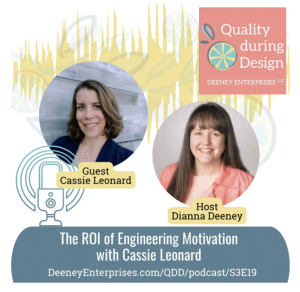
The ROI of Engineering Motivation with Cassie Leonard (A Chat with Cross-Functional Experts)
What if the career move that looks wrong on paper is actually the right call — and there’s an equation to prove it?
In this episode, Dianna talks with Cassie Leonard — aerospace engineer, executive coach, and two-time bestselling author of STEM Moms and Beyond the Pipeline — about why the traditional “linear pipeline” model of engineering careers is failing both people and the products they build.
Cassie introduces an ROI-style equation rooted in expectancy-value theory that explains why engineers make the career moves they do. And how leaders can use the same framework to retain talent, recognize top performers, and build more empathetic cross-functional teams.
This interview is part of our series, “A Chat with Cross Functional Experts”. Our focus is speaking with people that are typically part of a cross-functional team within engineering projects.
About Cassie
Cassie Leonard is an engineer, two-time bestselling author, and dedicated working parent with 19 years of experience in technical leadership and executive coaching. Through her company, ELMM (Engineers, Leaders, Moms, and Mentors), she helps working parents and allies in STEMM grow fearlessly, connect wholeheartedly, and design careers that actually work.
Aerospace is at her roots. With degrees from UCLA and the University of Sheffield, she spent 16 years climbing the corporate ladder from entry-level analyst to Senior Aircraft Integration Leader. Today, she pairs that technical grit with mom skills to help clients reverse-engineer their own version of success.
As Editor and Lead Author of Beyond the Pipeline: Redefining Value, Success, and the Future of Women in STEMM — Together, Cassie collaborated with women and allies worldwide to create an insightful, practical, and action-oriented exploration of today’s technical workplaces. Beyond the Pipeline has been an international bestseller since its launch in August 2025. Her first book, STEM Moms: Design, Build, and Test to Create the Work-Life of Your Dreams, launched her into this global conversation with stories and
solutions for solving the partial differential equations of life as a mother in a male-dominated industry.
Learn more at ELMMcoaching.com
What Cassie and Dianna Talk About
She shares how a simple ROI framework, rooted in decades of research, can explain the career moves that look surprising from the outside. And how leaders who understand it stop losing their best people to decisions that could have gone differently.
You’ll walk away with:
- A six-factor equation for evaluating career decisions — and how to apply it to your team, not just yourself
- A new way to think about retention that goes beyond compensation and titles
- One conversation starter you can use in your next 1-on-1 to uncover misalignment before it becomes an attrition risk
This isn’t about forcing engineers into a five-year plan. It’s about understanding what actually drives the people on your team so you can build the kind of environment where great engineers choose to stay and do their best work.

Some of the main takeaways from our discussion:
The Problem with the Linear Pipeline
The traditional model assumes everyone wants to move up and that leaving the pipeline equals failure. Cassie explains why that narrative is both outdated and damaging — to people and to the products they work on.
The ROI Equation for Career Decisions
Rooted in expectancy-value theory (Jacqueline Eccles, 1980s), the framework breaks every decision into six factors:
Numerator (Value): Attainment value — what this says about you externally; Intrinsic value — how it feels to you personally; Utility value — the functional “we need to eat” reality
Denominator (Cost): Effort and energy expended; Loss of valued alternatives; Risk or cost of failure
Cassie walks through her own decision to leave a Fortune 100 aerospace company using all six factors — including how one conversation with a senior manager nearly zeroed out her risk-of-failure cost.
For the Individual Engineer
How understanding your own equation builds confidence and authenticity — and why no one else can solve it for you. Cassie frames career choices as partial differential equations: dynamic, non-binary, and highly personal.
For the Engineering Leader
Leaders who ignore value misalignment risk losing their best people — or keeping them in roles that quietly drain them. Key takeaways include:
- Ask about loss of alternatives, not just the shiny new opportunity
- Use the six factors to structure 1-on-1 conversations beyond start/stop/continue
- Recognize “rock stars” (Kim Scott, Radical Candor) who want depth over promotion — and find ways to celebrate them that match their actual values
- Retention isn’t always about money — energy management is an attrition risk
For the Cross-Functional Team
Different departments carry different value equations into the same project. R&D, supply chain, and the shop floor may all be working toward the same plane but experiencing entirely different cost-to-value ratios. Cassie and Dianna explore how speaking to each function’s “numerator” — what’s in it for them — creates more collaborative, solution-based conversations under cost and schedule pressure.
Insight to Action
For engineers: Pick one of the six factors — start with energy. Which life domains are filling your bucket right now, and which ones have a hole in them? Just building awareness of that is a powerful first step.
For leaders: In your next 1-on-1, try this question: “If you took this opportunity, what do you think you’d be giving up?” Acknowledging that career moves involve real loss — not just gain — builds the kind of trust that keeps top performers from quietly walking out the door.
Contact Cassie
ELMMcoaching.com
Cassie Leonard | LinkedIn
Cassie’s Recommendation
Books:
Beyond the Pipeline — ELMM Coaching
STEM Moms, by Cassie Leonard — ELMM Coaching
Reimagine your Work by Wendy A. Cocke
Other podcast episodes you might like:
Slow Down to Speed Up: Jake McKee’s Guide to AIX (A Chat with Cross-Functional Experts)
Social Dynamics within Engineering with Yakira Mirabito (A Chat with Cross-Functional Experts)



Leave a Reply