Accendo Reliability

Your Reliability Engineering Professional Development Site

  • Home
  • About
    • Contributors
    • About Us
    • Colophon
    • Survey
  • Reliability.fm
    • Speaking Of Reliability
    • Rooted in Reliability: The Plant Performance Podcast
    • Quality during Design
    • CMMSradio
    • Way of the Quality Warrior
    • Critical Talks
    • Asset Performance
    • Dare to Know
    • Maintenance Disrupted
    • Metal Conversations
    • The Leadership Connection
    • Practical Reliability Podcast
    • Reliability Hero
    • Reliability Matters
    • Reliability it Matters
    • Maintenance Mavericks Podcast
    • Women in Maintenance
    • Accendo Reliability Webinar Series
  • Articles
    • CRE Preparation Notes
    • NoMTBF
    • on Leadership & Career
      • Advanced Engineering Culture
      • ASQR&R
      • Engineering Leadership
      • Managing in the 2000s
      • Product Development and Process Improvement
    • on Maintenance Reliability
      • Aasan Asset Management
      • AI & Predictive Maintenance
      • Asset Management in the Mining Industry
      • CMMS and Maintenance Management
      • CMMS and Reliability
      • Conscious Asset
      • EAM & CMMS
      • Everyday RCM
      • History of Maintenance Management
      • Life Cycle Asset Management
      • Maintenance and Reliability
      • Maintenance Management
      • Plant Maintenance
      • Process Plant Reliability Engineering
      • RCM Blitz®
      • ReliabilityXperience
      • Rob’s Reliability Project
      • The Intelligent Transformer Blog
      • The People Side of Maintenance
      • The Reliability Mindset
    • on Product Reliability
      • Accelerated Reliability
      • Achieving the Benefits of Reliability
      • Apex Ridge
      • Breaking Bad for Reliability
      • Field Reliability Data Analysis
      • Metals Engineering and Product Reliability
      • Musings on Reliability and Maintenance Topics
      • Product Validation
      • Reliability by Design
      • Reliability Competence
      • Reliability Engineering Insights
      • Reliability in Emerging Technology
      • Reliability Knowledge
    • on Risk & Safety
      • CERM® Risk Insights
      • Equipment Risk and Reliability in Downhole Applications
      • Operational Risk Process Safety
    • on Systems Thinking
      • The RCA
      • Communicating with FINESSE
    • on Tools & Techniques
      • Big Data & Analytics
      • Experimental Design for NPD
      • Innovative Thinking in Reliability and Durability
      • Inside and Beyond HALT
      • Inside FMEA
      • Institute of Quality & Reliability
      • Integral Concepts
      • Learning from Failures
      • Progress in Field Reliability?
      • R for Engineering
      • Reliability Engineering Using Python
      • Reliability Reflections
      • Statistical Methods for Failure-Time Data
      • Testing 1 2 3
      • The Hardware Product Develoment Lifecycle
      • The Manufacturing Academy
  • eBooks
  • Resources
    • Special Offers
    • Accendo Authors
    • FMEA Resources
    • Glossary
    • Feed Forward Publications
    • Openings
    • Books
    • Webinar Sources
    • Journals
    • Higher Education
    • Podcasts
  • Courses
    • Your Courses
    • 14 Ways to Acquire Reliability Engineering Knowledge
    • Live Courses
      • Introduction to Reliability Engineering & Accelerated Testings Course Landing Page
      • Advanced Accelerated Testing Course Landing Page
    • Integral Concepts Courses
      • Reliability Analysis Methods Course Landing Page
      • Applied Reliability Analysis Course Landing Page
      • Statistics, Hypothesis Testing, & Regression Modeling Course Landing Page
      • Measurement System Assessment Course Landing Page
      • SPC & Process Capability Course Landing Page
      • Design of Experiments Course Landing Page
    • The Manufacturing Academy Courses
      • An Introduction to Reliability Engineering
      • Reliability Engineering Statistics
      • An Introduction to Quality Engineering
      • Quality Engineering Statistics
      • FMEA in Practice
      • Process Capability Analysis course
      • Root Cause Analysis and the 8D Corrective Action Process course
      • Return on Investment online course
    • Industrial Metallurgist Courses
    • FMEA courses Powered by The Luminous Group
      • FMEA Introduction
      • AIAG & VDA FMEA Methodology
    • Barringer Process Reliability Introduction
      • Barringer Process Reliability Introduction Course Landing Page
    • Fault Tree Analysis (FTA)
    • Foundations of RCM online course
    • Reliability Engineering for Heavy Industry
    • How to be an Online Student
    • Quondam Courses
  • Webinars
    • Upcoming Live Events
    • Accendo Reliability Webinar Series
  • Calendar
    • Call for Papers Listing
    • Upcoming Webinars
    • Webinar Calendar
  • Login
    • Member Home
Home » You searched for mtbf » Page 21

Search Results for: mtbf

by nomtbf Leave a Comment

Math, Statistics, and Engineering

Math, Statistics, and Engineering

14586673050_b71972cc74_m_dMath, Statistics, and Engineering

In college, Mechanics was a required class from the civil engineering department. This included differential equation.

Luckily for me, I also enjoyed a required course called analytical mechanics for my physics degree. This included using Lagrange and Hamiltonian equations to derived a wide range of formulas to solve mechanisms problems.

In the civil engineering course, the professor did the derivation as the course lectures, then expected us to use the right formula to solve a problem. He even gave us a ‘cheat sheet’ with an assortment of derived equations. We just had to identify which equation to use for a particular problem and ‘plug-and-chug’ or just work out the math. It was boring. [Read more…]

Filed Under: Articles, NoMTBF Tagged With: Statistics concepts

by James Kovacevic Leave a Comment

How to Measure Success: The 7 Key Performance Indicators You Must Measure

How to Measure Success: The 7 Key Performance Indicators You Must Measure

Being able to see what world class Reliability & Maintenance looks like is one thing. Communicating that success and level of performance to non-maintenance people can be difficult. Not to mention, that we always need to improve, and how can we if we only use qualitative measures?

I remember one time, trying to explain how Maintenance Planning & Scheduling has improved our maintenance department. I used explanations like; “The team isn’t wandering around looking for parts” and “They don’t need to leave the job to get the manuals anymore”. I was met with blank stares and was asked “How much were we saving on labour” and “How much were we able to reduce planned downtime”. [Read more…]

No Fields Found.

Filed Under: Articles, Maintenance and Reliability, on Maintenance Reliability Tagged With: Metrics

by John Paschkewitz Leave a Comment

SOR 168 Prediction or Estimate of Reliability

SOR 168 Prediction or Estimate of Reliability

Prediction or Estimate of Reliability

Abstract

John and Fred discuss when we include reliability predictions and estimates in our program.
ᐅ Play Episode

by Fred Schenkelberg Leave a Comment

Reliability Questions to Ask Your Suppliers

Reliability Questions to Ask Your Suppliers

Here’s a question for you: Do you ask your suppliers the right questions concerning reliability?

Probably not.

If you are getting the right information from your suppliers, then you would enjoy few supplier related field issues, or as little downtime or low warranty costs.

Asking the right set of questions will help you gain the understanding you need to improve your reliability performance. [Read more…]

Filed Under: Articles, Musings on Reliability and Maintenance Topics, on Product Reliability Tagged With: Supplier reliability

by Fred Schenkelberg Leave a Comment

Time to Failure Data Analysis for Your Factory Equipment

Time to Failure Data Analysis for Your Factory Equipment

Time to Failure Data Analysis for Your Factory Equipment

We have data. Often, an abundance of data concerning equipment failures. Failures per month or MTBF-type measures do not reveal sufficient insights to understand the pattern of failures.

ᐅ Play Episode

by Fred Schenkelberg Leave a Comment

Time to Failure Data Analysis for Your Factory Equipment

Time to Failure Data Analysis for Your Factory Equipment

An Accendo Reliability recorded webinar event

We have data. Often, an abundance of data concerning equipment failures. Failures per month or MTBF-type measures do not reveal sufficient insights to understand the pattern of failures.

[Read more…]

by Carl S. Carlson Leave a Comment

SOR 122 Our Top Reliability Tools and Goal Setting

SOR 122 Our Top Reliability Tools and Goal Setting

Our Top Reliability Tools and Goal Setting

Abstract

Carl and Fred discussing common reliability tools.
ᐅ Play Episode

by Fred Schenkelberg Leave a Comment

Data Q&A with Fred and James

Data Q&A with Fred and James

A Question & Answer Period with Fred Schenkelberg and James Kovacevic on the what can be done with your data and analysis.

Data and the analyses that use the data can be tricky to manage at best, let along extremely difficult.

In this last post of the series on using the maintenance data you have, Fred and James will answer many of the common questions asked about data and the analyses. [Read more…]

Filed Under: Articles, Maintenance and Reliability, on Maintenance Reliability

by Greg Hutchins Leave a Comment

Poor Reliability: A Risk to Production

Poor Reliability: A Risk to Production

Guest Post by John Ayers (first posted on CERM ® RISK INSIGHTS – reposted here with permission)

Reliability is designed into a product.  Quality is built into a product.  Poor reliability is long term, difficult and expensive to rectify because it is woven into the fabric of the product.

Quality is a relative short term problem because once the badly written procedure, non-compliant material or poor workmanship is identified, it usually can be fixed relatively quickly with minimal impact to the program. [Read more…]

Filed Under: Articles, CERM® Risk Insights, on Risk & Safety

by nomtbf Leave a Comment

Are the Measures Failure Rate and Probability of Failure Different?

Are the Measures Failure Rate and Probability of Failure Different?

Old machinery enjoyed a failure rate, which one though?Are the Measures Failure Rate and Probability of Failure Different?

Failure rate and probability are similar. They are slightly different, too.

One of the problems with reliability engineering is so many terms and concepts are not commonly understood.

Reliability, for example, is commonly defined as dependable, trustworthy, as in you can count on him to bring the bagels. Whereas, reliability engineers define reliability as the probability of successful operation/function within in a specific environment over a defined duration.

The same for failure rate and probability of failure. We often have specific data-driven or business-related goals behind the terms. Others do not.
If we do not state over which time period either term applies, that is left to the imagination of the listener. Which is rarely good.

Failure Rate Definition

There at least two failure rates that we may encounter: the instantaneous failure rate and the average failure rate. The trouble starts when you ask for and are asked about an item’s failure rate. Which failure rate are you both talking about?

The instantaneous failure rate is also known as the hazard rate h(t)

$latex \displaystyle&s=3 h\left( t \right)=\frac{f\left( t \right)}{R\left( t \right)}$

Where f(t) is the probability density function and R(t) is the relaibilit function with is one minus the cumulative distribution function. The hazard rate, failure rate, or instantaneous failure rate is the failures per unit time when the time interval is very small at some point in time, t. Thus, if a unit is operating for a year, this calculation would provide the chance of failure in the next instant of time.

This is not useful for the calculation of the number of failures over that year, only the chance of a failure in the next moment.

The probability density function provides the fraction failure over an interval of time. As with a count of failures per month, a histogram of the count of failure per month would roughly describe a PDF, or f(t). The curve described for each point in time traces the value of the individual points in time instantaneous failure rate.

Sometimes, we are interested in the average failure rate, AFR. Where the AFR over a time interval, t1 to t2, is found by integrating the instantaneous failure rate over the interval and divide by t2 – t1. When we set t1 to 0, we have

$latex \displaystyle&s=3 AFR\left( T \right)=\frac{H\left( T \right)}{T}=\frac{-\ln R\left( T \right)}{T}$

Where H(T) is the integral of the hazard rate, h(t) from time zero to time T,
T is the time of interest which define a time period from zero to T,
And, R(T) is the reliability function or probability of successful operation from time zero to T.

A very common understanding of the rate of failure is the calculation of the count of failures over some time period divided by the number of hours of operation. This results in the fraction expected to fail on average per hour. I’m not sure which definition of failure rate above this fits, and yet find this is how most think of failure rate.

If we have 1,000 resistors that each operate for 1,000 hours, and then a failure occurs, we have 1 / (1,000 x 1,000 ) = 0.000001 failures per hour.

Let’s save the discussion about the many ways to report failure rates, AFR (two methods, at least), FIT, PPM/K, etc.

Probability of Failure Definition

I thought the definition of failure rate would be straightforward until I went looking for a definition. It is with trepidation that I start this section on the probability of failure definition.

To my surprise it is actually rather simple, the common definition both in common use and mathematically are the same. There are two equivalent ways to phrase the definition:

  1. The probability or chance that a unit drawn at random from the population will fail by time t.
  2. The proportion or fraction of all units in the population that fail by time t.

We can talk about individual items or all of them concerning the probability of failure. If we have a 1 in 100 chance of failure over a year, then that means we have about a 1% chance that the unit we’re using will fail before the end of the year. Or it means if we have 100 units placed into operation, we would expect one of them to fail by the end of the year.

The probability of failure for a segment of time is defined by the cumulative distribution function or CDF.

When to Use Failure Rate or Probability of Failure

This depends on the situation. Are you talking about the chance to failure in the next instant or the chance of failing over a time interval? Use failure rate for the former, and probability of failure for the latter.

In either case, be clear with your audience which definition (and assumptions) you are using. If you know of other failure rate or probability of failure definition, or if you know of a great way to keep all these definitions clearly sorted, please leave a comment below.

Filed Under: Articles, NoMTBF Tagged With: Failure Rate

by Fred Schenkelberg 2 Comments

Establishing Part Specific Reliability Specifications

Establishing Part Specific Reliability Specifications

Unless you are working with raw materials directly, you rely on your suppliers to provide reliable parts.

Do you suppliers know your reliability objectives for the parts they supply?

If you didn’t tell them, they probably do not know. If you did tell them, did you make it the reliability specification clear and understandable?

As with any specification, clear communication is essential. Guessing or assuming both parties know and have the same reliability goals is, well, not a good practice. The ability of a supplier to build and deliver the parts that meet all your specification has to include a clear and understandable reliability specification.

There is a range of common reliability specifications in use, some are better than others. Let’s start with a brief review of reliability specification types.

Then briefly outline how you establish the reliability specifications for each supplied component. [Read more…]

Filed Under: Articles, CRE Preparation Notes, Reliability in Design and Development Tagged With: Requirements

by Fred Schenkelberg Leave a Comment

First Step in Analyzing Repairable Systems Data

First Step in Analyzing Repairable Systems Data

Using the right plot enables your team to know what is working or need improvement.

Part 4 of 7

Your facility has data and maybe too much data. Using simple plotting may be the key to unlocking how well your maintenance program is performing.

Building on the concept of reliability growth modeling James Kovacevic described a convenient way to quickly visualize your repairable system failure data is with a mean cumulative function (MCF) plot. [Read more…]

Filed Under: Articles, Maintenance and Reliability, on Maintenance Reliability Tagged With: Data analysis

by Leave a Comment

Next Generation HALT and HASS: Robust Design of Electronics and Systems

Next Generation HALT and HASS: Robust Design of Electronics and Systems

Kirk Gray picture for Accendo ReliabilityHALT and HASS: Robust Design of Electronics and Systems co-author Kirk Gray is a regular co-host with the Speaking of Reliability podcast. You can learn more about Kirk via his bio.


The HALT and HASS book benefits for you:

  • Guides engineers and managers on the benefits of the deterministic and more efficient methods of HALT and HASS.
  • Integrates the empirical limit discovery methods of HALT and HASS into a physics of failure based robust product and process development method.
  • Guides the process from customer needs and risk assessment to accelerated test to find product limits and weaknesses to corrective action and confirming robust and reliable products in production.
  • Illustrates how the HALT Methodology can be extended to other products and stresses
  • Presents opportunities to develop reliability test discriminators for prognostics using empirical stress limits.
  • Provides a guide to moving from MTBF and reliability prediction to more practical, direct and efficient latent defect discovery methods
  • `Presents a case history and the physics to explain and illustrate how thermal, voltage and other HALT stresses help discover marginal signal integrity and software issues.

by James Kovacevic 4 Comments

Quantify the Improvements (or Gaps) In Your Reliability

Quantify the Improvements (or Gaps) In Your Reliability

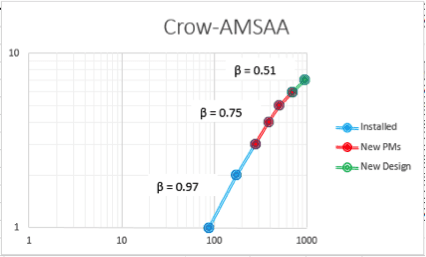
Using a Crow-AMSAA [Reliability Growth Analysis (RGA)] to Quantify Your Reliability Improvements (or Losses)

Part 3 of 7

67 rga graphImagine being able to predict the next time a failure will occur for a piece of equipment without a huge amount of work.  Wouldn’t it be nice to know the approximate point in time that a failure will occur on a critical piece of equipment?  It is possible, but I am not talking about using MTBF, as it is not a good measure (if you need to understand why, please visit http://www.NoMTBF.com).   What I am talking about is a Crow-AMSAA analysis. [Read more…]

Filed Under: Articles, Maintenance and Reliability, on Maintenance Reliability

by James Kovacevic Leave a Comment

Using the Maintenance Data You Already Have

Using the Maintenance Data You Already Have

Leverage the existing data in your CMMS to make sustainable improvements to your maintenance program

Part 1 of 7

Let’s face it, your technicians have been entering data into the CMMS for years, but you haven’t been able to use it to make improvements.  Is it because the data isn’t codified or it doesn’t have the right data points?  Generally, this is how most maintenance managers will view their data, but it is incorrect.  The CMMS does have data that you can use almost immediately. [Read more…]

Filed Under: Articles, Maintenance and Reliability, on Maintenance Reliability

  • « Previous Page
  • 1
  • …
  • 19
  • 20
  • 21
  • 22
  • 23
  • …
  • 26
  • Next Page »
Get Weekly Email Updates
The Accendo Reliablity logo of a sun face in circuit

Please login to have full access.


Lost Password? Click here to have it emailed to you.

Not already a member? It's free and takes only a moment to create an account with your email only.

Join

Your membership brings you all these free resources:

  • Live, monthly reliability webinars & recordings
  • eBooks: Finding Value and Reliability Maturity
  • How To articles & insights
  • Podcasts & additional information within podcast show notes
  • Podcast suggestion box to send us a question or topic for a future episode
  • Course (some with a fee)
  • Largest reliability events calendar
  • Course on a range of topics - coming soon
  • Master reliability classes - coming soon
  • Basic tutorial articles - coming soon
  • With more in the works just for members

© 2025 FMS Reliability · Privacy Policy · Terms of Service · Cookies Policy

Book the Course with John
  Ask a question or send along a comment. Please login to view and use the contact form.
This site uses cookies to give you a better experience, analyze site traffic, and gain insight to products or offers that may interest you. By continuing, you consent to the use of cookies. Learn how we use cookies, how they work, and how to set your browser preferences by reading our Cookies Policy.