
Dealing With Product Characteristics
Abstract
Dianna and Fred discussing engineering projects and dealing with product characteristics and requirements.
ᐅ Play Episode
Your Reliability Engineering Professional Development Site
Dianna and Fred discussing engineering projects and dealing with product characteristics and requirements.
ᐅ Play Episode
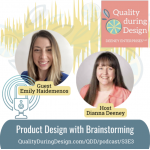
Dianna Deeney interviews Emily Haidemenos about product design with brainstorming. She hosted a workshop at a conference about this topic, titled “Brainstorming: The Solution to Structured Problem Solving”.
This interview is part of our series, “A Chat with Cross Functional Experts”. Our focus is speaking with people that are typically part of a cross-functional team for new product development. We discuss their viewpoints and perspectives regarding new products, the values they bring to new product development, and how they’re involved and work with product design engineering teammates.
Emily has a master’s degree in Design and Manufacturing Engineering from the University of Massachusetts Lowell. After initially working as a Design Engineer, Emily left and moved into a New Product Development Quality Engineering position. In this role, she worked with multiple cross-functional engineering teams to ensure the effectiveness of quality systems while earning her Six Sigma Black Belt certification. Now as a Chief Engineer for next generation high voltage automotive products, she aims to grow and develop a team of technically competent individuals who realize their maximum potential.
Listen to be inspired to either take on brainstorming or change-up how you’re doing your sessions!
Sounds simple … right? We simply test faster! Great! But what does this get us? Many organizations are faced with a dilemma when it comes to testing to MEASURE reliability. If we test an amazing new product in ‘at use’ conditions, it might take many years before it will fail. This is time we simply don’t have when it comes to product development. So, how do we test faster? One of the more obvious answers is to increase the stress. Turn the temperature up. Increase the vibration. Use more voltage. But how do we get this right? How can we know that (for example) one week of accelerated testing is equivalent to 10 years of actual use? This webinar will help introduce you to the idea of Accelerated Life Testing, or ALT, to help you and your organization make reliability testing a reality.
[Read more…]
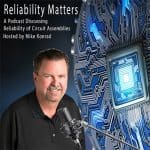
Electricity is the life blood for all circuit assemblies. It can also afflict significant damage via electrostatic discharge. My guest, Christopher Almeras of Raytheon reviews the various ESD mitigation strategies as well as some ESD horror stories!
Christopher Almeras began his career in process engineering for a small electronics manufacturer in the late 1990s. There he became responsible for the sites ESD compliance verification. His next career move took him to a high-volume manufacturer where he added ESD Coordinator to his process duties. He eventually made the jump into the Military/Aerospace side of electronics manufacturing (with Raytheon) in 2010 where he has remained working in process, capital installations, continuous improvement, and ESD.
In 2009, Christopher completed his ESD Certified Program Manager from the ESDA. He serves as a member on several ESD Association standards committees including S20.20, TR53, Process Assessment, High Reliability, Electrostatic Attraction among others. In 2022 he took over the working group chair for Soldering/Desoldering Hand Tools.
Christopher was elected to the ESD Association Board of Directors and continues to be active with the ESD Symposium each year. In 2018 he presented his technical paper “An ESD Case Study of Defect Analysis in High Speed Electronics Manufacturing” at the symposium.
Christopher earned a BS in Mechanical Engineering from Purdue University and an MS in Industrial Engineering from Oklahoma State University. He is an
ESD Certified Program Manager (ESDA).
Christopher may be contacted here:
lonestaresd@outlook.com
https://www.lonestaresd.com
During this episode, I referenced the following:
Reliability Matters Episode 104: A Conversation about ESD Flooring with Thomas Ricciardelli
https://youtu.be/peyNVuE7Ink
4 Easy Ways to BLOW UP Your Test Gear
Daniel Bogdanoff – Keysight
https://www.youtube.com/watch?v=dDvue5whx0s
Dianna and Fred discussing new innovations from a reliability point-of-view: how is this new stuff going to break? What are going to be the new ways to break things?
ᐅ Play Episode

Chris and Fred discuss the changing ideas of leadership … and how people lament newer generations and their approaches to (and expectations of) leadership. There are challenges … so what does this mean?
ᐅ Play Episode
In this episode I discuss two lessons I learned as a process engineer in the semiconductor fab. One lesson was a real-life example of the effects of manufacturing processes on metal microstructure and the resulting effects on a metal property that was used to monitor a manufacturing process. The other lesson was about the fallacy of engineering or scientific ingenuity.

Sometimes we need to gather with our team and come up with some ideas, whether we’re looking for new product ideas, trying to discover possible solutions, or we need to improve a service.
Gathering a team to come up with ideas is common. What are some of the ways we approach this activity? We talk about systematic and structured methods and new approaches to brainstorming.
What does this title mean? Chris and Fred discuss how some vendors make ‘startling’ claims regarding reliability from some small amounts of test data. So where does this 60th percentile some of us hear from time to time come from?
ᐅ Play Episode

Steve is an experienced Maintenance & Reliability professional with experience in organizational leadership, project development, & change management. He is the host of the podcast “Fire Forged Leader”. Fire Forged Leader serves it’s listeners by exploring leadership lessons while talking to successful leaders in all areas of life. Check it out on Apple: https://podcasts.apple.com/us/podcast/fire-forged-leader/id1621708130

Kirk and Fred discussing the use of statistics in reliability engineering, where they are useful and where their use may not be the most efficient way to find and fix the cause of failure.
ᐅ Play Episode

As engineers, we need to write reports all the time.
Are ours getting returned by reviewers frequently?
Or are we not getting any feedback and are not sure when our report is ‘done’?
We explore the spirits of technical writing past, present, and future – they help us to write for ALL of our audiences. We explore how and why in the episode.
Historically, circuit assemblies are rigid devices. IoT (Internet of Things) has opened up the opportunity to embed electronics into a near limitless array of form factors. Some of these form factors require the electronic assembly to be flexible such as in wearable and medical applications.
To complicate matters, The metal conductors on the assembly are rigid, and not flexible or malleable. That may change with the adoption of liquid metals. We were all exposed to the concept of liquid metal in the 1991 film Terminator 2. Will science fiction become reality?
My guest today is Dr. Michael Dickey. Michael is currently the Camille and Henry Dreyfus Professor in the Department of Chemical & Biomolecular Engineering at NC State University.
Michael Dickey received a BS in Chemical Engineering from Georgia Institute of Technology and a PhD from the University of Texas. From 2006-2008 he was a post-doctoral fellow in the lab of Professor George Whitesides at Harvard University. Michael completed a sabbatical at Microsoft in 2016. Michael’s research interests include soft matter (liquid metals, gels and polymers) for soft and stretchable devices (electronics, energy harvesters, textiles, and soft robotics), and hopefully, for the sake of humanity, not liquid metal T1000 villains.
Dr. Michael Dickey’s Contact Information:
mddickey@ncsu.edu
Link to Michael Dickey’s TED-X Talk:
https://www.youtube.com/watch?v=lfUnK_rME8E
Kirk and Fred discussing the idea of listing of failure mechanisms and their different viewpoints on how we learn some of the common failure mechanisms
ᐅ Play Episode
