What you will learn from this article:
- How shaft packing works.
- What to consider when selecting and using shaft packing.
- Good installation practices.
- Proper commissioning of shaft packing.
Your Reliability Engineering Professional Development Site
What you will learn from this article:

Guest Post by Greg Hutchins (first posted on CERM ® RISK INSIGHTS – reposted here with permission)
Last year, we reported that White House Office of Management and Budget (OMB – executive office) is requiring US departments to design and implement Enterprise Risk Management (ERM). The requirements are part of the OMB Circular A 11 Section 270 – Performance and Strategic Reviews.
US Departments are:
expected to manage risks and challenges related to delivering the organization’s mission. ERM is a strategic discipline that can help agencies to properly identify and manage risks to performance, especially those risks related to achieving strategic objectives.

Unless you are working with raw materials directly, you rely on your suppliers to provide reliable parts.
Do you suppliers know your reliability objectives for the parts they supply?
If you didn’t tell them, they probably do not know. If you did tell them, did you make it the reliability specification clear and understandable?
As with any specification, clear communication is essential. Guessing or assuming both parties know and have the same reliability goals is, well, not a good practice. The ability of a supplier to build and deliver the parts that meet all your specification has to include a clear and understandable reliability specification.
There is a range of common reliability specifications in use, some are better than others. Let’s start with a brief review of reliability specification types.
Then briefly outline how you establish the reliability specifications for each supplied component. [Read more…]

Your facility has data and maybe too much data. Using simple plotting may be the key to unlocking how well your maintenance program is performing.
Building on the concept of reliability growth modeling James Kovacevic described a convenient way to quickly visualize your repairable system failure data is with a mean cumulative function (MCF) plot. [Read more…]

A recent LinkedIn discussion addressed the question of the best strategy for dealing with poor supplier performance.
A lot of the respondents seemed to advocate a punitive approach, either threatening the loss of future business if performance doesn’t improve, or combing through the terms & conditions of the contract for enforcement language.
I’ve always thought that there’s a lot of similarity between managing suppliers and managing subordinates, and I wonder if some of these same people threaten their teams with punitive actions when individual performance doesn’t meet expectations. [Read more…]

We make decisions all the time. Often our decision making is with little more than a gut feeling.
When faced with a major decision we often look data to help us decide. Is the product reliable enough as designed? Which field returns indicate we should stop production?
Some decision may help us earn or lose thousands if not millions of dollars.
Deciding to delay a product launch by six months means we have no revenue for the duration. The delay may also permit us to address a design flaw that would cause half the products to fail within a few months.
The later may cause loss of market share, erosion of brand loyalty, not to mention the cost of warranty claims. [Read more…]

This article is Part Two in my three part series about “PM” programs.
Reliability Centered Maintenance (RCM) is the world’s leading method for identifying maintenance and other activities required to sustain reliable performance of physical assets. If you want a proactive maintenance program that really works, then Reliability Centered Maintenance is the most thorough approach you can take to get there. [Read more…]

Chemical corrosion can destroy the containment materials in contact with a process.
Means exist to mitigate and even prevent chemical corrosion. This article focuses on several such methods.
At times chemical corrosion is acceptable and one need only allow for it by using thicker materials. An example is the storage of sulphuric acid in mild steel tanks at ambient conditions and concentrations [Read more…]
Guest Post by Greg Hutchins (first posted on CERM ® RISK INSIGHTS – reposted here with permission)
ISO 31000 is organized around 11 risk management principles. A management principle refers to a fundamental idea, rule, or truth about a subject. ISO 31000 risk principles serve as the guideline, method, logic, design, and implementation for the risk management framework and its process. [Read more…]

Even products with relatively quick design cycles and short stays in the market deal with part obsolescence.
Long design periods along with long durations in service or in production simply increases the chance that one or more parts will become obsolete.
Designing systems with part obsolescence in mind helps. Working with suppliers to select parts with many sources, with long-term plans to produce, and with long term commitments, all may help. Even then, companies change priorities, go out of business, or simply discontinue the part you need. [Read more…]

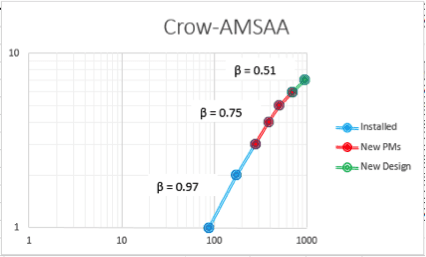 Imagine being able to predict the next time a failure will occur for a piece of equipment without a huge amount of work. Wouldn’t it be nice to know the approximate point in time that a failure will occur on a critical piece of equipment? It is possible, but I am not talking about using MTBF, as it is not a good measure (if you need to understand why, please visit http://www.NoMTBF.com). What I am talking about is a Crow-AMSAA analysis. [Read more…]

Quality issues have been on my mind a lot lately, specifically some of the more frustrating things that I’ve had to deal with during my career as a quality manager.
In my last job, my team was responsible for managing the discrepant material review (DMR) process for our US-based factory.

The Department of Energy (DOE) Office of Energy conducted an Energy Storage Reliability Workshop this week provide a unique glimpse at how the stakeholders across an industry view reliability.
The representatives from government and private sector, including national labs, large and small companies, insurers and consultants gather to talk about the reliability of large-scale stationary energy storage systems.
Specifically, the focus of the workshop was on helping the DOE identify the specific activities and focus for their involvement in this relatively new industry segment.
[Read more…]

Do you replace your car headlights at regular intervals of six months? Do you wait to replace your tires until they wear through? Do you check your car engine oil with some sort of oil analysis before replacing it? Each component and system in your car has a function that is prone to failure. Each of those has consequences – some with little importance and others with great importance. [Read more…]

Guest Post by John Ayers (first posted on CERM ® RISK INSIGHTS – reposted here with permission)
Risk management involves the identification of risks, prioritization of the risks based on probability of occurrence and impact of occurrence, and mitigation plans to control the risks. Once identified and prioritized the question then becomes which risks should be incorporated into the schedule and which ones should be included in the risk register?
The general rule of thumb I have used requires risks with a 50% or greater probability of occurrence to be incorporated into the schedule. The other risks are entered into the risk register. [Read more…]